Uncategorized

A Dumbo Octopus (Grimpoteuthis sp.) seen by a NOAA Ocean Explorer team from a deep sea submersible near the Many Mounds Area of the West Florida Escarpment in the Gulf of Mexico.
(via: NOAA Ocean Explorer)
It’s like it’s got a floofy skirt. :3
Friend
Read more
Beautiful photo of the BICEP2 telescope, used to detect cosmic inflation, at the Amundsen-Scott South Pole station.
(via The Echo of Creation – Astronomers Hear the B of the Big Bang | Inside the Science Museum)
Station Ident.
Read more
A wall painting in the tomb of Djehutihotep clearly shows a person standing on the front of the pulled sledge and pouring water over the sand just in front of it.
Besides revealing something about the ancient Egyptians, the results are also interesting for modern-day applications. We still do not fully understand the behaviour of granular material like sand. Granular materials are, however, very common. Other examples are asphalt, concrete and coal. The research results could therefore be useful for examining how to optimise the transport and processing of granular material, which at present accounts for about ten percent of the worldwide energy consumption.
Ancient Egyptians transported pyramid stones over wet sand
Read moreRead moreBut based on evidence from ancient bones, spears, and porridge, Speth believes our Stone Age cousins likely boiled their food. He suggests that Neanderthals boiled using only a skin bag or a birch bark tray by relying on a trick of chemistry: Water will boil at a temperature below the ignition point of almost any container, even flammable bark or hides…
Speth suggests that Neanderthals boiled foods in birch bark twisted into trays, a technology that prehistoric people used to boil maple syrup from tree sap.
Archaeologists have demonstrated that Neanderthals relied on birch tar as an adhesive for hafting spear points as long as 200,000 years ago. Making birch tar requires clever cooking in an oxygen-free container, says paleontologist Michael Bisson of Canada’s McGill University.
“I’ve burned myself trying to do it,” Bisson says, adding that Neanderthals were plenty clever when it came to manipulating birch. They likely ignited rolled-up birch bark “cigars” and plunged them into holes to cook the tar in an oxygen-free environment.
If the tar is exposed to oxygen in the air as it cooks, “it explodes,” Bisson adds.
Supporting the boiling idea, Speth said that animal bones found in Neanderthal settings are 98 percent free of scavenger’s gnawing marks, which he says suggests the fat had been cooked off.
And some grains found in the teeth of a Neanderthal buried in Iraq’s Shanidar Cave site appear to have been cooked, according to a 2011 Proceedings of the National Academies of Science report.
“It is speculative, but I think it is pretty likely that they knew how to boil,” Speth says.
In a separate talk at the meeting, University of Michigan paleontologist Andrew White noted recent evidence that Neanderthal mothers weaned their children at an earlier age than human mothers typically do. He said the early transition from milk to food supports the theory that Neanderthals boiled their youngsters’ food to make it more digestible.



With Farm Robotics, the Cows Decide When It’s Milking Time – NYTimes.com:
“It just clicked,” said Susan Borden, Tom Borden’s 24-year-old daughter. “One day we came in and they had started milking themselves.”
Sure enough, on a recent Friday, the Bordens stood watch as cows lined up in front of the closet-size devices; each quietly allowed the machine to wash and scan its underbelly with lasers before attaching mechanical milk cups.
The cows ate the whole time, then moved along when the machine was finished. Nearby, another new device, a Roomba-style robot, pushed feed toward cows who lounged in a pen or lay on straw mats.
“We’re the most disruptive thing in here,” Mr. Borden said.
How do you fund deextinction and the rewilding of ecosystems forward to their next-natural state? What if you can make it pay for itself?
What if you can farm the rewilding with robots???
Why choose between domestication and the wild, that is so twentieth century binary thinking man. Embrace the xor!
Ride that paleo diet wave, and that suburban quest for authenticity via cable tv gurus: sell Auroch milk for $20 a litre in Williamsburg and to the greater citizens of Portlandia!
The first Boskarin cattle have now been released in the Velebit mountains. Part of the Taurus program to resurrect Europe’s only recently extinct ancient cattle:
The aurochs stands at the very roots of the whole idea of our continent but was sadly driven to its extinction by man. Luckily, it can also be brought back by man. In 2008, the Taurus Foundation decided to give the re-breeding of the aurochs a serious try. It has since grown into a joint effort together with Rewilding Europe and the Dutch organization ARK Nature. The end result will look like an aurochs, live like an aurochs, behave, eat, mate, defecate and eventually die like an aurochs. For the time being, this animal will be called the Tauros, the Greek word for the bull.
It’s 2017, and Oprah is saying: forget Quinoa, forget the ancient grains and antioxidant berries from the Amazon, try the milk of recently resurrected pre-domesticated cattle. The real, true superfoods harness the power of the palaeolithic, that Ice Age hardiness imbued unto you!
“Rumour has it this is what Cleopatra really bathed in,” the signs on the spas say.
Flown in by drones direct from the biomemetic milking stations built by anthropology majoring makers trained in augmented reality set design and custom blinds.
Untouched by a single human hand. Unseen by a single human eye. Reveal in the Authenticity consumers! Drink it in.
For an extra $99.99 you can have it tweaked with custom gut biota to cure all your ails.
And for 9,000 Euro you can have your own personal herd, visible to all your “friends” on Facebook via our special Farmville plugin.
It’s 2022 and the herds are now big enough to offer safaris for corporate retreats, buck’s nights and any other manner of escape.
Armed only flint knives chipped with the very finest rocks. Wearing only hare-skin loincloths. Juiced up with Neanderthal DNA temporarily spliced in by harmless virii. They hunt their food for the year on foot and gather tales enough to entertain the crowds at their neighbourhood barbecues. Watched over by fleets of robot medics, ready to resurrect them or repair any injury.
We get a restored ecosystem, a better gardened planet, and they get… fed body, soul and hyperego.
— don’t you just love it when a future path into a better gardened Earth practically writes itself?
Read moreFrom Athletes to Couch Potatoes: Humans Through 6,000 Years of Farming
“Work published by biological anthropologist Dr Colin Shaw (also Cambridge University) has enabled Macintosh to interpret this male decline in relation to Cambridge University students. Using Shaw’s study of bone rigidity among modern Cambridge University undergraduates, Macintosh suggests that male mobility among earliest farmers (around 7,300 years ago) was, on average, at a level near that of today’s student cross-country runners. Within just over 3,000 years, average mobility had dropped to the level of those students rated as sedentary, after which the decline slowed.”
* weird sample group, amirite?
From Athletes to Couch Potatoes: Humans Through 6,000 Years of Farming
Read more "From Athletes to Couch Potatoes: Humans Through 6,000 Years of Farming"Move over exoplanets, exomoons may harbour life too
if a Jupiter-like exoplanet orbits within a star’s habitable zone, it begs the question: might that exoplanet host habitable moons? Jupiter has Europa, which is suspected to have liquid water buried under an ice crust, and Saturn has Enceladus, which definitely has water hidden underneath its coat of hydrocarbon ices. So Earth-like exomoons are certainly not out of the question.
Recent research by Duncan Forgan and Vergil Yotov at the University of Edinburgh highlights the various factors that may make an exomoon more or less habitable. They investigate how the climate of an exomoon will be affected by tidal stresses which provide a source of internal heating for the exomoon as it is stretched and deformed by the gravitational pull of its planet. They also investigated how light reflected from the exoplanet, and eclipses by the exoplanet, can also subtly alter the exomoon’s climate.
The researchers lump theoretical exomoons into a number of classifications: “habitable”, “hot”, “snowball” or “transient”. Those in the first class have more than 10% of their surface at a temperature between the freezing and boiling points of water, with only a small fluctuation around the average temperature value.
Those in the second class have average temperatures above 100°C at all times, whereas those in the third class are permanently frozen – in both cases less than 10% of the surface is habitable. Exomoons in the fourth, transient class are on average habitable, but the amount of habitable surface area varies widely with time. Overall, this research shows that exomoon climates are rather more complex than previous research has supposed.
As yet, no exomoons have been discovered, but there are various techniques proposed for finding them. One way is by studying the effects that an exomoon will have on the exoplanet it is orbiting – their gravitational connection means there will be a to-and-fro tugging between them. This will cause variations in the times at which the planet transits in front of its star and in the durations of these transits, which we are able to measure.
Move over exoplanets, exomoons may harbour life too
Read more "Move over exoplanets, exomoons may harbour life too"Let me throw out this specifically very creepy science fiction scenario for you.
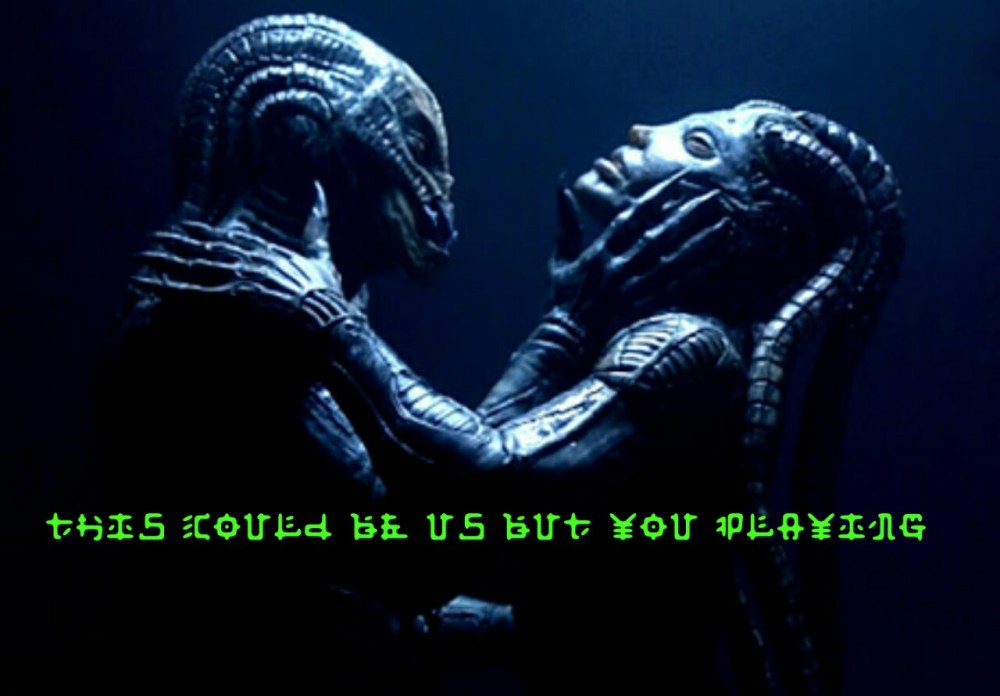
When people in a zoo or in a preserve will try to raise a panda from a baby, or try to raise a condor from a baby or whatever they have ways they can convince the other, because they are so much more intelligent than the creatures. They have all sorts of tools for convincing the creatures that they are one of them. Like they will let you feed them … you can even make yourself look like its mother or smell like its mother. And out in the wild even, you know, in many cases if you can make yourself smell perfectly like another gazelle you can walk around the gazelles, and they’re so dumb … they can smell a lion and they know it’s a lion, and they know to be alarmed. …
So it’s easy to fool them that you’re one of them. In a way that’s it’s impossible for them to detect.So, if there was another species that wanted to study us the way we study gazelles or the way we study rare birds or whatever,
if they are that much smarter than we are than we are to the animals, they would absolutely have ways to walk among us in ways that are absolutely undetectable.
Even we wouldn’t see them at all, or else we would mistake them for a fellow human.But the way we portray them in movies, like the aliens are sort of clumsy in how they do it, like they don’t know how to mimic human emotion or that they don’t understand love or they’re very robotic … We’re kind of insulting the aliens when we assume that. They’d be smart enough to come here and they’d be of much higher intelligence, but they wouldn’t be able to mimic our social cues.
Ok, just like we can smear animal urine over our own bodies in order to pass among them, they would totally know how to imitate love and charisma and all of those things.
So I think if they were here and watching us, if they were that much more advanced than we are, we would never know they’re here. We would not be capturing their ships on freakin’ camera phones or whatever.
They would pass among us completely undetected and we would never know until they chose to let us know.
David Wong (aka Jason Pargin) on the Cracked Podcast
I recommend listening to the whole thing — it’s a pretty interesting conversation overall. This was just my favorite excerpt.
(quote starts around 55:20)
This is on point for several reasons.
(via flavorcountry)
A++++









Personal immortality in a physical body is impossible, since a physical body exists in time and time is that which ends. When someone says he wants to live forever, he forgets that forever is a time word. All three-dimensional immortality projects, to say the least, are ill-advised, since they always immerse the aspirant deeper in time.
…
A step toward rational immortality is to break down the concept of a separate personal, and therefore inexorably mortal, ego. This opens many doors. Your spirit could reside in a number of bodies, not as some hideous parasite draining the host, but as a helpful little visitor.
…
Cloning isn’t ego gone berserk. On the contrary, cloning is the end of the ego. For the first time, the spirit of man will be able to separate itself from the human machine, to see it and use it as a machine. He is no longer identified with one special Me machine. The human organism has become an artifact he can use like a plane, a boat, or a space capsule.
IMMORTALITY ~ William S. Burroughs
William S. Burroughs is actually a vampire. He doesn’t live in your attic though. No need to check.
Read more The Committee to Nuke Elysium