Read moreSuch is Matt Taylor’s devotion to the cause he proudly wears tattoos depicting key ESA projects: “I had a tattoo done of a previous mission I was working on so of course I had to have one done of Rosetta.”
Uncategorized
Read moreGötherström thinks there are a few possible explanations. One is that after humans left Africa, some flourished by becoming farmers and exploiting the fertile lands they found in the Near East. Others ventured further north, where they continued to rely on the wild animals they killed and the plants and berries they collected from the landscape. These groups were split into small populations that survived in isolation between the ice sheets.
The Swedish data shows some mixing between the two groups, suggesting that as the farmers later swept north they interbred with the hunter-gatherers they encountered and assimilated them into their cultures. The exchange seems to have been unidirectional: there is very little if any evidence that farmers were assimilated into the hunter-gatherers.
Read moreTo climb straight back to the surface, without stopping to rig ropes and phone wire, would take them four days. It took three days to get back from the moon…
Casteret and Chevalier helped turn caving into a heroic undertaking, and the search for the world’s deepest cave into an international competition—a precursor to the space race…
“In the past, I’d lose twenty-five pounds on one of these trips,” Stone told me. “We can burn as many calories as a Tour de France rider every day underground.” Ascending Chevé, he once said, was like climbing Yosemite’s El Capitan at night through a freezing waterfall. To fine-tune the team’s diet, he’d modelled it on Lance Armstrong’s program, aiming for a ratio of seventeen per cent protein, sixteen per cent fat, and sixty-seven per cent carbohydrates…
Over the years, caving gear has undergone a brutal Darwinian selection, lopping off redundant parts and vestigial limbs. Toothbrushes have lost their handles, forks a tine or two, packs their adjustable straps. Underwear is worn for weeks on end, the bacteria kept back by antibiotic silver and copper threads. Simple items are often best: Nalgene bottles, waterproof and unbreakable, have replaced all manner of fancier containers; cavers even stuff their sleeping bags into them. Yet the biggest weight savings have come from more sophisticated gear. Stone has a Ph.D. in structural engineering from the University of Texas and spent twenty-four years at the National Institute of Standards and Technology, in Gaithersburg, Maryland. His company has worked on numerous robotics projects for NASA, including autonomous submarines destined for Europa, Jupiter’s sixth moon. The rebreathers for the Chevé trip were of his own design. Their carbon-fibre tanks weighed a fourth of what conventional tanks weigh and lasted more than four times longer underwater; their software could precisely regulate the mix and flow of gases.
Stone’s newest obsession was a set of methanol fuel cells from a company called SFC Energy. Headlamps, phones, scuba computers, and hammer drills (used to drive rope anchors into the rock) all use lithium batteries that have to be recharged. On this trip the cavers would also be carrying GoPro video cameras for a documentary that would be shown on the Discovery Channel. In the past, Stone had tried installing a paddle wheel underground to generate electricity from the stream flow, with fairly feeble results. But a single bottle of methanol and four fuel cells—each about the size of a large toaster—could power the whole expedition…
“Welcome to Hell,” one of the cavers told me, when I joined him by the campfire that first night. “Where happiness goes to die,” another added. There was a pause, then someone launched into the colonel’s monologue from “Avatar”: “Out there, beyond that fence, every living thing that crawls, flies, or squats in the mud wants to kill you and eat your eyes for jujubes. . . . If you wish to survive, you need to cultivate a strong mental attitude.” It was a favorite conceit around camp: the cloud forest as hostile planet…
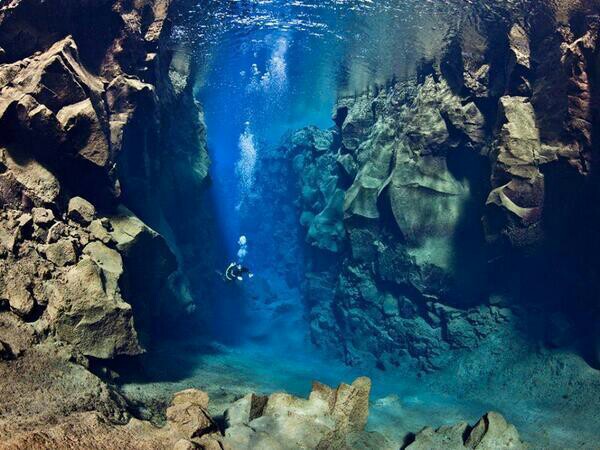
“Where did the water go a million years ago? That’s what you have to ask yourself,” Stone said. “As a cave diver, you have to think four-dimensionally.”
Kepler 186f: Is It Inhabited?
The SETI Institute has examined this star system using its Allen Telescope Array, searching for transmissions over a wide range of the radio dial, from 1 to 10 GHz. So far no dice, although we will surely keep trying.
But the fact that we’ve not yet picked up radio noise from this sibling world is hardly discouraging. To begin with, Kepler 186f is nearly 500 light-years away, which is a fair piece, even for astronomers. To detect radio signals with the Allen Array would require aliens wielding a transmitter of at least 100 million watts, mounted on an antenna the size of a football field. They’d also have to train the antenna in our direction.
But of course, they don’t know about Homo sapiens, so their incentive to beam signals our way is probably small.
Read more "Kepler 186f: Is It Inhabited?"Everyone has the right to roam Finland’s forests and countryside freely, no matter who owns the land, thanks to a legal concept, unique to the Nordic countries, known as Everyman’s Right.
Everyman’s Right enables Finns and foreigners alike to explore Finland’s famous forests, fells and lakes – and also freely collect natural products like tasty wild berries and mushrooms, even where they grow in privately owned forests.
“The legal concept of Everyman’s Right has developed over many generations,” explains legal expert Anne Rautiainen from the Outdoors Association of Finland. “It’s not enshrined in any single law, though its scope is well defined in many pieces of legislation on different issues.
“The fundamental idea behind Everyman’s Right is to enable everyone to freely enjoy outdoor activities that have always been popular in Finland, like walking and skiing in the forest, boating, swimming, and picking mushrooms and berries.”
Free to explore Finland’s great outdoors – thisisFINLAND (via juhavantzelfde)
Read more
#civilisation #commonwealth

A Tale of Two Countries
The Problem With Profitless Start-ups:
Yesterday, I ordered lunch from a gourmet meal-delivery start-up called SpoonRocket – a takeout container of sirloin au poivre and roasted cauliflower that was shuttled to my door in exactly 11 minutes, costing me $8. I then took an UberX car to…
Human → citizen → consumer → feedstock.
If you’re not paying, you’re the product™
The Revolution will not be Ad-supported ®
IMMANENTIZE THE ESCHATON: SOCIALIZE THE FOURTH INDUSTRIAL AGE AT BIRTH©
Read more "A Tale of Two Countries"
 The Committee to Nuke Elysium