
Sure, obviously you go hang out at a Lagrange point on the way back to Earth, after rendezvousing with a Type C Asteroid.
Read more
Sure, obviously you go hang out at a Lagrange point on the way back to Earth, after rendezvousing with a Type C Asteroid.
Read more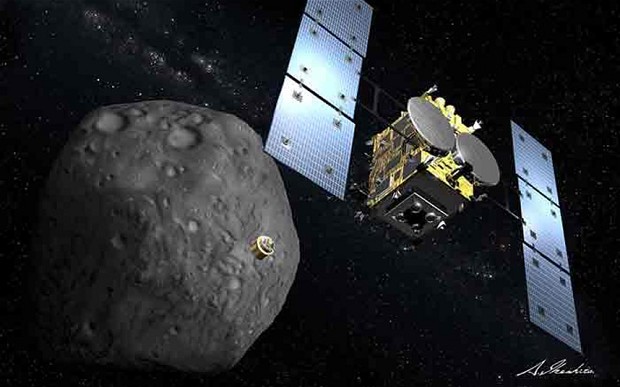
Read more‘Space Cannon’ To Be Fired Into Asteroid
Japanese craft to fire “space cannon” into asteroid in search for origins of the universe
Japan’s space agency has successfully test-fired a “space cannon” designed to launch a projectile into an asteroid as part of the search for the origins of the universe.
The device will be aboard the Hayabusa-2 space probe that is scheduled to take off in 2014 and rendezvous with an asteroid identified as 1999JU3 that orbits between Earth and Mars in 2018.
Once in position close to the asteroid, the space cannon will detach itself and remotely fire a 4lb metal projectile into the surface of the miniature planet.
“An artificial crater that can be created by the device is expected to be a small one, a few meters in diameter, but … by acquiring samples from the surface that is exposed by the collision, we can get fresh samples that are less weathered by the space environment or heat,” the Japan Aerospace Exploration Agency said in a statement.
The mother craft will then land close to the crater and use a small rover to collect samples that would have otherwise been below the surface of the asteroid and return to Earth in late 2020. In all, JAXA scientists say the craft will shadow the 2,950-foot-diameter asteroid for around 18 months.
The project has “the potential to revolutionise our understanding of pristine materials essential to understanding the conditions for planet formation and the emergence of life,” JAXA said.
“It can provide important information needed to develop strategies to protect the Earth from potential hazards,” the agency added.
“Moreover, robotic sampling missions to primitive bodies will be pathfinders for … human missions that might use asteroid resources to facilitate human exploration and the development of space.”
Hayabusa-2 is the second project to recover particles from deep space and will build on the success of Hayabusa, which in 2010 gathered surface dust from an asteroid and returned to Earth.
Source: telegraph UK
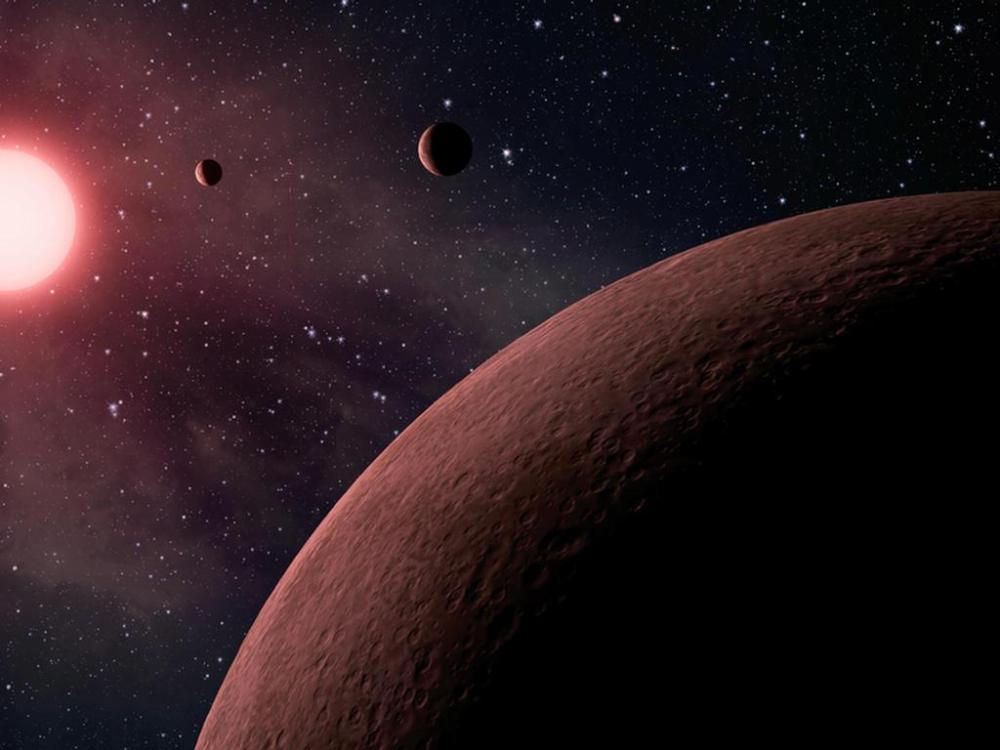
Read moreThis artist’s concept shows a tiny planetary system. It’s so compact that it’s more like Jupiter and its moons than a star and its planets. Astronomers using data from NASA’s Kepler mission and ground-based telescopes have confirmed that the system, called KOI-961, hosts the three smallest exoplanets known so far to orbit a star other than our sun. (Image credit: NASA/JPL-Caltech)
We’re working to shorten production times for you, but we’re still bound by the laws of physics. We don’t have replicators, teleportation, or delivery drones just yet!

A fine suite of plates demonstrating the Muggletonian sect’s geocentric astronomical theory, which refuted the Newtonian standpoint.
Isaac Frost, a scientist and author (with his brother) ofThe Works of J. Reeve and L. Muggleton (1832) was a practicing Muggletonian, the religious sect founded in the aftermath of the English Civil War by two cousins who claimed themselves to be the “two witnesses” mentioned in the Book of Revelations.
The plates, first issued under the title Two Systems of Astronomy, illustrate the “The Newtonian System of the Universe”, and “The System According to the Holy Scipture”, the text caption on plate 6 reading “This diagram will show that if the Earth revolves round the sun, as the Solar System states, then it will necessarily follow, that the Earth will differ in its position with the sun and any given fixed star on its equator, every day throughout the whole year. Now consider it is so. If it is not so, then it will make much in favor of the Holy Scriptures, that the Sun revolves round the Earth.”
They were presumably circulated amongst members of the Muggletonian sect (which, due to a rule on not proselytizing, remained small until the last member died in 1979) and therefore printed in limited numbers. Printed by George Baxter, using his patented colour oil technique, they were originally unrecorded by Baxter’s first bibliographer Courtney Lewis.
Read morereptilianprince: “what do you look for in a girl” decalcified pineal gland
Read more
Mars may be an alien world, but if you went there and looked up at the night sky you’d see something that might surprise you: the stars would look exactly the same. The distance between the Earth and Mars isn’t nearly enough to change the perspective on the much more distant stars. You’d see all the familiar constellations, the Big Dipper and Orion and the Milky Way. The only difference in the sky, other than the sharp brilliance of everything seen through such thin air, would be that “extra” evening or morning star and its little companion.
You would look at that spark, and you would know you weren’t alone.
Read more


 The Committee to Nuke Elysium