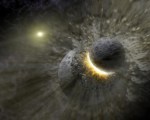
Measurements from Rosetta’s Rosina instrument found that water on comet 67P /Churyumov-Gerasimenko contains about three times more deuterium – a heavy form of hydrogen – than water on Earth.

The discovery seems to overturn the theory that Earth got its water, and so its ability to harbour life, from water-bearing comets that slammed into the planet during its early history.

Comet 67P is thought to have come from what is called the Kuiper belt, a broad band of frozen bodies that begins beyond the orbit of Neptune. The main asteroid belt contains more rocky objects that circle the sun between the orbits of Mars and Jupiter.

Kathrin Altwegg at the University of Bern said that rather than comets ferrying water to Earth, it may have arrived onboard asteroids instead. Details of the discovery are reported in the journal, Science.

“Today asteroids have very limited water, that’s clear. But that was probably not always the case, said Altwegg. In the earliest period of the solar system, 3.8bn years ago, asteroids are thought to have crashed into Earth regularly in what is called the late heavy bombardment. “At that time, asteroids could well have had much more water than they have today,” Altwegg said.

The Rosina instrument measured water coming off the comet as it flew around the body. Scientists plan to take more measurements as the comet nears the sun and its begins to spew more water vapour and dust out into space.

Measurements from other comets have found water with similar deuterium contents to that on Earth. But the strange composition of comet 67P’s water suggests that the picture of comets bringing water to Earth is too simplistic.

TIRED: comets are the source of water for Earth.

WIRED: asteroids are the life giving, death dealing forces of nature.

and my updated guide to Panspermia needs revising again.

Read more

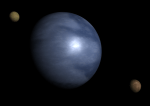
Uranus is an oddball in the solar system. Its rotational axis is tilted by almost 90 degrees, like a spinning top lying on its side. One lap around the sun takes about 85 years. Uranus’ spring equinox in 2007 marked the beginning of a 43-year long period of darkness for the south pole and its surroundings, hidden from Earth’s view. It seemed that the southern half of Uranus southern hemisphere was destined to stay a bland spot in the solar system — a region of unknown winds for decades to come.

Karkoschka did not want to wait that long. He experimented with different processing techniques and developed pattern recognition software until previously unseen features popped out. The largest improvement came when he stacked 1,600 images on top of one another to account for various possibilities of the rotation of Uranus. In the end, dozens of features became visible where only a single one was known before. The features were scattered all over the southern half of Uranus’ southern hemisphere so that its detailed circulation pattern finally became known. All these features, except the one previously known, are of very low contrast and become visible when the contrast is enhanced 300 times.

Karkoschka’s work illustrates the scientific value that can be gleaned from data that have been around for a long time, available to anyone with Internet access. He had similar success when he investigated 13-year-old Voyager images of Uranus’ surroundings and discovered the satellite Perdita.

Read more

Mad Max: Fury Road

tabling for later a discussion of the realities of Peak Oil now versus the crisis of the 01970s and cultural processing of these things. Welcome to the pre Jackpot years.

Read more

Aside from a small amount of water acquired by the youthful Earth in the form of hydrated silicate rocks, the great bulk of Earth’s water must have been delivered from beyond. The pummelling Earth received in its youth from asteroids and comets will have delivered the water that is so vital to life as we know it.

The problem is actually exacerbated by the collision that formed the moon. That giant impact occurred after the proto-Earth had differentiated – with the heaviest elements (such as iron and nickel) settling to our planet’s core. This means that the mantle and crust of the Earth, stripped off by the collision, would also have contained most of Earth’s water at the time.

Without the asteroid and comet collisions that have occurred since the moon’s formation, the Earth would most likely be dry and lifeless. But impacts are a stochastic, chance thing – some planetary systems will have architectures that are poorly set up from the point of view of the delivery of volatiles to any terrestrial worlds therein.

On the other hand, studies of the formation and evolution of the “hot Jupiters” – planets like Jupiter orbiting far closer to their hosts than Mercury orbits the sun – suggest that the inward migration of such planets could drag with them vast amounts of volatiles.

In those models, so much water is delivered to the inner reaches of those systems that any Earth-like planets that form are water worlds – drenched in oceans hundreds of kilometres deep.

While such worlds might well be teeming with life, it is unlikely that it would be easy to detect. Indeed, without continents, the oceans could be almost completely lifeless, with the only source of nutrients being volcanoes on the ocean floor.

If life on such water worlds did exist, it might be so deeply buried in the ocean that any sign of it would be extremely challenging to detect, particularly from a distance measured in tens or hundreds of light-years. As such, ocean worlds would most likely be poor targets for the initial stages of the search for life elsewhere.

Read more

There are a lot of assumptions here: For one, that alien biology will have comparable physical requirements to our own. If biotic life isn’t limited to Earth-sized planets in the habitable zone—a restriction that precludes the icy moons Europa and Titan—the number of life-harboring worlds could actually be much higher.

Read more

The team discovered that in order to shape Titan’s dunes, the moon’s westerly winds must be about 50 percent stronger than previously predicted. Though these westerlies only prevail about two percent of the time on Titan, they are the driving forces shaping the moon’s dunes. “That’s what does all the geomorphic work,” Burr confirmed.

The findings are further proof that Titan is a world of extremes, in which brief periods of seasonally-driven unrest can have more influence than the moon’s “normal” weather during the rest of the Saturnian year. It also demonstrates how a discarded, antiquated piece of equipment can be reinvented to resolve modern questions.

Along those lines, Burr plans to use Ames wind tunnel to investigate Titan’s past. “We just had some new work funded, and we get to go back now and experiment with different paleoclimates on Titan,” she told me. “There’s the thought that Titan has gone through some very significant climatic shifts over the age of the solar system, and the atmosphere we see there now may be unusual.”

Given that the moon supports such a variety of bizarre features, it wouldn’t be surprising to find out that it’s an atypical place not just by the solar system’s standards, but by its own as well. If that’s true, then we are just lucky enough to catch it during its more dynamic episodes, when rivers are flowing, winds are blowing, and sand is formed in its skies.

Read more

In Spitzer’s infrared view of the Helix nebula, the eye looks more like that of a green monster’s. Infrared light from the outer gaseous layers is represented in blues and greens. The white dwarf is visible as a tiny white dot in the center of the picture. The red color in the middle of the eye denotes the final layers of gas blown out when the star died.

The brighter red circle in the very center is the glow of a dusty disk circling the white dwarf (the disk itself is too small to be resolved). This dust, discovered by Spitzer’s infrared heat-seeking vision, was most likely kicked up by comets that survived the death of their star. Before the star died, its comets and possibly planets would have orbited the star in an orderly fashion. But when the star blew off its outer layers, the icy bodies and outer planets would have been tossed about and into each other, resulting in an ongoing cosmic dust storm. Any inner planets in the system would have burned up or been swallowed as their dying star expanded.

The Helix nebula is one of only a few dead-star systems in which evidence for comet survivors has been found.

Read more