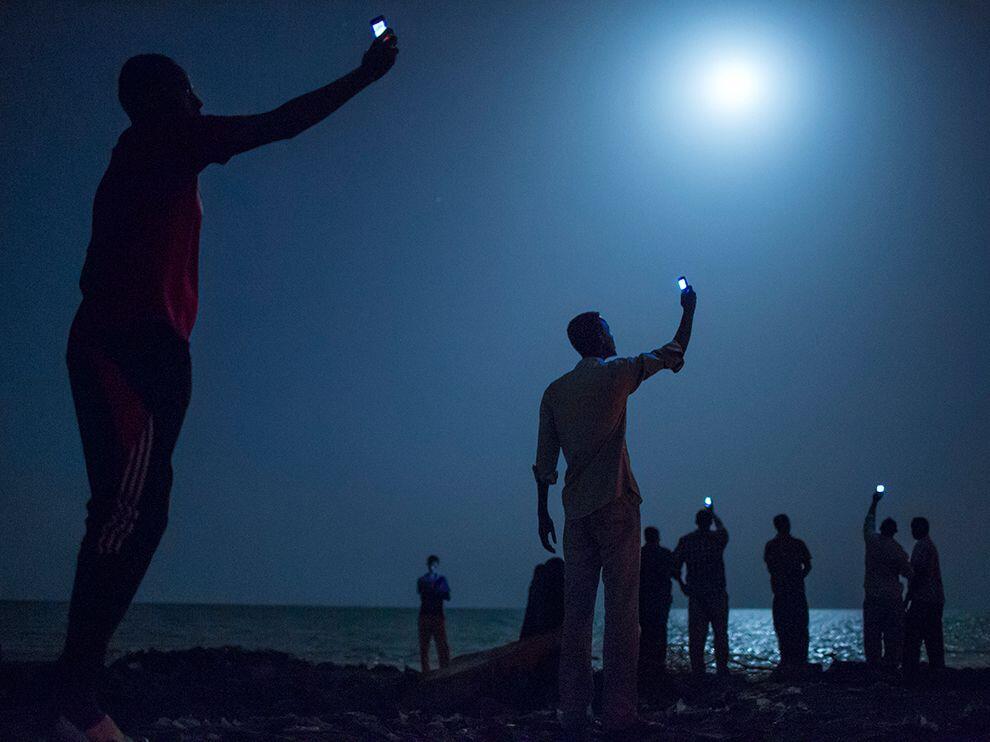
Read more“Djibouti migrants try to capture cheap cell signals from Somalia to call relatives” (Photo: John Stanmeyer/@NatGeo)
v/ @pourmecoffee
This photo has a nice, viral quality to it, because it is showing people in Africa using technology, and doing so in a photogenic manner with strange lighting, adding to the ethereal aesthetic of the image.
But I reblogged it not because this is a weird way to use technology, but because this is a normal way to use technology. This is precisely how I use my cell phone, here in Portland, Oregon.
I don’t have a “cell phone”. I have a device I cobbled together out of broken iPhone 4 pieces, that works well enough to be recognized by the towers. It’s ear speaker is broken, and the speaker phone quality is garbage, so I can only take voice calls by plugging in headphones, which leads to no lack of confusion for callers when they are trying to reach me and I pick up the phone but don’t say anything for 30 seconds while I fumble with cords, and often means we go through 3 rings back and forth until we can connect.
I can’t afford both a voice plan and a data plan. I have a pay-per-month plan, and I’m currently experimenting with buying data and unlimited texts (because of the above, I don’t make many voice calls) with only 100 minutes. This way I can still get data on the go, which is infinitely of more use to me than phone calls. The other option is 1500 minutes but zero data. This means when I’m forced to make voice calls, like to talk to the student loan people, I quickly burn through the available voice minutes I have.
Then I switch over to VoIP. Google Hangouts is free, unlike Skype, but takes a typical 3 tries to connect a voice call, and then it often has echoes and delays. The microphone quality on the iPhone headset is better than the microphone on my laptop, so I am dailing VoIP on my handset, while connecting to the house Wifi (because my cell carrier only provides a couple bars in my lower middle-class neighborhood, which isn’t enough to maintain VoIP). This means I have to place the phone on the table, because if I pick it up I’ll lose the Wifi signal (you remember the famous iPhone 4 antenna issues, right?) so I have to talk while maintaining headphone cord distance between my head and the desk. Meanwhile, the Wifi is a wireless hotspot, with its own issues about where it can be placed in the house to receive an optimal signal while still plugged in and still connecting all the household devices, and what times of day are most crowded on the network.
And people wonder why I like email so much.
The question any technologist will ask is “why don’t you do X, Y, and Z solution that will cost you $10 and improve this particular part of the puzzle?” But this is precisely the point—I don’t have $10. If I had $10, I would have fixed something, believe me. I would have a real cell plan, a real phone, a longer cord, a faster connection, more minutes, less interference. This is the “solution” I have, after 3 years of canceling plans and shuffling SIM cards and using broken screens and borrowing old handsets. This is the best that I can get it, and only through my patience and ingenuity (can you build an iPhone from spare parts? I’m kind of proud of that) did I get it this good.
Most people in the world are just like these Djibouti migrants. We’re taping our antennas to the roof, and the tape gets wet, falls apart, and leaves residue everywhere, but we get some more tape and fix it, knowing tomorrow we’ll have to fix it again.
Dude, I am hella impressed by the Frankenapple device, props to you.
Same
Thanks! Also thanks to ifixit, that taught me everything I know about my Scrapple ehPhone. Be careful with those ribbon cables, they really tear easy.
I could also talk at length about the iPhone. I don’t have a lot of good things to say about Apple and the way they make and market their products. But when you take a device with a singular design, that is sold to so many people, and sold to a class of people that are most likely to replace the device every year or two, or sooner if they chip their screen, that leads to a wealth of spare parts. It’s like the Island of Misfit Smart Phones… the living graveyeard of Robot Town. Every component inside your iPhone connects to the board with cables (
historical tangent about the American Manufacturing System and Fordism). So you can mix-and-match working components from a dozen iPhones of the same generation with no problem. Add to that the difficulty in selling Apple products as a licensee, it means that outside of the Apple stores themselves there is a very limited and sporadic grey market in repairs. This means that you can get pretty much any iPhone component online from China, because this is the only place to get them—not from big lots or directly from Apple. Any iPhone repair place (that is not the Apple store) fixes your screen by buying a replacement one online for $20-30. And you can too. All of this results in a perfect storm of awesomeness for the budding cyberpunk frankenstein, who can scrape up the used detritus of other people’s old phones for cheap, and then reassemble the pieces.If I had my pick of phones, I would use Android. But trying to scrape together all the parts of a single model Samsung would take forever, if I could even do it. So, because people like Apple, I end up with the hand-me-downs. Smart phones are weird that way. Did you know that Toyota Camrys and Civics are the most commonly stolen cars, because they are chopped for parts? Their wide use (and so-so manufacture) means there is a huge market for spare parts. Different technologies have different features, market saturation, and price points that enable unique grey/black market usage. They don’t teach that sort of stuff in design school, probably.
I wouldn’t say this makes Apple “great for people on a budget” though. You wouldn’t believe how few apps work on your phone once you’re two OS releases behind the curve. Apple still reminds you that you can’t afford their shit.
 The Committee to Nuke Elysium