Zalasiewicz is one geologist who has given some thought to what will remain in 10,000 years. Certainly some record of cities, plastics and the millions of fossil-fuel wells and mines will persist as what he calls technofossils. The concentrations of carbon dioxide in the atmosphere could still be out of whack from the emissions resulting from the burning of all those fossil fuels in just the last few decades. In a million years, barring profound shifts, the climate should have returned to its natural rhythms but any cities buried in sediment by rising seas should still be preserved, along with those signs of anthroturbation, human-induced disturbances underground, like the plutons from underground explosions of nuclear bombs. Those are good for 10 million even 100 million years, or until plate tectonics lifts them back to the surface and exposes those strata to the rain that will, ever so slowly, erode these signs away. For certain, nothing made by contemporary humanity will be left at the surface that far in the future, even stone edifices like the pyramids or Mount Rushmore will be wiped away, though the fine imprints of plastic objects, like say a vinyl record, may be legible—and even perhaps listenable—in the rock like the fronds of a fern.

Ten thousand years is all that separates today’s people from those who lived at Catalhöyük in Turkey, a city whose mud-brick homes had doors in the roofs. The inhabitants were seemingly obsessed with leopards, slept on their own ancestors’ graves and occasionally kept the skulls as mementoes. In the far future will anyone even understand the binary code and English scrawlings in the Roman alphabet in which the very idea of the Anthropocene is recorded? The Rosetta stone was required to unlock the mysteries of hieroglyphics from a mere 5,000 years ago and the world is no closer to understanding the hash marks left by ancient hominins hundreds of thousands of years ago. One million years ago, Homo sapiens did not exist and our hominin ancestors stalked the savannas of Africa and perhaps not much else, the human population explosion still far in the future.

Read more

These species were not just ornaments of the natural world. The new work presented at the conference suggests that they shaped the rest of the ecosystem. In Britain during the last interglacial period, elephants, rhinos and other great beasts maintained a mosaic of habitats: a mixture of closed canopy forest, open forest, glade and sward. In Australia, the sudden flush of vegetation that followed the loss of large herbivores caused stacks of leaf litter to build up, which became the rainforests’ pyre: fires (natural or manmade) soon transformed these lush places into dry forest and scrub.

In the Amazon and other regions, large herbivores moved nutrients from rich soils to poor ones, radically altering plant growth. One controversial paper suggests that the eradication of the monsters of the Americas caused such a sharp loss of atmospheric methane (generated in their guts) that it could have triggered the short ice age which began about 12,800 years ago, called the Younger Dryas.

Read more

warrenellis:

At The Farmhouse Sunday January 26, 6pm – 9pm @farmhouse ____ DESCRIPTION: In the intimate surroundings of The Farmhouse Barn, writer Warren Ellis sits down for a State Of The Weird, picking over the radioactive bones of 2013 and gathering the stories for a Briefing on the science-fiction condition of 2014. That night, he will be in the middle of writing a novella about futurists and a non-fiction book about the future of cities — except that they’re both also about strange history and Weird Shit — and he’s here to talk about deep time, storytelling and the weather of tomorrow. BIO:: Warren Ellis is the award-winning writer of graphic novels like TRANSMETROPOLITAN, FELL, MINISTRY OF SPACE and PLANETARY, and the author of the New York Times bestselling GUN MACHINE and the “underground classic” novel CROOKED LITTLE VEIN. The movie RED is based on his graphic novel of the same name, its sequel having been released in summer 2013. His GRAVEL books are in development for film at Legendary Pictures, with Tim Miller attached to direct. IRON MAN 3 is based on his Marvel Comics graphic novel IRON MAN: EXTREMIS. He’s also written extensively for VICE, WIRED UK and Reuters on technological and cultural matters, and is co-writing a video project called WASTELANDERS with Joss Whedon. Warren Ellis is currently working on a non-fiction book about the future of the city for Farrar Giroux Straus. His newest publication is the digital short-story single DEAD PIG COLLECTOR, from FSG Originals. A documentary about his work, CAPTURED GHOSTS, was released in 2012. Recognitions include the NUIG Literary and Debating Society’s President’s Medal for service to freedom of speech, the EAGLE AWARDS Roll Of Honour for lifetime achievement in the field of comics & graphic novels, the Grand Prix de l’Imaginaire 2010, the Sidewise Award for Alternate History and the International Horror Guild Award for illustrated narrative. The Farmhouse : Barn Talks : 1 — Warren Ellis Shane Becker

Stand Up Deep Time History slash Hauntological Philosophy dot tumblr dot doge

Read more

PBSNewshour tour of Fukushima site.

Not mentioned: rising sea temperatures affecting ability to cool reactors… which have been dumping hot, radioactive water back into sea. Heavy water and heavy weather in a feedback loop, dancing us to death.

Cut to them towing iceberg chunks or melted polar ice to the site for maximum Anthropocene Horror.

Read more

The number of reactors peaked in 2002 at 444, compared with 427 today. The share of electricity they produce is down 12% from its 2006 peak, largely because of post-Fukushima shutdowns in Japan. As a proportion of all electricity generated, nuclear peaked in 1993 at 17% and has now fallen to 10%. The average age of operating plants is increasing, with the number over 40 years old (currently 31 plants) set to grow quite rapidly.

Read more

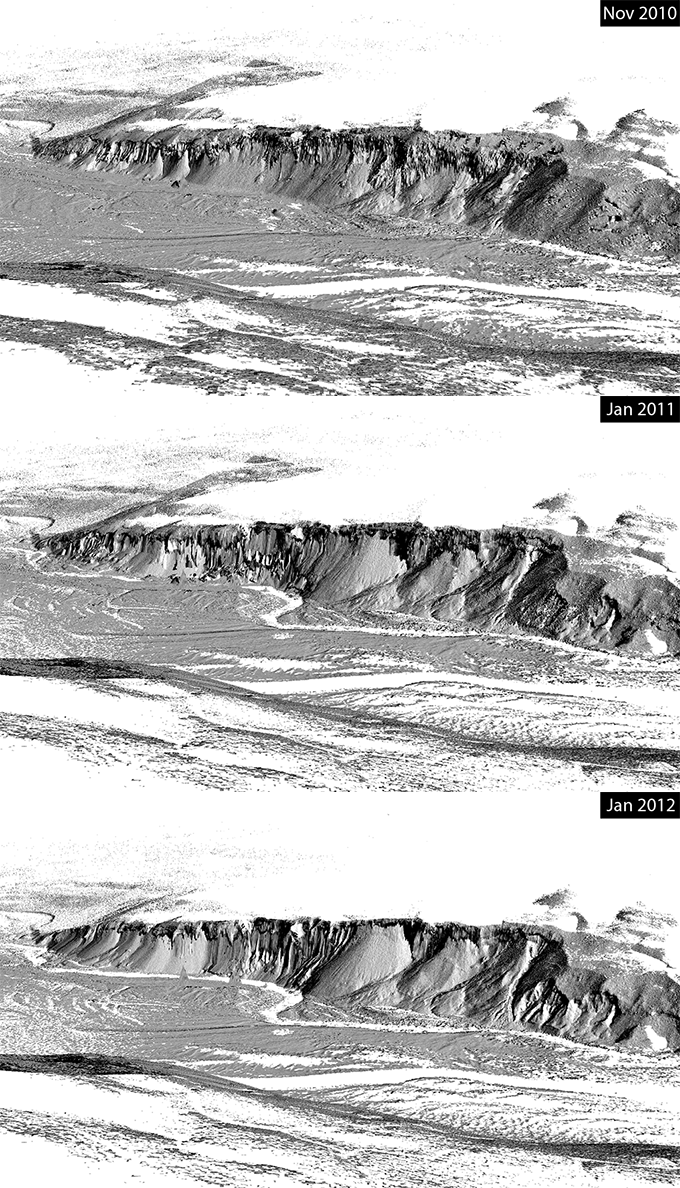
In another study, researchers from the University of Texas at Austin found that coastal Antarctic permafrost—which, unlike Arctic permafrost, was considered to be stable—is actually melting much faster than scientists had expected. Researchers had though that the permafrost in the region was in equalibrium—ice would melt during the summer, only to refreeze in the winter. But the Texas study, published in Scientific Reports, shows a rapid melting of permafrost in Antarctica’s Garwood Valley, diminishing the overall mass of ground ice. “The big tell here is that ice is vanishing—it’s melting faster each time we measure,” said Joseph Levy, a research associate at the University of Texas’s Institute for Geophysics and the lead author on the paper.
“That’s a dramatic shift from recent history.”

It’s important to note that global warming is not responsible for the permafrost melt here—that region of Antarctic actually experienced a cooling trend from 1986 to 2000, followed by relatively stable temperatures. The Scientific Letters researchers suggest instead that the melting is due to an increase in radiation from sunlight resulting from changing weather patterns that allow more light to reach the ground during the summer. (In the winter, of course, Antarctica experiences 24-hour darkness.) As the permafrost melts, it actually alters the land surface, creating “retrogressive thaw slumps.” The changes observed in the study are occurring around 10 times faster than the average during the Holocene, the current geological epoch, and can actually be seen with time-lapse photography

Read more