Read moreAs work progressed, a portrait of [9000 year old] Kennewick Man emerged. He does not belong to any living human population. Who, then, are his closest living relatives? Judging from the shape of his skull and bones, his closest living relatives appear to be the Moriori people of the Chatham Islands, a remote archipelago 420 miles southeast of New Zealand, as well as the mysterious Ainu people of Japan.
“Just think of Polynesians,” said Owsley.
Not that Kennewick Man himself was Polynesian. This is not Kon-Tiki in reverse; humans had not reached the Pacific Islands in his time period. Rather, he was descended from the same group of people who would later spread out over the Pacific and give rise to modern-day Polynesians. These people were maritime hunter-gatherers of the north Pacific coast; among them were the ancient Jōmon, the original inhabitants of the Japanese Islands. The present-day Ainu people of Japan are thought to be descendants of the Jōmon. Nineteenth-century photographs of the Ainu show individuals with light skin, heavy beards and sometimes light-colored eyes.
Jōmon culture first arose in Japan at least 12,000 years ago and perhaps as early as 16,000 years ago, when the landmasses were still connected to the mainland. These seafarers built boats out of sewn planks of wood. Outstanding mariners and deep-water fishermen, they were among the first people to make fired pottery.
The discovery of Kennewick Man adds a major piece of evidence to an alternative view of the peopling of North America. It, along with other evidence, suggests that the Jōmon or related peoples were the original settlers of the New World. If correct, the conclusion upends the traditional view that the first Americans came through central Asia and walked across the Bering Land Bridge and down through an ice-free corridor into North America.
Sometime around 15,000 years ago, the new theory goes, coastal Asian groups began working their way along the shoreline of ancient Beringia—the sea was much lower then—from Japan and Kamchatka Peninsula to Alaska and beyond. This is not as crazy a journey as it sounds. As long as the voyagers were hugging the coast, they would have plenty of fresh water and food. Cold-climate coasts furnish a variety of animals, from seals and birds to fish and shellfish, as well as driftwood, to make fires. The thousands of islands and their inlets would have provided security and shelter. To show that such a sea journey was possible, in 1999 and 2000 an American named Jon Turk paddled a kayak from Japan to Alaska following the route of the presumed Jōmon migration. Anthropologists have nicknamed this route the “Kelp Highway.”
“I believe these Asian coastal migrations were the first,” said Owsley. “Then you’ve got a later wave of the people who give rise to Indians as we know them today.”
What became of those pioneers, Kennewick Man’s ancestors and companions? They were genetically swamped by much larger—and later—waves of travelers from Asia and disappeared as a physically distinct people, Owsley says. These later waves may have interbred with the first settlers, diluting their genetic legacy. A trace of their DNA still can be detected in some Native American groups, though the signal is too weak to label the Native Americans “descendants.”
Whether this new account of the peopling of North America will stand up as more evidence comes in is not yet known. The bones of a 13,000-year-old teenage girl recently discovered in an underwater cave in Mexico, for example, are adding to the discussion. James Chatters, the first archaeologist to study Kennewick and a participant in the full analysis, reported earlier this year, along with colleagues, that the girl’s skull appears to have features in common with that of Kennewick Man and other Paleo-Americans, but she also possesses specific DNA signatures suggesting she shares female ancestry with Native Americans.
Kennewick Man may still hold a key. The first effort to extract DNA from fragments of his bone failed, and the corps so far hasn’t allowed a better sample to be taken. A second effort to plumb the old fragments is underway at a laboratory in Denmark.
anthropology
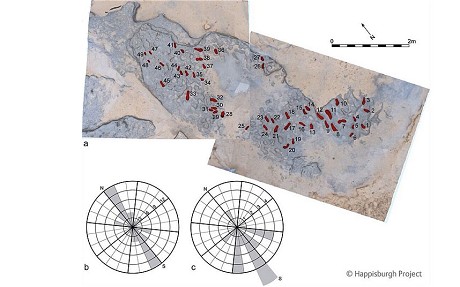
Footprints left behind by what may be one our first human ancestors to arrive in Britain have been discovered on a beach in Norfolk.
The preserved tracks, which consisted of 49 imprints in a soft sedimentary rock, are believed to be around 900,000 years old and could transform scientists understanding of how early humans moved around the world.
Anthropologists and evolutionary biologists from around the UK have been studying the tracks, and believe they may have been related to an extinct form of human ancestor known as Homo antecessor, or “Pioneer Man”.
The tracks include up to five different prints, indicating a group of both adults and children walked across the ancient wet estuary silt.
They are the earliest direct evidence of human ancestors in the area and may belong to some of the first ever Britons.
From their analysis of the prints, researchers believe the group were probably heading in a southerly direction over what would at the time have been an estuary surrounded by salt marsh and coniferous forest.
At the time Britain was connected to continental Europe by land and the site at Happisburgh would have been on the banks of a wide estuary several miles from the coast.
The estuary itself would have provided a rich array of plants, seaweed and shellfish. Fossils of mammoth, an extinct kind of horse and early forms of voles have also been found at the site Happisburgh.
The early humans could also have hunted or scavenged the grazing herds for meat.
The discovery of the footprints is particularly significant as there are few surviving tracks of human ancestors elsewhere in the world.
Scientists can glean large amounts of information about our ancestors, including the size of the groups they travelled in, how they walked, their size and weight.
The prints were discovered in deposits that have also revealed stone tools and fossilised bones dating to between 800,000 and one million years ago.
It is thought that the footprints may have belonged to a relative of a Homo antecessor – an extinct hominid species that may have been a common ancestor to both modern humans and Neanderthals, although such theories are still highly disputed.
Remains from Homo antecessor were discovered in the Atapuerca Mountains in Spain.
Professor Chris Stringer, an eminent anthropologist at the Natural History Museum in London who worked with the team, said: “The humans who made the Happisburgh footprints may well have been related to the people of similar antiquity fromi Atapuerca in Spain, assigned to the species Homo antecessor.
“These people were of a similar height to ourselves and were fully bipedal. They seem to have become extinct in Europe by 600,000 years ago and were perhaps replaced by the species Homo heidelbergensis.
“Neanderthals followed from about 400,000 years ago and eventually modern humans some 40,000 years ago.”
Read moreAncient native boy’s genome reignites debate over first Americans
A new analysis challenges the out-of-Europe hypothesis, which has figured in a political debate over the rights of present-day Native American tribes. Scientists announced on Wednesday that they had, for the first time, determined the full genome sequence of an ancient American, a toddler who lived some 12,600 years ago and was buried in western Montana. His DNA, they report, links today’s Native Americans to ancient migrants from easternmost Asia.
The study, published in the journal Nature, “is the final shovelful of dirt” on the European hypothesis, said anthropological geneticist Jennifer Raff of the University of Texas, co-author of a commentary on it in Nature.
The idea that the first Americans arrived millennia earlier than long thought and from someplace other than Beringia – which spans easternmost Russia and western Alaska – has poisoned relationships between many Native Americans and anthropologists. Some tribes fear that the theory that the continent’s first arrivals originated in Europe might cast doubt on their origin stories and claims to ancient remains on ancestral lands.
Despite the new study, other experts say the debate over whether the first Americans arrived from Beringia or southwestern Europe, where a culture called the Solutrean thrived from 21,000 to 17,000 years ago, is far from settled.
“They haven’t produced evidence to refute the Solutrean hypothesis,” said geneticist Stephen Oppenheimer of Oxford University, a leading expert on using DNA to track ancient migrations. “In fact, there is genetic evidence that only the Solutrean hypothesis explains.”
…
“The genetic data from Anzick confirms that the ancestors of this boy originated in Asia,” said Eske Willerslev of the Natural History Museum of Denmark, who led the study. The DNA shows that the child belonged to a group that is a direct ancestor to as many as 80 percent of the Native Americans tribes alive today, he said: “It’s almost like he is a missing link” between the first arrivals and today’s tribes.
The most likely scenario, said Texas’s Raff, is that humans reached eastern Beringia from Siberia 26,000 to 18,000 years ago. By 17,000 years ago, receding glaciers allowed them to cross the Bering Strait. Some migrated down the Pacific coast, reaching Monte Verde in Chile by 14,600 years ago, while others – including the ancestors of Anzick-1 – headed for the interior of North America.
The genetic analysis found that the boy is less closely related to northern Native Americans than to central and southern Native Americans such as the Maya of Central America and the Karitiana of Brazil. That can best be explained, the scientists say, if he belonged to a population that is directly ancestral to the South American tribes.
…
Genetic analysis is also keeping the out-of-Europe idea alive.
One variant of DNA that is inherited only from a mother, called mitochondrial DNA, and is found in many Native Americans has been traced to western Eurasia but is absent from east Eurasia, where Beringia was before the sea covered it, Oppenheimer explained. For the variant, called X2a, to have such a high frequency in Native Americans “it must have got across the Atlantic somehow,” he said. The new study “completely ignored this evidence, and only the Solutrean hypothesis explains it.”
Ancient native boy’s genome reignites debate over first Americans
Expanding Mind – The New Animism – 02/02/14 at Expanding Mind
Animist practice, sacred sites, and cultivating a relationship to significant otherness: a talk with Robert Wallis, professor of Visual Culture at Richmond University and a scholar of paganism, shamanism, and rock art.
Expanding Mind – The New Animism – 02/02/14 at Expanding Mind
Read more "Expanding Mind – The New Animism – 02/02/14 at Expanding Mind " The Committee to Nuke Elysium