Read more“For about two years, I had the coolest job title in NASA: manager of the interstellar propulsion research project.”
Johnson’s team determined that the most practical path to the stars was via solar sails, which required fewer scientific breakthroughs than fusion-powered nuclear engines or exotic propulsion methods like warp drive. Ultra-thin sails would use the faint but constant pressure of sunlight or high-powered lasers to propel them to a few percent of the speed of light. (NASA plans to launch a 124-foot solar sail, called Sunjammer after a sail in an Arthur C. Clarke novel, in 2015, although it will stay well within the bounds of the solar system.) “Sailships are the only way we know to get to velocities that are anywhere close to the speed of light,” Gregory Benford, another physicist/sci-fi author, tells the Starship Congress attendees.
Yet even with this relatively reasonable-sounding technology, the problems are so vast that we won’t be sailing to the stars anytime soon. Johnson says that to propel a craft to Alpha Centauri, the nearest star system, a solar sail would have to be as big as the state of Alabama, and would need a millennium to travel the 4.3-light-year distance. Change the power source from solar radiation to terawatt-scale lasers and you could cut the travel time to a century. The big drawback? Such a system would require power “equivalent to the total output of humanity today,” Johnson says.
…
Lubin acted as conference contrarian, frequently asking presenters pointed questions about their proposed technologies. But he also offered up his own sci-fi-sounding project: a planetary defense system that could double as a solar sail’s power source, using beamed energy to propel an unmanned probe to the stars.
The system would collect sunlight with miles-wide solar arrays in Earth orbit and convert it to a beam of energy, similar to a giant laser. Lubin says that over a year, such a beam could completely vaporize a threatening asteroid a third of a mile (1,760 feet) wide at a range of one astronomical unit—the distance from Earth to the sun (93 million miles)—and deflect much larger ones. “It wouldn’t require any miracles, just a lot of hard work,” he says. Such a system could start on a much smaller scale—big enough to zap space debris, perhaps—then be expanded as engineering and funding allow.
If used to propel starships, the energy beam could boost probes to substantial speeds, Lubin says. A 100-kilogram (220-pound) probe with a 100-foot reflector to catch the beam could reach Mars in three days; with a much larger reflector, such a probe could hit three percent of lightspeed—up to 20 million mph—by the time it reached the edge of the solar system in less than a month.
asteroids

Sure, obviously you go hang out at a Lagrange point on the way back to Earth, after rendezvousing with a Type C Asteroid.
Read more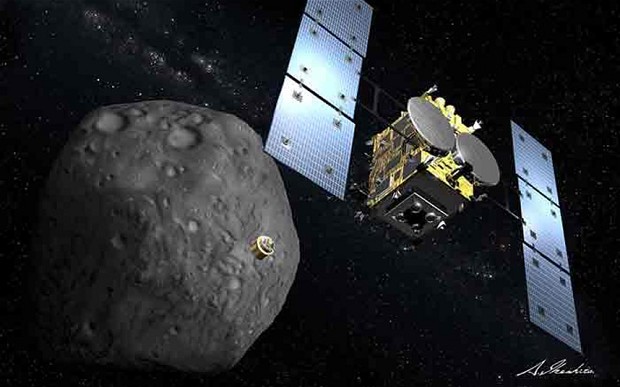
Read more‘Space Cannon’ To Be Fired Into Asteroid
Japanese craft to fire “space cannon” into asteroid in search for origins of the universe
Japan’s space agency has successfully test-fired a “space cannon” designed to launch a projectile into an asteroid as part of the search for the origins of the universe.
The device will be aboard the Hayabusa-2 space probe that is scheduled to take off in 2014 and rendezvous with an asteroid identified as 1999JU3 that orbits between Earth and Mars in 2018.
Once in position close to the asteroid, the space cannon will detach itself and remotely fire a 4lb metal projectile into the surface of the miniature planet.
“An artificial crater that can be created by the device is expected to be a small one, a few meters in diameter, but … by acquiring samples from the surface that is exposed by the collision, we can get fresh samples that are less weathered by the space environment or heat,” the Japan Aerospace Exploration Agency said in a statement.
The mother craft will then land close to the crater and use a small rover to collect samples that would have otherwise been below the surface of the asteroid and return to Earth in late 2020. In all, JAXA scientists say the craft will shadow the 2,950-foot-diameter asteroid for around 18 months.
The project has “the potential to revolutionise our understanding of pristine materials essential to understanding the conditions for planet formation and the emergence of life,” JAXA said.
“It can provide important information needed to develop strategies to protect the Earth from potential hazards,” the agency added.
“Moreover, robotic sampling missions to primitive bodies will be pathfinders for … human missions that might use asteroid resources to facilitate human exploration and the development of space.”
Hayabusa-2 is the second project to recover particles from deep space and will build on the success of Hayabusa, which in 2010 gathered surface dust from an asteroid and returned to Earth.
Source: telegraph UK
For years, astronomers have been scanning nearby asteroids, the moon, Mars, and deeper space for evidence of the building blocks of life.
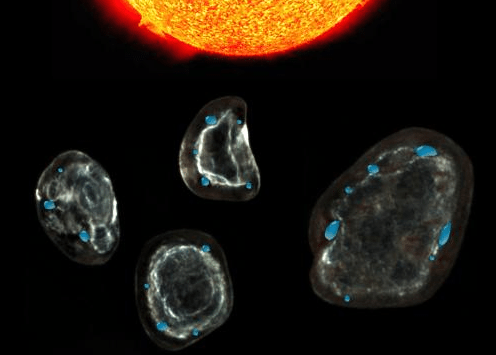
Now, a new study in the Proceedings of the National Academy of Sciences finds that both water and organic material could actually have our planet surrounded, floating around space on ubiquitous interplanetary dust particles that constantly rain down on Earth and the other bodies in our solar system.
“It is a thrilling possibility that this influx of dust has acted as a continuous rainfall of little reaction vessels containing both the water and organics needed for the eventual origin of life on Earth and possibly Mars,” researcher and study co-author Hope Ishii of the Hawaii Institute of Geophysics and Planetology said in a release.
…
In the case of comets, the icy space rocks import frozen water from beyond the solar system when they come to visit, but the traces of water on interplanetary dust particles are actually a product of the solar wind that blasts them with hydrogen ions, shaking up the atoms of the silicate mineral crystals in the dust particles. This process leaves behind some oxygen to react with hydrogen and create water molecules.
“Perhaps more exciting,” Ishii said, “interplanetary dust, especially dust from primitive asteroids and comets, has long been known to carry organic carbon species that survive entering the Earth’s atmosphere, and we have now demonstrated that it also carries solar-wind-generated water. So we have shown for the first time that water and organics can be delivered together.”
(via Ingredients for life hitching ride on space dust, study says | Crave – CNET)
Read more
Though NASA’s StarDust mission flew through the tail of comet Wild2 in 2004, no craft has ever orbited one. Rosetta will orbit its target at a leisurely walking pace, searching for a landing spot. Things will get even more exciting in November, when the robotic lander Philae (illustrated) detaches from the mother ship and becomes the first spacecraft to land on a comet.
Philae will anchor itself with a harpoon before starting to dig. An on-board lab will analyse the scoops of rock and beam the results to Earth. Like asteroids, comets are thought to preserve material from the birth of the solar system, 4.6 billion years ago. Comets contain water, so the chemistry of the scoops could reveal whether our oceans, and a bunch of molecules necessary for life, came from comets smashing into early Earth.
Read moreNewly Discovered 400-Foot Asteroid To Zip Past Earth | Orbit Animation | Space.com
Asteroid 2014 AA: Harmless impact over Atlantic Ocean last night.
It’s only the second time in history that an asteroid was seen before it hit us; the first was 2008 TC3, which burned up over Sudan in Africa in 2008. That one was also discovered just a day before atmospheric entry. Other rocks have been discovered in the past that gave us a very close shave, and usually small asteroids that actually hit us go undetected until someone looks up and sees them! That’s because they are so small: That makes them faint and hard to detect. Because they are close by they also tend to move very rapidly across the sky, making them harder to find. The 19-meter wide asteroid that blew up over Russia last year was undetected until it hit, for example.
It’s possible some satellites may have observed the entry of 2014 AA, and hopefully we’ll get an image or two. Stay tuned.
And of course this underscores how seriously we need to take asteroid impacts. While 2014 AA wasn’t a threat, there are a million bigger rocks out there that cross Earth’s orbit, big enough to cause real damage should they hit us. And given enough time, they will.
That’s why we need to keep scanning the skies, locating and characterizing these asteroids. Both NASA and the B612 Foundation are working on better detection methods, but that’s only the first step; we also need a plan in place should we find one with our number on it. B612 is working on that, but we’re a long way from being able to implement it.
Asteroid 2014 AA: Harmless impact over Atlantic Ocean last night.
Read more "Asteroid 2014 AA: Harmless impact over Atlantic Ocean last night."Read moreplanetary scientists increasingly suspect that comets (frozen balls of dust and ice) and ice-laden meteorites crashing into the primordial Earth probably provided most of the planet’s water—and perhaps much of the organic material—necessary for life.
Organic molecules have been detected in comets such as the Hale-Bopp, and, in a recent study, researchers simulated those cosmic crash landings by using a gas gun to fire metal projectiles at 16,000 miles per hour into blocks of ice containing some of the same chemicals that make up comets. The shock wave and heat generated by the impact created molecules that formed amino acids, the building blocks of proteins.
Yet the very same objects that gave this planet life could also spell its demise. Astronomers predict that a comet or asteroid large enough to cause global devastation will smash into the Earth about every 100 million years or so.
Fortunately, if such a comet or asteroid were to arrive sooner than expected, we are constructing observational systems to discover and track near-Earth objects, conceivably providing us with sufficient time to pre-empt catastrophe.
 The Committee to Nuke Elysium