NASA plans a robotic mission to search for life on Europa

No. No. No. No. No!!!

Posthuman Flight Club rule #1: ATTEMPT NO LANDING THERE.

Gorram pseudomasonic NASA folk trying to break my hyperreal spirituality. Hell no.

NASA plans a robotic mission to search for life on Europa

Read more "NASA plans a robotic mission to search for life on Europa"

For years, astronomers have been scanning nearby asteroids, the moon, Mars, and deeper space for evidence of the building blocks of life.

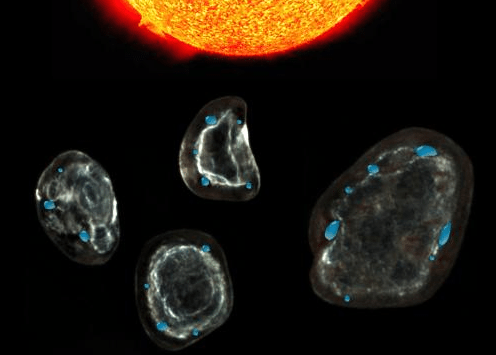
Now, a new study in the Proceedings of the National Academy of Sciences finds that both water and organic material could actually have our planet surrounded, floating around space on ubiquitous interplanetary dust particles that constantly rain down on Earth and the other bodies in our solar system.

“It is a thrilling possibility that this influx of dust has acted as a continuous rainfall of little reaction vessels containing both the water and organics needed for the eventual origin of life on Earth and possibly Mars,” researcher and study co-author Hope Ishii of the Hawaii Institute of Geophysics and Planetology said in a release.

In the case of comets, the icy space rocks import frozen water from beyond the solar system when they come to visit, but the traces of water on interplanetary dust particles are actually a product of the solar wind that blasts them with hydrogen ions, shaking up the atoms of the silicate mineral crystals in the dust particles. This process leaves behind some oxygen to react with hydrogen and create water molecules.

“Perhaps more exciting,” Ishii said, “interplanetary dust, especially dust from primitive asteroids and comets, has long been known to carry organic carbon species that survive entering the Earth’s atmosphere, and we have now demonstrated that it also carries solar-wind-generated water. So we have shown for the first time that water and organics can be delivered together.”

(via Ingredients for life hitching ride on space dust, study says | Crave – CNET)

Read more

Study: seemingly cool planets could be warm enough to host life underground (Wired UK)

To calculate habitable zones across the galaxy we take into account a host star’s luminosity, along with the planet’s distance from it and that planet’s size relative to the star.

The well-established Goldilocks theory, however, fails to take life beneath the surface into account, where temperatures dramatically change.

“As you get deeper below a planet’s surface, the temperature increases, and once you get down to a temperature where liquid water can exist – life can exist there too,” PhD student at the University of Aberdeen Sean McMahon said. “The deepest known life on Earth is 5.3km below the surface, but there may well be life even 10km deep in places on Earth that haven’t yet been drilled.”

The computer model was used to estimate what the temperature beneath the surface would be of any given planet it had the necessary parameters for. It found that the habitable zone would be around three times bigger than previously thought if it included the first 5km beneath an Earth-like planet’s surface. When depths of up to 10km below the Earth’s surface were included, the model found the habitable zone was 14 times wider. Applied to our own Solar System, it means the habitable zone extends beyond Saturn.

“The results suggest life may occur much more commonly deep within planets and moons than on their surfaces.”

“Rocky planets a few times larger than the Earth could support liquid water at about 5km below the surface even in interstellar space (i.e. very far away from a star), even if they have no atmosphere because the larger the planet, the more heat they generate internally.”

Study: seemingly cool planets could be warm enough to host life underground (Wired UK)

Read more "Study: seemingly cool planets could be warm enough to host life underground (Wired UK)"