PLOS ONE: Characterizing a Middle Bronze Palatial Wine Cellar from Tel Kabri, Israel


During the 2013 excavation season of the Kabri Archaeological Project, a rare opportunity materialized when forty large storage vessels were found in situ in an enclosed room located to the west of the central courtyard within the Middle Bronze Age Canaanite palace. A comprehensive program of organic residue analysis has now revealed that all of the relatively uniform jars contain evidence for wine. Furthermore, the enclosed context inherent to a singular intact wine cellar presented an unprecedented opportunity for a scientifically intensive study, allowing for the detection of subtle differences in the ingredients or additives within similar wine jars of apparently the same vintage. Additives seem to have included honey, storax resin, terebinth resin, cedar oil, cyperus, juniper, and perhaps even mint, myrtle, or cinnamon, all or most of which are attested in the 18th century BC Mari texts from Mesopotamia and the 15th century BC Ebers Papyrus from Egypt.
These additives suggest a sophisticated understanding of the botanical landscape and the pharmacopeic skills necessary to produce a complex beverage that balanced preservation, palatability, and psychoactivity. This new study has resulted in insights unachievable in the past, which contribute to a greater understanding not only of ancient viticulture but also of Canaanite palatial economy.

* coming soon I’m sure Atemporal Alcohol – authentic Canaanite wino

PLOS ONE: Characterizing a Middle Bronze Palatial Wine Cellar from Tel Kabri, Israel

Read more "PLOS ONE: Characterizing a Middle Bronze Palatial Wine Cellar from Tel Kabri, Israel"
A wall painting in the tomb of Djehutihotep clearly shows a person standing on the front of the pulled sledge and pouring water over the sand just in front of it.

Besides revealing something about the ancient Egyptians, the results are also interesting for modern-day applications. We still do not fully understand the behaviour of granular material like sand. Granular materials are, however, very common. Other examples are asphalt, concrete and coal. The research results could therefore be useful for examining how to optimise the transport and processing of granular material, which at present accounts for about ten percent of the worldwide energy consumption.

Ancient Egyptians transported pyramid stones over wet sand

Read more

We are now living in a history glut; the Internet has muddled the line between past and present.

The transformation was slow at first, and hardly anyone besides librarians noticed. Project Gutenberg, founded in 1971, was a cheerfully radical effort to turn old books into text files. When the web came along, the Online Books Page appeared and began listing links to thousands of digitized titles. Then, after the turn of the millennium, the pace rapidly accelerated: Google set up Google Books, Amazon launched Kindle, and Archive.org started scanning public-domain works from libraries. Meanwhile, shifts in the economics of music, film, and video set off an explosion in the digitization of back catalogs, until then the furtive territory of file-sharing pirates. Spotify and Netflix, Apple and YouTube have all now built enormous businesses based on organizing the past for commercial exploitation. Suddenly we find ourselves living in an online realm where the old is just as easy to consume as the new. We’re approaching an odd sort of asymptote, as our past gets closer and closer to the present and the line separating our now from our then dissolves.

There’s an irony here: All of the data we’re collecting, all of the data points and metadata, is history itself. Much as we marvel at Babylonian clay tablets listing measures of grain, future generations will find just as much meaning in our log files as they will in the media we consume. Sure, Frank Sinatra sang a bunch of songs; sure, Jennifer Lawrence was a big star in 2014. But the log files tell you who listened, and when, and where they were on the planet. It’s these massive digital archives—and the records that show how we used them—that will be the defining historical objects of our era.

Netflix and Google Books Are Blurring the Line Between Past and Present

BY PAUL FORD – http://www.wired.com/underwire/2014/02/history/

Read more

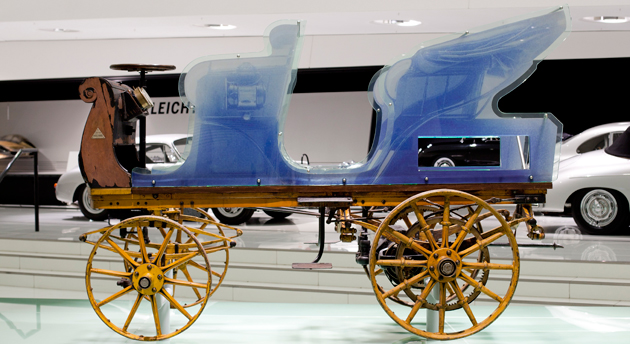
“ The automaker has recovered the P1, an electric car that Ferdinand Porsche built while working for a carriage maker in 1898; it was also the first car he ever built. ”

This is basically what he’s rocking around in in Dracula, amirite?

Bust that boy outta the museum and let me rock the Tesla Boy Gangster Bond Villain chic yo. Somebody’s gotta be Elon Musk’s personal shopper…

Now somebody get me those guys that build Da Vinci’s machines for the lulz on Skype.

You have been watching an infomercial on Multiverse TV.

Read more

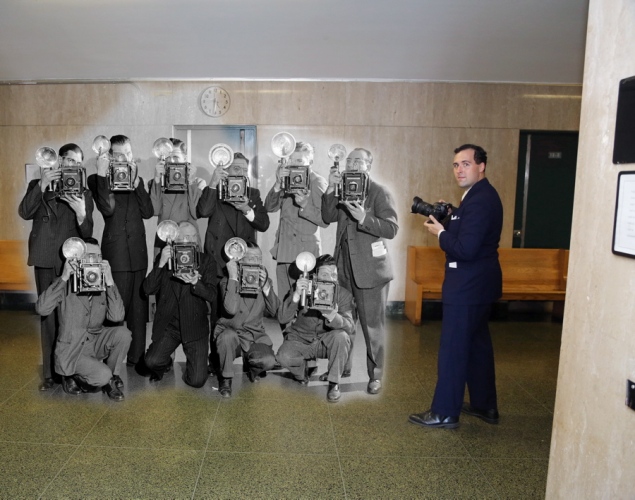
*New York City photographers*

Here, Marc A. Hermann (r.) and his colleagues of 70 years prior get caught in a rare moment on the opposite side of the camera lens. Hermann began this photo project because of his love for history and it has since blossomed into a series that reminds us all that there has been bustling life in the Big Apple for decades. “New York is constantly changing and transforming, and tragedies that affected individuals’ lives are forgotten. We may stand on what was once the site of a horrific murder and not even know it, simply because life goes on,” says Hermann. Now you can relive these historic moments in present-day.

http://fstoppers.com/vintage-crime-scene-photos-superimposed-on-modern-ny-streets-warning-graphic

Read more