Billionaires’ battle for historic launch pad goes into overtime – NBC News.com

The competition demonstrates two kinds of clout at work: Musk’s SpaceX was once seen as an upstart challenger to the space establishment — but after a string of successes, it now plays a leading role in NASA’s vision for commercial spaceflight. Bezos’ Blue Origin doesn’t have as much of a track record in spaceflight, but it does have powerful allies in the launch industry as well as in the halls of Congress.

Billionaires’ battle for historic launch pad goes into overtime – NBC News.com

Read more "Billionaires’ battle for historic launch pad goes into overtime – NBC News.com"

Buckminster Fuller was great at dreaming up inventions that, he hoped, would help humanity by making people’s lives easier and less stressful. However, most of them never caught on. One of his ideas was the fog gun.

The basic concept was to combine the cleansing effects of wind and heavy fog. His system used compressed air, atomized water and liquid soap. Standing in the blast of this “fog gun” for approximately ten minutes would completely clean a person.

*** real dotcom zillionaire wannabe bond villains build fuller tech for the lulz

Read more

You’ve just spent five weeks in limbo, stateless, living in the interzone of an airport terminal.

Your rival for Technomad Citizen#1 was under “house arrest” in the country estate of a sympathetic aristocrat.

Fleeing the might of the Empire, he’s now residing in the diplomatic safe zone of a South American embassy, from which he conspired to break you out of Hong Kong with the power of the network and the voodoo magic of temporary papers he conjured up with his host, hacking Authority.

You’ve been granted a solar year of asylum in the bounds of the Russian Federation, formerly trading as the Evil Empire ™. Anna Chapman has already proposed to you. You can regroup at an undisclosed location of your choice. You literally left paradise when you began this journey. You are a massive geek, and are well aware that it would be an easier and less perilous to take a rocket to the ISS, than travel anywhere else on Earth.

Maybe you make this your temporary base of Bond Villain operations.

(You definitely aren’t still part of the Company. This isn’t a massive psyops action.)

Read more

The firm that links these three stories together is Serco. Its range of activities, here and abroad, is truly mind-boggling, taking in no end of things that were once done by the state, but are now outsourced to private companies. Amazingly, its contracts with government are subject to what’s known as “commercial confidentiality” and as a private firm it’s not open to Freedom of Information requests, so looking into the details of what it does is fraught with difficulty.

Among their scores of roles across the planet, Serco is responsible for air traffic control in the United Arab Emirates, parking-meter services in Chicago, driving tests in Ontario, and an immigration detention centre on Christmas Island, run on behalf of those well-known friends of overseas visitors the Australian government.

In the US, the company has just been awarded a controversial $1.25bn contract by that country’s Department of Health. All told, its operations suggest some real-life version of the fantastical mega-corporations that have long been invented by fiction writers; a more benign version of the Tyrell Corporation from Blade Runner, say, or one of those creations from James Bond movies whose name always seems to end with the word “industries”.

I first heard Serco’s name about eight years ago, when I was just starting to understand the amazing growth of what are now called “public service companies”. Once I started looking, their logos were everywhere, suggesting a shadow state that has since grown ever-bigger. Their names seemed anonymously stylised, in keeping with the sense that they seemed both omnipresent, and barely known: Interserve, Sodexo, Capita, the Compass Group.

Serco is among the biggest of them all. At the last count, its annual pre-tax profits were up 27%, at £302m. In 2012 alone, its British workforce grew by 10,000, to 53,000 people (tellingly, as many as 90% of them are said to be former civil servant employees). In terms of employees, that makes it more than twice as large as the BBC, and around 20% bigger than Philip Green’s Arcadia group. A very significant player, in other words, and one that has come a long way since its foundation 1929, when it was a branch of the American RCA corporation called RCA Services Ltd, involved in the then booming UK cinema industry. It was renamed Serco in 1987, after a management buy-out, and floated on the stock exchange the following year. In the 25 subsequent years, during which the UK has grown ever-fonder of outsourcing and privatisation, Serco has grown at an amazing rate.

The current chief executive of the global Serco Group is 49-year-old Chris Hyman, born in Durban, South Africa. His annual remuneration is around £700,000, plus bonuses; in 2011, the value of his total package rose 18%, to £1.86m (the company’s finance director had to slum it at £948,295).

In 2010, Hyman was given a CBE for services to business and charity; he is also an enthusiastic fan of motor racing and an evangelical Christian. Four years ago, he was asked about his company’s very low profile, and he said this: “We had a dilemma – what do we do with the Serco name. We are proud of it. We thought we needed billboards at airports and places like that, to be seen with Tiger Woods on. But we worked out very quickly that is not what we are meant to do. We are meant to be known by the 5,000 not the five billion. The people who serve the people need to choose who supplies the service. We are delighted when the public knows who we are, but really, we need to be known by the people who make decisions.”

Work for the British government accounts for 40% of Serco’s revenues; to quote from the Daily Telegraph. “Without Serco, Britain would struggle to go to war”. That gives you some idea of how deeply its work penetrates the state, and how unthinkable any kind of corporate crisis would be.

“Interestingly, we are looking at this. The National Audit Office is doing work around the development of quasi-monopoly private providers, which is the world we’re moving into. We don’t really understand the size of their empires. We’ve got to start getting hold of this. It’s a new phenomenon.”

Read more

“There are many exciting things you could do that are illegal or not allowed by regulation,” Page said. “And that’s good, we don’t want to change the world. But maybe we can set aside a part of the world.” He likened this potential free-experimentation zone to Burning Man and said that we need “some safe places where we can try things and not have to deploy to the entire world.”

Read more

“It’s an asymmetric weapon, and it’s in the hands of a billionaire psychopath”

“All the power at our disposal… We can’t find one man with a laptop.”

“Gerhardt has the resources to become invisible. He has gone to ground and we can’t find him.”

The invisible billionaire “Bond Villain” of season 1 of XIII: The SeriesRainer Gerhardt taking down the world’s infrastructure, whilst lying on a couch in an unknown location.

Call back to piece on Spartan by Matt Jones:

…the modern Bond villain (and he might have added, villains in pop culture in general) is placeless, ubiquitous, mobile. His hidden fortress is in the network, represented only by a briefcase, or perhaps even just a mobile phone.

Or a rugged laptop.

Read more

But then in an almost throw-away aside to Adam, he reflected that the modern Bond villain (and he might have added, villains in pop culture in general) is placeless, ubiquitous, mobile.

His hidden fortress is in the network, represented only by a briefcase, or perhaps even just a mobile phone.

Maybe it’s in the objects. It’s not the pictures that got small, but the places our villains draw they powers from.

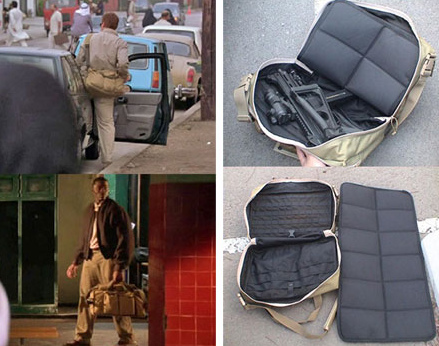
Perhaps the architypical transformation from gigantic static lair to mobile, compact “UbiLair” is in the film Spartan, where Val Kilmer’s anti-heroic ronin carries everything he needs in his “go-bag” – including a padded shooting mat that unfolds from it to turn any place into a place where he holds the advantage.

[Snip… where to my delight he starts invoking Zeke Stane, already on this tag]

So – for a “4th generation warfare” supervillain there aren’t even objects for the production designer to create and imbue with personality. The effects and the consequences can be illustrated by the storytelling, but the network and the intent can’t be foreshadowed by environments and objects in the impressionist way that Adam employed to support character and storytelling.

Read more