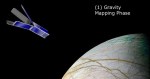
In its first stage, a small satellite about as large as a half-gallon of milk would orbit the moon. Using two highly accurate accelerometers, it could sense small changes in Europa’s gravitational field, eventually mapping the gravity of the entire surface. These detailed gravity maps could then suggest the location of watery oceans below the planet’s surface—or the openings to these oceans.
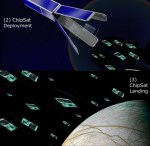
Once an ocean (or the entryway to one) was found, the probe would begin its second stage. The small satellite would release even smaller instruments over the interesting region. These “chipsats,” each no larger than a fingernail, could enter Europa’s thin atmosphere unharmed and float down to the surface.
“When there is an atmosphere, they flutter down like little pieces of paper, not like a rock,” said John West, leader of the advanced concepts team at Draper. He added that while they expect to lose some of the smaller “chipsats,” enough would be released that useful science could be performed.
Once deployed, the tiny chipsats would then send their measurements back to their orbiting mothership, which would in turn beam them back to Earth.
Read more The Committee to Nuke Elysium