Europa
(Source: https://player.vimeo.com/)
Read more
Scientists believe there is an ocean hidden beneath the surface of Jupiter’s moon Europa. NASA-JPL astrobiologist Kevin Hand explains why scientists are so excited about the potential of this ice-covered world to answer one of humanity’s most profound questions.
Read morePerhaps a safer way for seed to spread would be for whole rocks to travel other worlds. Previous research has showed that, theoretically, a massive meteorite impact could blast up and scatter tonnes of rock across the solar system.
In their recent paper, Hara and colleagues considered one of the biggest meteorite hits known in Earth’s history: the Chicxulub impact 65 million years ago, usually blamed for killing off the dinosaurs. The 10-kilometre-wide asteroid weighed well over a trillion tonnes, and could have excavated as much mass from the surface of the Earth.
The team calculated how much of that stuff could have ended up on the bodies in the solar system thought most likely to be hospitable to life: Saturn’s moon Enceladus and Jupiter’s moon Europa, both of which are thought to have subsurface oceans of liquid water.
Under certain conditions, as many as 300 million individual rocks could have ended up on Europa, and 500 on Enceladus, they calculated. Even more could have ended up on the moon and Mars. The team write:
“Although it is uncertain how rocks enter the presumed sea under the surface, for example, of Enceladus and Europa, the probability may be high that microorganisms transferred from Earth would be adapted and grow there.”
A handful of rocks could even have made it to planets around other stars. Once such could be Gliese 581, a red dwarf 20 light years away with a super-Earth orbiting at the outer edge of its habitable zone, where water could be liquid. Hana and colleagues calculated that about 1000 rocks from the Chicxulub impact could have reached that far in about a million years, meaning any life that made it would have had 64 million years to develop – or die off.
Such active geology suggests that Europa’s icy surface is connected to its buried ocean — creating a possible pathway for salts, minerals and maybe even microbes to get from the ocean to the surface and back again.
…
Places have already been spotted on Europa where fresh ice crust is being born, but the latest research is the first to pinpoint where it might be going to die.
But without high-resolution images from more areas, researchers cannot tell whether subduction might also be happening in other locations. If it turns out to be common, it might mean that the moon could be cycling life-friendly compounds between the surface and the deep, and that substantially increases the chance that its ocean is habitable, says Michael Bland, a planetary scientist at the US Geological Survey in Flagstaff, Arizona.
The discovery adds to excitement set off in December, when scientists reported plumes of water vapour spurting out at Europa’s south pole (L. Roth et al. Science 343, 171–174; 2014). The plumes have not been seen since, and they may or may not be related to Europa’s newly appreciated system of plate tectonics. NASA now needs to figure out what kind of mission might best to explore these discoveries.
Plate tectonics found on Europa
Read more "Plate tectonics found on Europa "Bill Nye: We May Discover Life on Europa
This plan does not involve landing on Europa and therefore meets the approval criteria from Posthuman Flight Club.
Start sending your empty coffee cups to NASA now, or something.

Reddish Bands on Europa
This colorized image of Europa is a product of clear-filter grayscale data from one orbit of NASA’s Galileo spacecraft, combined with lower-resolution color data taken on a different orbit.
The blue-white terrains indicate relatively pure water ice, whereas the reddish areas contain water ice mixed with hydrated salts, potentially magnesium sulfate or sulfuric acid.
The reddish material is associated with the broad band in the center of the image, as well as some of the narrower bands, ridges, and disrupted chaos-type features. It is possible that these surface features may have communicated with a global subsurface ocean layer during or after their formation.
The image area measures approximately 101 by 103 miles (163 km by 167 km). The grayscale images were obtained on November 6, 1997, during the Galileo spacecraft’s 11th orbit of Jupiter, when the spacecraft was approximately 13,237 miles (21,700 kilometers) from Europa. These images were then combined with lower-resolution color data obtained in 1998, during the spacecraft’s 14th orbit of Jupiter, when the spacecraft was 89,000 miles (143,000 km) from Europa.
Read more
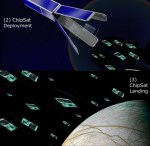
In its first stage, a small satellite about as large as a half-gallon of milk would orbit the moon. Using two highly accurate accelerometers, it could sense small changes in Europa’s gravitational field, eventually mapping the gravity of the entire surface. These detailed gravity maps could then suggest the location of watery oceans below the planet’s surface—or the openings to these oceans.
Once an ocean (or the entryway to one) was found, the probe would begin its second stage. The small satellite would release even smaller instruments over the interesting region. These “chipsats,” each no larger than a fingernail, could enter Europa’s thin atmosphere unharmed and float down to the surface.
“When there is an atmosphere, they flutter down like little pieces of paper, not like a rock,” said John West, leader of the advanced concepts team at Draper. He added that while they expect to lose some of the smaller “chipsats,” enough would be released that useful science could be performed.
Once deployed, the tiny chipsats would then send their measurements back to their orbiting mothership, which would in turn beam them back to Earth.
Read more“
Europa — a moon of Jupiter first discovered by Galileo — never ceases to surprise and amaze astronomers and amateurs alike. Last December astronomers announced water plumes erupting 100 miles high from the moon’s icy south pole. It was the best evidence yet that Europa, heated internally by the powerful tidal forces generated by Jupiter’s gravity, has a deep subsurface ocean. It caused the search for life in the outer solar system to take quite a turn.
Now, NASA has issued a Request for Information (RFI) to science and engineering communities for ideas for a mission to the enigmatic moon. Any ideas need to address fundamental questions about the subsurface ocean and the search for life beyond Earth.
”
In my newly self-appointed role as inheritor to Galileo…
As the spiritual leader of the hyperreal religion practiced by the Posthuman Flight Club…
I say: No. No, no, no, no, no, NO!
I say: exercise some patience and restraint.
I say: take only readings.
I declare Europa a protected moon in the solar system’s ecology.
If there really is the highest chance of life there we should tread as gently as possible. Taking each step with maximum certainty.
And right now there is clear doubt that we can send something there that won’t be carrying microscopic life from our own biosphere. (http://www.sciencedaily.com/releases/2014/05/140502120231.htm)
And whilst I can dig on panspermia, I’m not ready to be party to what amounts to ecological colonization just yet.
NASA Is Now Accepting Ideas For A Mission To Europa
Read more "NASA Is Now Accepting Ideas For A Mission To Europa"Read moreMiller had filled the vial in 1972 with a mixture of ammonia and cyanide, chemicals that scientists believe existed on early Earth and may have contributed to the rise of life.
He had then cooled the mix to the temperature of Jupiter’s icy moon Europa—too cold, most scientists had assumed, for much of anything to happen. Miller disagreed. Examining the vial in his laboratory at the University of California at San Diego, he was about to see who was right. As Miller and his former student Jeffrey Bada brushed the frost from the vial that morning, they could see that something had happened. The mixture of ammonia and cyanide, normally colorless, had deepened to amber, highlighting a web of cracks in the ice. Miller nodded calmly, but Bada exclaimed in shock. It was a color that both men knew well—the color of complex polymers made up of organic molecules.
Tests later confirmed Miller’s and Bada’s hunch. Over a quarter-century, the frozen ammonia-cyanide blend had coalesced into the molecules of life: nucleobases, the building blocks of RNA and DNA, and amino acids, the building blocks of proteins…
Although life requires liquid water, small amounts of liquid can persist even at –60°F. Microscopic pockets of water within the ice may have gathered simple molecules like the ones Miller synthesized, assembling them into longer and longer chains. A single cubic yard of sea ice contains a million or more liquid compartments, microscopic test tubes that could have created unique mixtures of RNA that eventually formed the first life.
If life on Earth arose from ice, then our chances of finding life elsewhere in the solar system—not to mention elsewhere in the galaxy—may be better than we ever imagined…
Cyanide is a good candidate as a precursor molecule in the life-in-a-freezer model for several reasons. First, planetary scientists suspect that cyanide was abundant on early Earth, deposited here by comets or created in the atmosphere by ultraviolet light or by lightning (once the atmosphere became oxygen rich, 2.5 billion years ago, the process would have stopped). Second, although cyanide is lethal to modern animals, it has a convenient tendency to self-assemble into larger molecules. Third, and perhaps most important, no matter how much cyanide rained down, it could become concentrated only in a cold environment—not in warm coastal lagoons—because it evaporates more quickly than water…
According to some solar evolution models, the sun was some 30 percent dimmer at that time, providing less heat to Earth. So as soon as the hail of asteroids stopped, Earth may have cooled to an average surface temperature of –40°F and a crust of ice as much as 1,000 feet thick may have covered the oceans. Many scientists have puzzled over how life could have arisen on a planet that was essentially a giant snowball…
Biebricher sealed small amounts of RNA nucleobases—adenine, cytosine, guanine—with artificial seawater into thumb-size plastic tubes and froze them. After a year, he thawed the tubes and analyzed them for chains of RNA. For decades researchers had tried to coax RNA chains to form under all sorts of conditions without using enzymes; the longest chain formed, which Orgel accomplished in 1982, consisted of about 40 nucleobases. So when Biebricher analyzed his own samples, he was amazed to see RNA molecules up to 400 bases long. In newer, unpublished experiments he says he has observed RNA molecules 700 bases long…
Vlassov and his coworkers, Sergei Kazakov and Brian Johnston, realized that the ice was driving both enzymes to work in reverse. Normally when an enzyme cuts an RNA chain in two, a water molecule is consumed in the process, and when two RNA chains are joined, a water molecule is expelled. By removing most of the liquid water, the ice creates conditions that allow the RNA enzyme to work in just one direction, joining RNA chains. The SomaGenics scientists wondered whether an icy spot on early Earth could have driven a primitive enzyme to do the same.
To investigate this, they introduced random mutations into the hairpin RNA, shortened it from its normal length of 58 bases, and even cut it into pieces—all in an effort to produce RNA enzymes that were as dodgy and imperfect as early Earth’s first enzymes likely were.
These pseudoprimitive RNA enzymes do nothing at room temperature. But freeze them and they become active, joining other RNA molecules at a slow but measurable rate. These findings inspired a theory that the first, extremely inefficient RNA enzymes got help from ice, which created an environment that encouraged short segments of RNA to stick together and behave as a single, larger RNA molecule.
“Freezing stabilizes the complexes formed from multiple pieces of RNA,” concludes Kazakov. “So small pieces of RNA could be enzymes, not just large 50-base molecules.”
… On the young Earth, pockets of liquid could have expanded into a network of channels that mixed their contents during freeze-thaw cycles, like day-night temperature changes in summer. In winter, the liquid pores would have contracted and become isolated again, returning to their separate experiments. With all the mixing, something special might eventually have formed: an RNA molecule that made rough copies of itself. And as Earth warmed, these molecules might have found a home in newly thawed seas or ponds, where something even more complex might have emerged—such as a cell-like membrane…
Those speculations are more relevant than ever, with recent discoveries of geysers on Saturn’s icy moon Enceladus and elaborate organic molecules on Titan, another Saturnian moon. Recent studies show that Mars too has vast quantities of buried ice, especially at its poles.
No. No. No. No. No!!!
Posthuman Flight Club rule #1: ATTEMPT NO LANDING THERE.
Gorram pseudomasonic NASA folk trying to break my hyperreal spirituality. Hell no.
NASA plans a robotic mission to search for life on Europa
Read more "NASA plans a robotic mission to search for life on Europa" The Committee to Nuke Elysium