Today, Alexei Sharov at the National Institute on Ageing in Baltimore and his mate Richard Gordon at the Gulf Specimen Marine Laboratory in Florida, have taken a similar to complexity and life.
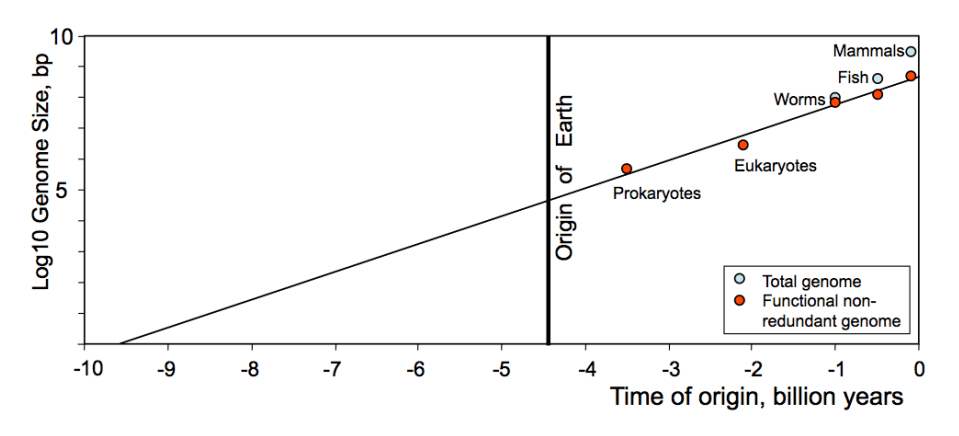
These guys argue that it’s possible to measure the complexity of life and the rate at which it has increased from prokaryotes to eukaryotes to more complex creatures such as worms, fish and finally mammals. That produces a clear exponential increase identical to that behind Moore’s Law although in this case the doubling time is 376 million years rather than two years.
That raises an interesting question. What happens if you extrapolate backwards to the point of no complexity–the origin of life?
Sharov and Gordon say that the evidence by this measure is clear. “Linear regression of genetic complexity (on a log scale) extrapolated back to just one base pair suggests the time of the origin of life = 9.7 ± 2.5 billion years ago,” they say.
And since the Earth is only 4.5 billion years old, that raises a whole series of other questions. Not least of these is how and where did life begin.
Of course, there are many points to debate in this analysis. The nature of evolution is filled with subtleties that most biologists would agree we do not yet fully understand.
For example, is it reasonable to think that the complexity of life has increased at the same rate throughout Earth’s history? Perhaps the early steps in the origin of life created complexity much more quickly than evolution does now, which will allow the timescale to be squeezed into the lifespan of the Earth.
Sharov and Gorden reject this argument saying that it is suspiciously similar to arguments that squeeze the origin of life into the timespan outlined in the biblical Book of Genesis.
Let’s suppose for a minute that these guys are correct and ask about the implications of the idea. They say there is good evidence that bacterial spores can be rejuvenated after many millions of years, perhaps stored in ice.
They also point out that astronomers believe that the Sun formed from the remnants of an earlier star, so it would be no surprise that life from this period might be preserved in the gas, dust and ice clouds that remained. By this way of thinking, life on Earth is a continuation of a process that began many billions of years earlier around our star’s forerunner.
Sharov and Gordon say their interpretation also explains the Fermi paradox, which raises the question that if the universe is filled with intelligent life, why can’t we see evidence of it.
However, if life takes 10 billion years to evolve to the level of complexity associated with humans, then we may be among the first, if not the first, intelligent civilisation in our galaxy. And this is the reason why when we gaze into space, we do not yet see signs of other intelligent species.
Ref: arxiv.org/abs/1304.3381: Life Before Earth
Read more

 The Committee to Nuke Elysium