Nearly twice as tall as Mount Everest, Arsia Mons is the third tallest volcano on Mars and one of the largest mountains in the solar system. This new analysis of the landforms surrounding Arsia Mons shows that eruptions along the volcano’s northwest flank happened at the same time that a glacier covered the region around 210 million years ago. The heat from those eruptions would have melted massive amounts of ice to form englacial lakes — bodies of water that form within glaciers like liquid bubbles in a half-frozen ice cube.

The ice-covered lakes of Arsia Mons would have held hundreds of cubic kilometers of meltwater, according to calculations by Kat Scanlon, a graduate student at Brown who led the work. And where there’s water, there’s the possibility of a habitable environment.

“This is interesting because it’s a way to get a lot of liquid water very recently on Mars,” Scanlon said.

While 210 million years ago might not sound terribly recent, the Arsia Mons site is much younger than the habitable environments turned up by Curiosity and other Mars rovers. Those sites are all likely older than 2.5 billion years. The fact that the Arsia Mons site is relatively young makes it an interesting target for possible future exploration.

“If signs of past life are ever found at those older sites, then Arsia Mons would be the next place I would want to go,” Scanlon said

Based on the sizes of the formations, Scanlon could estimate how much lava would have interacted with the glacier. Using basic thermodynamics, she could then calculate how much meltwater that lava would produce. She found that two of the deposits would have created lakes containing around 40 cubic kilometers of water each. That’s almost a third of the volume of Lake Tahoe in each lake. Another of the formations would have created around 20 cubic kilometers of water.

Even in the frigid conditions of Mars, that much ice-covered water would have remained liquid for a substantial period of time. Scanlon’s back-of-the-envelope calculation suggests the lakes could have persisted or hundreds or even a few thousand years.

That may have been long enough for the lakes to be colonized by microbial life forms, if in fact such creatures ever inhabited Mars.

“There’s been a lot of work on Earth — though not as much as we would like — on the types of microbes that live in these englacial lakes,” Scanlon said. “They’ve been studied mainly as an analog to [Saturn’s moon] Europa, where you’ve got an entire planet that’s an ice covered lake.”

In light of this research, it seems possible that those same kinds of environs existed on Mars at this site in the relatively recent past.

There’s also possibility, Head points out, that some of that glacial ice may still be there. “Remnant craters and ridges strongly suggest that some of the glacial ice remains buried below rock and soil debris,” he said. “That’s interesting from a scientific point of view because it likely preserves in tiny bubbles a record of the atmosphere of Mars hundreds of millions of years ago. But an existing ice deposit might also be an exploitable water source for future human exploration.”

Read more
“Alien Electromagnetic Signals Will Be Discovered by 2040” –SETI’s Chief Astronomer

Writing in Acta Astronautica, Shostak says that the odds favour detecting such alien AI rather than “biological” life. Seti researchers have long argued that nature may have solved the problem of life using different designs or chemicals, suggesting extraterrestrials would not only not look like us, but that they will not be carbon based life forms, but be bound to follow “at least some rules of biochemistry, live for a finite period of time, procreate, and above all be subject to the processes of evolution.”

“If you look at the timescales for the development of technology, at some point you invent radio and then you go on the air and then we have a chance of finding you,” he told BBC News.“But within a few hundred years of inventing radio – at least if we’re any example – you invent thinking machines; we’re probably going to do that in this century. So you’ve invented your successors and only for a few hundred years are you… a ‘biological’ intelligence.”

From a probability point of view, if AI-powered machines evolved, we would be more likely to spot signals from them than from the “biological” life that invented them.

“But having now looked for signals for 50 years, Seti is going through a process of realizing the way our technology is advancing is probably a good indicator of how other civilisations – if they’re out there – would’ve progressed. Certainly what we’re looking at out there is an evolutionary moving target.”

Dr Shostak says that artificially intelligent alien life would be likely to migrate to places where both matter and energy – the only things he says would be of interest to the machines – would be in plentiful supply. That means the Seti hunt may need to focus its attentions near hot, young stars or even near the centers of galaxies.

“I think we could spend at least a few percent of our time… looking in the directions that are maybe not the most attractive in terms of biological intelligence but maybe where sentient machines are hanging out.” Shostak thinks SETI ought to consider expanding its search to the energy- and matter-rich neighborhoods of hot stars, black holes and neutron stars.

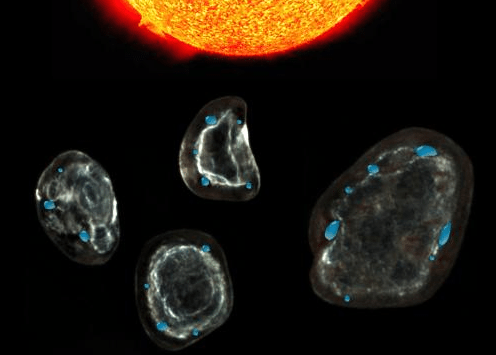
Data centers like this generate a lot of heat, and keeping them cool is a major challenge for modern computing. Intelligent computers would likely seek out a low-temperature habitat. Bok globules (image at top of page) are another search target for sentient machines. These dense regions of dust and gas are notorious for producing multiple-star systems. At around negative 441 degrees Fahrenheit, they are about 160 degrees F colder than most of interstellar space.

This climate could be a major draw because thermodynamics implies that machinery will be more efficient in cool regions that can function as a large “heat sink”. A Bok globule’s super-cooled environment might represent the Goldilocks Zone for the AI powered machines, says Shostak. But because black holes and Bok globules are not hospitable to life as we know it, they are not on SETI’s prime target list.

“Machines have different needs,” he says. “They have no obvious limits to the length of their existence, and consequently could easily dominate the intelligence of the cosmos. In particular, since they can evolve on timescales far, far shorter than biological evolution, it could very well be that the first machines on the scene thoroughly dominate the intelligence in the galaxy. It’s a “winner take all” scenario.”

“Alien Electromagnetic Signals Will Be Discovered by 2040” –SETI’s Chief Astronomer

Read more "“Alien Electromagnetic Signals Will Be Discovered by 2040” –SETI’s Chief Astronomer"

For years, astronomers have been scanning nearby asteroids, the moon, Mars, and deeper space for evidence of the building blocks of life.

Now, a new study in the Proceedings of the National Academy of Sciences finds that both water and organic material could actually have our planet surrounded, floating around space on ubiquitous interplanetary dust particles that constantly rain down on Earth and the other bodies in our solar system.

“It is a thrilling possibility that this influx of dust has acted as a continuous rainfall of little reaction vessels containing both the water and organics needed for the eventual origin of life on Earth and possibly Mars,” researcher and study co-author Hope Ishii of the Hawaii Institute of Geophysics and Planetology said in a release.

In the case of comets, the icy space rocks import frozen water from beyond the solar system when they come to visit, but the traces of water on interplanetary dust particles are actually a product of the solar wind that blasts them with hydrogen ions, shaking up the atoms of the silicate mineral crystals in the dust particles. This process leaves behind some oxygen to react with hydrogen and create water molecules.

“Perhaps more exciting,” Ishii said, “interplanetary dust, especially dust from primitive asteroids and comets, has long been known to carry organic carbon species that survive entering the Earth’s atmosphere, and we have now demonstrated that it also carries solar-wind-generated water. So we have shown for the first time that water and organics can be delivered together.”

(via Ingredients for life hitching ride on space dust, study says | Crave – CNET)

Read more

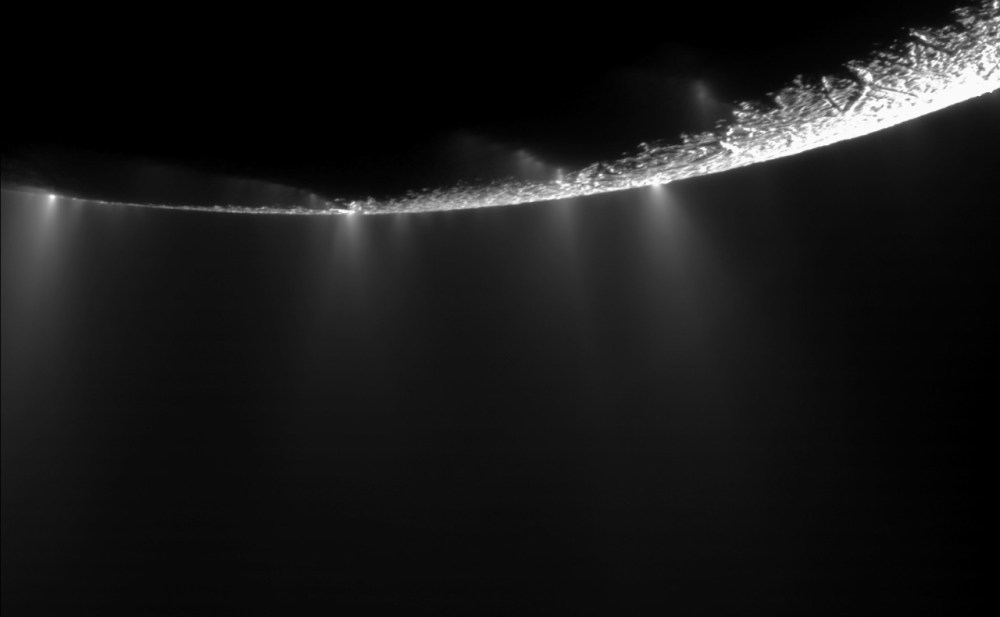
Enceladus seems to have liquid water under its icy surface. Cryovolcanoes at the south pole shoot large jets of water vapor, other volatiles and some solid particles (ice crystal, NaCl etc) into space (total approximately 200 kg per second).[14] Some of this water falls back onto the moon as “snow”, some of it adds to Saturn’s rings, and some of it reaches Saturn. The whole of Saturn’s E Ring is believed to have been made from these ice particles. Because of the apparent water at or near the surface, Enceladus may be one of the best places for humans to look for extraterrestrial life.

Read more