* click through to download a 35MB map sheet. Stick it on your wall, plan your Martian life.
See also:
USGS Scientific Investigations Map 3292: Geologic Map of Mars
Read more "USGS Scientific Investigations Map 3292: Geologic Map of Mars "* click through to download a 35MB map sheet. Stick it on your wall, plan your Martian life.
See also:
USGS Scientific Investigations Map 3292: Geologic Map of Mars
Read more "USGS Scientific Investigations Map 3292: Geologic Map of Mars "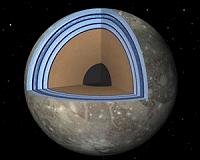
The results support the idea that primitive life might have possibly arisen on the icy moon. Scientists say that places where water and rock interact are important for the development of life; for example, it’s possible life began on Earth in bubbling vents on our sea floor.
Prior to the new study, Ganymede’s rocky sea bottom was thought to be coated with ice, not liquid – a problem for the emergence of life. The “club sandwich” findings suggest otherwise: the first layer on top of the rocky core might be salty water.
“This is good news for Ganymede,” said Vance. “Its ocean is huge, with enormous pressures, so it was thought that dense ice had to form at the bottom of the ocean. When we added salts to our models, we came up with liquids dense enough to sink to the sea floor.”
…
The results can be applied to exoplanets too, planets that circle stars beyond our sun. Some super-Earths, rocky planets more massive than Earth, have been proposed as “water worlds” covered in oceans. Could they have life? Vance and his team think laboratory experiments and more detailed modeling of exotic oceans might help find answers.
Ganymede is one of five moons in our solar system thought to support vast oceans beneath icy crusts. The other moons are Jupiter’s Europa and Callisto and Saturn’s Titan and Enceladus.
Read more The Committee to Nuke Elysium