
getyourasstomars
Another video from my favourite dashboard cam in the solar system.
Now, a fact:
The two moons were long thought to be asteroids that got captured in Mars’ orbit. However, some scientists believe they are actually chunks of Mars itself that broke off as the result of an ancient cosmic collision.
(Source: https://www.youtube.com/)
Read more




Best dashboard cam video ever: twelve months of Curiosity roving around Mars condensed into two minutes.
This is your reminder that we are a spacefaring, global civilization in the midst of a paradigm shift, communicating within a juvenile noosphere.
(Source: https://www.youtube.com/)
Read more

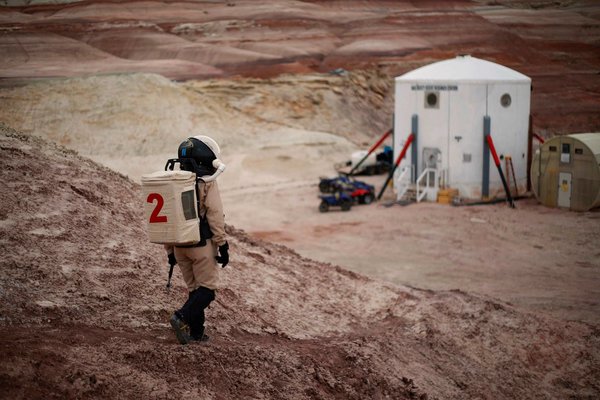
Radiation on the journey to Mars was measured by NASA’s newest Mars rover, Curiosity, which carries an instrument the size of a coffee maker that was originally intended to gauge radiation on the planet’s surface.
Investigators realized that by turning on the instrument right after the rover’s launching in November 2011, they could gather data on the radiation hitting the spacecraft from solar storms and from high-energy cosmic rays that come from outside the galaxy.
They determined that “the radiation environment is several hundred times more intense than it is on Earth,” Cary Zeitlin, a scientist at the Southwest Research Institute in Boulder, Colo., said during a NASA news conference on Thursday, “and that’s even inside a shielded spacecraft.” The findings will be published in Friday’s issue of the journal Science.
Radiation dosage is measured in units known as sieverts. A cumulative dose of one sievert is thought to raise the risk of a fatal cancer by about five percentage points.
During Curiosity’s 253-day, 350-million-mile trip, the rover absorbed about half a sievert — an average of 1.8 thousandths of a sievert per day, mostly from cosmic rays. “That could be higher under different circumstances,” Dr. Zeitlin said. The instrument measured radiation from only five solar storms, all modest.
NASA is not planning to send people to Mars until the 2030s, but with current technology, it would take six months to get there and six months to return to Earth. As such, astronauts would absorb about two-thirds of a sievert. By contrast, a person on Earth receives less than a thousandth of a sievert per year from outer space, Dr. Zeitlin said. Americans absorb a few thousandths of a sievert per year, mostly from X-rays and CT scans — still much less than from a Mars trip.
According to the National Cancer Institute, the lifetime risk of dying from cancer is 21 percent; the two-thirds of a sievert from a round-trip mission to Mars would raise that risk by three percentage points, to 24 percent.
The measurements largely agree with earlier estimates and measurements. “These are confirmatory measurements that will help us refine our models,” said Edward J. Semones, the spaceflight radiation health officer at NASA’s Johnson Space Center in Houston.
NASA’s standards currently limit the excess cancer risk for its astronauts to three percentage points.
——————————–
* All the more reason to catch a ride on a shooting star!
“Burrowing inside an asteroid whose orbit carries it past both the Earth and Mars could protect astronauts from radiation on their way to the Red Planet…” thanks past-me! http://blog.m1k3y.com/?p=823
Read more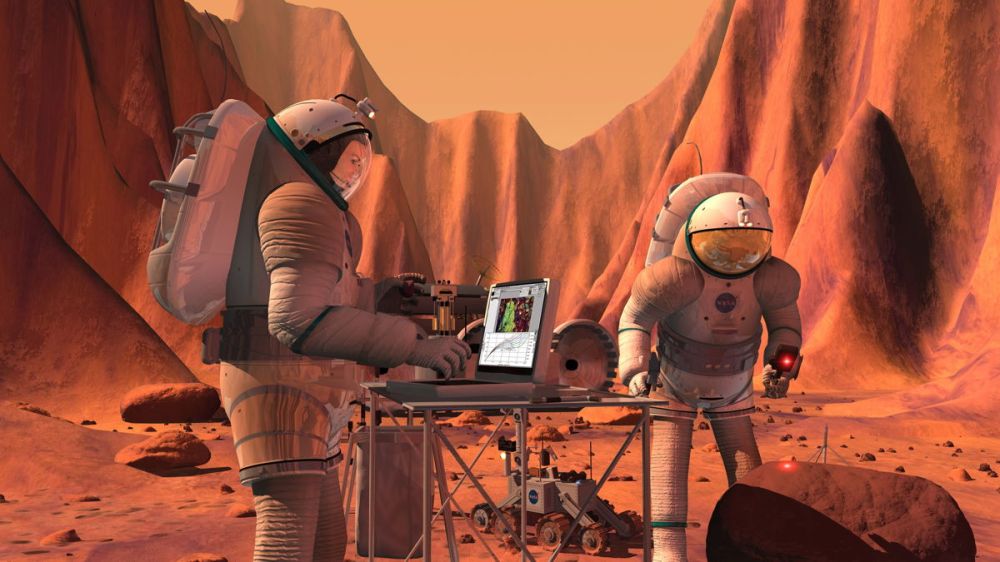
Read moreIt’s Time to Get Serious About Going to Mars, NASA Says
If NASA is to land humans on Mars by the 2030s, as President Barack Obama has directed, there’s not much time to settle on a plan and develop the technologies required, agency officials said Monday (May 6).
In the 1960s, America seized an opportunity to go to the moon, and succeeded. A second opportunity for a leap forward in space is upon us now, said NASA chief Charles Bolden at the Humans 2 Mars Summit here at George Washington University.
“Interest in sending humans to Mars I think has never been higher,” Bolden said. “We now stand on the precipice of a second opportunity to press forward to what I think is man’s destiny — to step onto another planet.” [Buzz Aldrin’s Visions for Mars Missions & More (Video)]Yet the road to Mars is long and challenging, and the difficulties are scientific, technological, political and economic, experts said.
Of Launches and Landings
Sending astronauts to the Red Planet will likely require at least three missions: one to launch the crew and the vehicle that will take them to Mars, one to launch the habitat humans will live on at the planet’s surface, and one to launch the vehicle that will lift off from Mars to take the crew home, said Doug Cooke, a former NASA associate administrator for the Exploration Systems Mission Directorate who now heads a space consulting firm.Overall, about 200 to 400 metric tons of equipment will have to be launched from Earth’s surface for the project — a mass roughly equivalent to that of the International Space Station. And about 40 metric tons of that mass will have to be delivered to the surface of Mars at one time. So far, NASA has been able to land only 1 metric ton at a time — a feat recently accomplished in nail-biting fashion when the agency landed the Curiosity rover last summer.
While this phase, called Mars entry, descent and landing, will be one of the most challenging elements of the mission, at least as difficult is the return, when the astronauts will have to lift off from the surface of Mars and travel home. [Missions to Mars: Robotic Invasion of Red Planet (Infographic)]
“To me this is one of the biggest challenges,” said Mike Raftery, director of space station utilization and exploration at Boeing, the primary contractor for NASA’s heavy-lift rocket being developed to go to Mars. “We have to essentially land a launch pad on the surface that’s then ready to launch the crew back to Earth.”
Watch: Flying To Mars – How Long Does It Take?
Living Off The Land
In addition to the launch system, Mars crews will have to bring their own life-support systems, medicine, food, communications systems and navigation equipment. Yet the space travelers won’t be able to pack everything they’ll need. Instead, they will have to take advantage of some of the resources on Mars, such as water and oxygen for breathing, drinking and other needs. However, the technologies needed to extract and use such resources don’t yet exist.“We’re going to have to rely on being able to live off the land,” said James Reuther of NASA’s Office of the Chief Technologist. “Those will require significant technology investments in order to actually bring that about.”
Engineers must also develop a means of shielding astronauts from the dangerous radiation in space, both during the journey to the Red Planet and on the Martian surface, which lacks a strong enough atmosphere to protect from these damaging particles.
And to adequately plan for a human landing, additional precursor missions may also be necessary.
“It’s very likely that we’ll send some kind of lander or rover to the site we want to send people to first, to drill a couple meters down to tell us if we have fresh water,” said John Grunsfeld, associate administrator for NASA’s science mission directorate. Such a spacecraft could also serve as a beacon to guide the crewed lander down to the chosen spot on Mars.
Despite the complexity of all these challenges, NASA has a limited amount of time to plan its mission if it wants humans to arrive in the 2030s.
Ticking Clock
By 2020, engineers must choose an architecture for the mission, including what type of propulsion to use to get to Mars, and how many launches are required, said Sam Scimemi, NASA’s International Space Station director. It must also establish partnerships with any other nations it hopes to team with for the journey. By 2025, the design for all the major vehicles and technologies must be completed and frozen.“That’s pencils down,” Scimemi said. “We don’t have a lot of time. If we’re going to get there we have to have a realistic approach from a budget, political and cultural standpoint.”
Still, many NASA and industry experts expressed confidence it can be done.
“In the coming days we have the opportunity to write history, to determine the future of humankind,” said Artemis Westenberg, president of Explore Mars Inc., the nonprofit space advocacy group that organized the conference. “We of Explore Mars give you this platform of this three-day summit. Now all you have to do is tell each other and the world the how” of getting to Mars.
You can watch the Humans 2 Mars Summit live on SPACE.com through May 8.
Read moreScientists work on fusion rocket for Mars
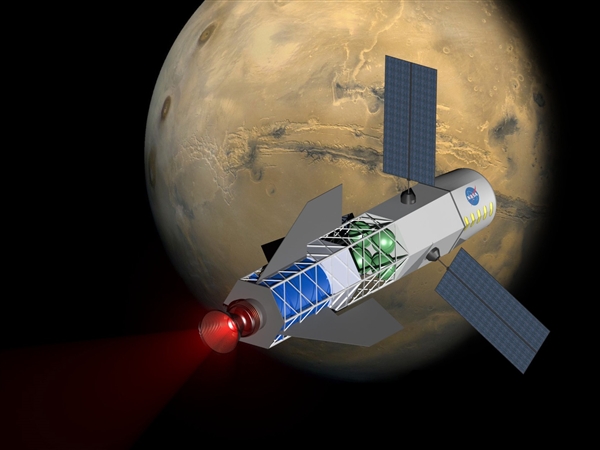
NBC News: Researchers at the University of Washington say they’ve built all the pieces for a fusion-powered rocket system that could get a crew to Mars in 30 days.
“If we can pull off a fusion demonstration in a year, with hundreds of thousands of dollars … there might be a better, cheaper, faster path to using fusion in other applications,” John Slough, a research assistant professor of aeronautics and astronautics, told NBC News. …
Timetables for the advent of fusion energy applications have repeatedly shifted to the right, reviving the old joke that the dawn of the fusion age will always be 30 years away.
Photo: An artist’s conception shows a spacecraft powered by a fusion-driven rocket. (UW / MSNW)
Read moreCaltech Challenges Students to Plan Manned Mission to Mars Moon
Humanity’s quest to send astronauts to Mars may get a boost from a student design competition being held this week.The Caltech Space Challenge, which runs from Monday through Friday (March 25-29) at the university’s campus in Pasadena, asks two teams of students from around the world to design a manned mission to Phobos or Deimos, Mars’ two tiny moons.
“This is a technical feat that, by necessity, will spark innovation the world over,” Nick Parziale, a PhD student in aeronautics at Caltech and leader of one of the teams, said in a statement. “We hope the Caltech Space Challenge serves as a reminder that these incredibly difficult problems are tractable, and that these passionate and dedicated students are just the women and men for the job.”
A total of 32 graduate and undergraduate students representing 21 universities and 11 different countries are participating in the competition, Caltech officials said. Scientists and engineers from Caltech, NASA’s Jet Propulsion Laboratory in Pasadena and a number of aerospace firms will advise the student teams and judge their final designs, which will be presented Friday.
Many scientists view Phobos and Deimos as potential stepping stones to Mars itself, as well as locations from which astronauts could efficiently operate robots exploring the Red Planet’s surface.
The two moons are both tiny, with Phobos measuring 14 miles (22 kilometers) across and Deimos just 8 miles (13 km). They’re probably former asteroids that Mars’ gravity captured long ago, researchers say.
NASA is looking into sending astronauts to Phobos or Deimos as part of a broad investigation of manned Mars mission options. In 2010, President Barack Obama directed the space agency to get humans to the vicinity of the Red Planet by the mid-2030s.
Students participating in the design competition hope their work brings a manned journey to Mars a little closer to reality.
“Sending humans to the neighborhood of Mars, and back, is going to be one of the most challenging engineering feats ever attempted,” Jason Rabinovitch, another Caltech aeronautics PhD student and leader of the competition’s other team, said in a statement.
“The Caltech Space Challenge is our way to continue to support and advance what is bound to be a long process of design, development and innovation leading to human footprints on Martian soil,” Rabinovitch added.
Public lectures associated with the design challenge will be given Monday through Wednesday (March 25-27). The public is also invited to attend the competition’s final presentations on Friday afternoon. More details on the student contest are available at the Caltech Space Challenge website.
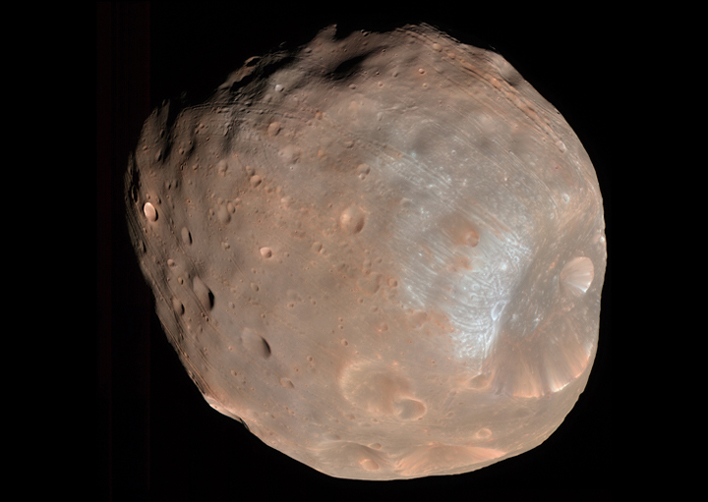
Image: NASA’s Mars Reconnaissance Orbiter took this image of the larger of Mars’ two moons, Phobos, from a distance of about 6,800 km (about 4,200 miles). via NASA/JPL/University of Arizona
*Psssst….click on the image to see Phobos in extremely high resolution
 The Committee to Nuke Elysium