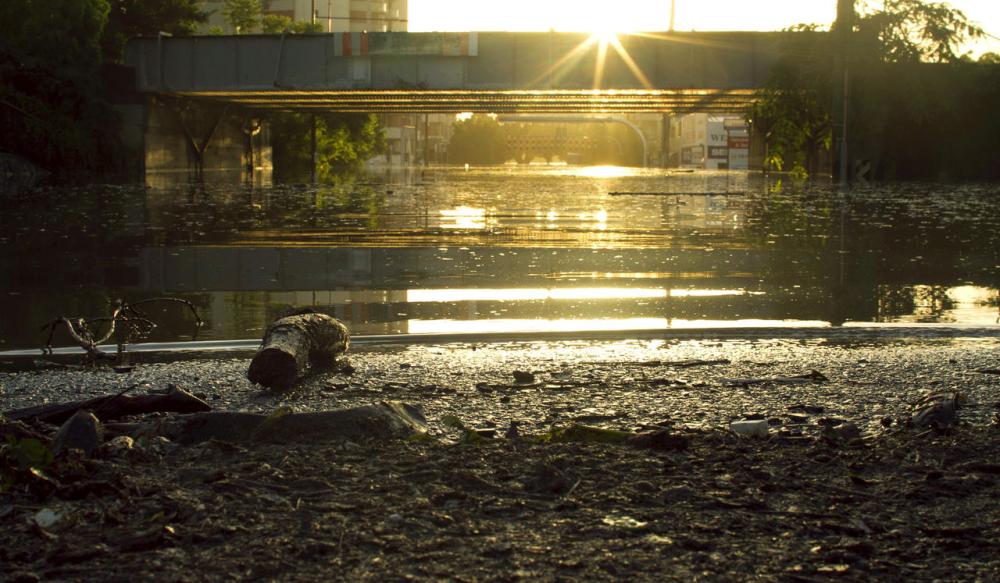
Arctic ice loss amplified Superstorm Sandy violence

warrenellis:

“Cornell and Rutgers researchers report in the March issue of Oceanography that the severe loss of summertime Arctic sea ice—attributed to greenhouse warming—appears to enhance Northern Hemisphere jet stream meandering, intensify Arctic air mass invasions toward middle latitudes, and increase the frequency of atmospheric blocking events like the one that steered Hurricane Sandy west into the densely populated New York City area.”

Arctic ice loss amplified Superstorm Sandy violence

Read more "Arctic ice loss amplified Superstorm Sandy violence"

greenfuturist:

Severe storms and tropical cyclones accounted for over 55% of these events, and nearly 60% of the inflation-adjusted damages. Elsewhere in the world the status quo is just as sobering; the Association of British Insurers (ABI), for example, estimated the financial impacts of climate change by looking under some very specific lampposts: inland floods in Great Britain induced by precipitation, winter windstorms in the UK, and typhoons in China. ABI concluded that insured flood losses on 100-year storms in Great Britain could rise by 30%, and insured losses resulting from typhoons in China could rise by 32% as a result of climate change. (via Mother Nature Doesn’t Do Bailouts – Julie Fox Gorte – Harvard Business Review)

Read more

climateadaptation:

kateoplis:

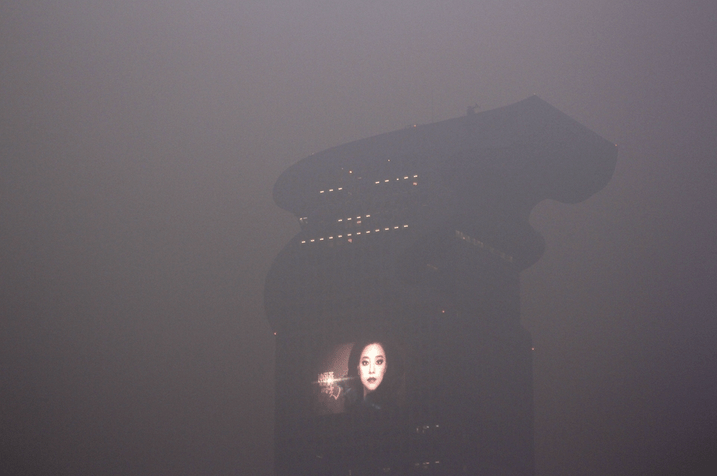
Nope, this is not a still from Blade Runner. It’s smog in Beijing. 

Some of my friends in Beijing have said the air burns their eyes and lungs. Here’s a picture of my colleague with his double-barreled air mask. Intense. Note he’s wearing a trash bag to protect his suit from the dirty air when he goes out.

Read more

climateadaptation:

Video of a glacier literally exploding. It’s called a “jökulhlaup,” a type of glacial flood caused by volcanic or geothermal pressure. An extremely rare event, it’s rarely caught on camera. The above catastrophic jökulhlaup occurred in 2010 when the Eyjafjallajökull erupted.

A jökulhlaup (Icelandic pronunciation: [ˈjœːkʏl̥ˌl̥øip]) is a glacial outburst flood. It is an Icelandic term that has been adopted by the English language. It originally referred to the well-known subglacial outburst floods from Vatnajökull, Iceland which are triggered by geothermal heating and occasionally by a volcanic subglacial eruption, but it is now used to describe any large and abrupt release of water from a subglacial or proglacial lake/reservoir. 

Since jökulhlaups emerge from hydrostatically-sealed lakes with floating levels far above the threshold, their peak discharge can be much larger than that of a marginal or extra-marginal lake burst. The hydrograph of a jökulhlaup from Vatnajökull typically either climbs over a period of weeks with the largest flow near the end, or it climbs much faster during the course of some hours. These patterns are suggested to reflect channel melting, and sheet flow under the front, respectively.

Similar processes on a very large scale occurred during the deglaciation of North America after the last ice age (e.g. Lake Agassiz), and presumably at earlier times, although the geological record is not well preserved. Via Wikipedia (great entry!)

Read more

“There is a dramatic, nonlinear relationship between climate conditions and tundra fires, and what one may call a tipping point,” he said. Once the temperature rises above a mean threshold of 10 degrees Celsius (50 degrees Fahrenheit) in the

June-through-September time period, he said, “the tundra is just going to burn more frequently.”

For the past 60 years, annual mean temperatures during this warm season have fluctuated between about 6 and 9 degrees Celsius (42.8 to 48.2 degrees Fahrenheit), with temperatures trending upward since 1995. In 2007, the year of the historic fire, the mean temperature was a record 11.1 degrees Celsius, while precipitation and soil moisture dipped to an all-time low.

Higher precipitation, if it occurs, could dampen the effects of higher temperatures, but only to a limited extent, said Philip Higuera, a professor of forest ecology and biogeosciences at the University of Idaho and a co-author on the study.

“As temperature rises, so too does evaporation,” he said. “So even if future precipitation increases, it’s likely that increased evaporation will result in overall lower moisture availability. This affects plants, but it also makes dead vegetation more flammable and fire prone.”

Read more

I suspect almost *everyone* feels that way at some point, which is why we have the sects and clades and religions and politics and culture and arts that we do. (The great irony of global hegemony is that, like fractals, its unity dissolves the closer you look; there is no “normal”, no matter how the media would like us to think otherwise.) Looking at the world as it stands – riven by falsely perceived differences, a multitude of groups arguing over ephemera at cross purposes while the important existential-risk-grade issues go unaddressed – I think seeking global unity is far more worthwhile a goal in the long run than hiving off, taking your ball and going home. If you believe you have good things to offer to the world – and I believe transhumanism *does* have good things to offer to the world – then keep offering them. The only way we’ll fix this mudball enough for us to escape it is by all pulling together; to go separatist is to concede defeat on behalf of the entire species, and in doing so help to ensure your own demise.

And as the resource crunches and climate shifts hit, anyone wandering off whistling Dixie and saying “well, we washed our hands of you normals, anyway” simply isn’t going to be allowed to head for the hills by the angry mobs. Regardless of their true intent, separatist groups are subject to our deeply-embedded primate-vintage tribal Hatred Of The Other. To imagine otherwise – and to imagine that any one group will somehow pull off, pacifisticly and nobly, what every vaguely rebellious twenty-something has considered at least once in their lives, but which has never been achieved, namely a successful bloodless secession from the rest of the planet – is certainly not evil or wrong, but I struggle to call it anything other than (charmingly) naive.

Schismatic transhuman sects | Blog | Futurismic

Paul speaking even greater truth, commenting on his own blog post, concluding a conversation with the Leader of the Transhuman Separatists, Rachel Haywire.

Read more

Mr Walker predicted the devastating Queensland floods and the first of five cyclones that has already formed off north Queensland. He says there is more heavy rain to come, with a second cyclone expected to form in late January and three more in late February and early March. (via More flooding predicted for Queensland – ABC News (Australian Broadcasting Corporation))

Read more