PLOS ONE: Characterizing a Middle Bronze Palatial Wine Cellar from Tel Kabri, Israel


During the 2013 excavation season of the Kabri Archaeological Project, a rare opportunity materialized when forty large storage vessels were found in situ in an enclosed room located to the west of the central courtyard within the Middle Bronze Age Canaanite palace. A comprehensive program of organic residue analysis has now revealed that all of the relatively uniform jars contain evidence for wine. Furthermore, the enclosed context inherent to a singular intact wine cellar presented an unprecedented opportunity for a scientifically intensive study, allowing for the detection of subtle differences in the ingredients or additives within similar wine jars of apparently the same vintage. Additives seem to have included honey, storax resin, terebinth resin, cedar oil, cyperus, juniper, and perhaps even mint, myrtle, or cinnamon, all or most of which are attested in the 18th century BC Mari texts from Mesopotamia and the 15th century BC Ebers Papyrus from Egypt.
These additives suggest a sophisticated understanding of the botanical landscape and the pharmacopeic skills necessary to produce a complex beverage that balanced preservation, palatability, and psychoactivity. This new study has resulted in insights unachievable in the past, which contribute to a greater understanding not only of ancient viticulture but also of Canaanite palatial economy.

* coming soon I’m sure Atemporal Alcohol – authentic Canaanite wino

PLOS ONE: Characterizing a Middle Bronze Palatial Wine Cellar from Tel Kabri, Israel

Read more "PLOS ONE: Characterizing a Middle Bronze Palatial Wine Cellar from Tel Kabri, Israel"

The first dog space crews were formed of stray mongrels: tough yet grateful, they knew what the struggle for survival was all about, and were quick to make friends with people.

The dogs were tested and trained at the Research Institute of Aviation Medicine in a red-brick building of the abandoned former Mauritania hotel just behind Dynamo Stadium north of central Moscow. Small animals weighing 6-7 kilos (13-15 lbs) were selected were selected for the first missions, because spaceships could not carry heavy payloads.

The first eligible passengers, aged two to six, had exemplary health and immunity to diseases and harsh environments, and had benign and patient dispositions. Females were preferred because their hygienic suits were easier to make.

Potential publicity mattered no less than scientific expediency, and so healthy, light-colored dogs, with clever looking faces were selected so that they would look good when televised or photographed for cover stories.

The training for short rocket flights and longer satellite expeditions started with the space suits. The dogs got accustomed to the protective and hygienic suits. Then, they learned to eat from an automated feeding system that used a conveyor belt to deliver food boxes on a schedule. The most difficult part was training the dogs to get used to confinement for up to three weeks, which was done using isolated cubicles.

The dogs also had to exercise, use the centrifuge, and be trained for the pod ejection process. The training finished with comprehensive tests, during which the dogs stayed in a sealed capsule for many days and were exposed to simulated adversities they could encounter during a space flight.

The first dog crew was launched at the Kapustin Yar space center on July 22, 1951. All told, there were 29 flights with dogs to the stratosphere at a height of 100-150 km (60-90 miles) between July 1951 and September 1962. Eight of them ended tragically due to hull breaches, parachute failures or life-support system failures.

The first returnable space vehicle with a comprehensive life-support system was built early in 1960, but the first flight ended in a crash.

The second, triumphant launch was made at the Baikonur space center at 3:44 pm on August 19, 1960, to study the space ray effect on animals and test air, food and water supply and waste disposal systems. The satellite weighed 4,600 kilos (more than 10,000 lbs), not including the carrier rocket, and consisted of a tight landing section and equipment bay.

Compressed gas containers for trajectory adjustment, jet engines, gauges, aerials, temperature regulators and solar batteries that turned toward the Sun automatically were all attached to the outside.

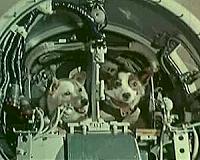
The two canine passengers – Belka and Strelka (whose names meant “Squirrel” and “Arrow”) – wore their own space suits, one red and the other green. There were a dozen caged mice, insects, plants, fungi, microbe cultures, corn, wheat grains, peas and onions with them in the ejection pod, whose instruments recorded their physical state throughout the flight. More animals – 28 mice and two rats – were traveling in the landing section outside the capsule.

The equipment bay was doomed to burn in the dense atmosphere during reentry, while the ejection pod and landing section had separate parachutes to reduce the speed to 6-8 and 10 meters/second (20-26 and 33 feet/second), respectively.

The landing section had heat-resistant windows and tight rapid-opening hatches. The pod was ejected through a hatch at a height of about 7-8 km (4-5 miles) above the ground, as triggered by the barometer gauges.

The landing section returned to the appointed spot on August 20, 1960. All the animals were safe and sound. The world’s first cosmonauts spent 25 hours in space, circling the Earth 17 times and bringing home valuable information on the impact of space flight on animal physiology, genes and cells.

The dogs became big stars. They faced a press conference the day after landing, and appeared on television a few days later. Footage of their somersaults in weightlessness was also shown – Strelka rigid in apprehension, and Belka rolling and tossing with joyful barks.

Read more

Origin of Egyptian mummies pushed back 2000 years

It had been assumed that before about 2500 BC, when Egyptians wanted to mummify their dead, they placed the wrapped bodies outside and let the hot, dry air and desert sand do the hard work. Deliberate mummification with preserving oils and resins was thought to be a much later development.

But the earliest known Egyptian burials date from 4500 to 3350 BC. These led some Egyptologists to suspect that mummification began early, but there was no hard evidence of this. For the first time, the bandages, skin and wadding from these ancient burials have been chemically analysed.

Stephen Buckley of the University of York in the UK and his colleagues used chromatography to identify a sticky, toffee-like resin found on linen wrappings on bodies from the El-Badari region of southern Egypt.

The resin contained “the same ingredients in roughly the same proportions” as found in much later deliberate mummifications, says Buckley. The mix of plant oils, animal fats, sugars, coniferous resins, natural petroleum and aromatic antibacterial agents would have made a poultice that repelled insects and preserved flesh.

“We knew from observation that there was artificial treatment of bodies at this early date, but what this research does do is tell us precisely what they were using”, says John Taylor of the British Museum in London, UK.

Taylor says that these early Egyptians were evidently accomplished embalmers, because they used complex mixtures of ingredients. As a result, “the beginnings of mummification could be even earlier”.

Origin of Egyptian mummies pushed back 2000 years

Read more "Origin of Egyptian mummies pushed back 2000 years"

The world heritage nomination of the Qhapaq Ñan (pronounced ca-pac NYAN in the Quechua language of the Incas) is extremely complicated, involving evaluations of 137 sections of the network embodying 273 components, including temples, funerary towers, fortresses and wayside inns, covering about 435 miles of the original 20,000. Only those 435 miles would be designated.

The road system began forming as trails as early as 1000 B.C., Professor Urton at Harvard said, and was developed into a complex network by the Incas in the 15th century A.D., so it was in use for nearly 2,500 years, 3,000 if calculated to the present day.

The Incas, who underwent a spectacular rise to found the largest pre-Columbian empire in South America, expanded these routes into the road network to unite their territory through Cuzco and serve a population of 40,000 spread over thousands of miles, the monuments council evaluation found. Runners carried administrative reports in the form of knotted ropes — the Incas had no written language — traders bought and sold gold and copper, seashells, weapons, feathers, wood, cocoa and textiles, and fresh fish from the Pacific.

After the conquistadors arrived from the north in 1526, they used the roads to subdue the Incas, driving them into remote mountain territories.

“The road network was the life giving support to the Inca Empire integrated into the Andean landscape,” the researchers said.

Read more

But whence the week? Throughout history, human societies have found it useful to divide time into groups of days shorter than a lunar month. One of the most common uses of this cycle has been to establish a regular market day, though just how regular varies. At one point, the Basques evidently employed a three-day week. For centuries, China, Japan, and Korea employed a 10-day week. Other societies have employed four-, five-, six-, eight-, and nine-day weeks.

So how did lucky No. 7 come to rule our calendars? It all began logically enough, when the ancient Babylonians divided their lunar months into four, yielding weeks that were mostly seven days. Then superstition kicked in. The final day of the week came to be considered evil or unlucky, and certain taboos developed around that day—against eating meat, for example.

It’s likely that the Babylonian week was the model for the seven-day Jewish week, with its own taboos against certain behaviors on the seventh day, or Sabbath. Babylon also probably served as the source of another important seven-day week used in Hellenistic Alexandria. The influence of that week remains with us in the names of heavenly bodies it assigned to each day—like Saturn-day, Sun-day, and Moon-day.

Meanwhile, the Romans marked time differently, which is why you never heard of anyone warning Caesar to “beware the third Tuesday in March!” Roman lunar months began on the Kalends, which scholars believe coincided with the new moon. The Ides, which fell on the 13th or 15th day of a month, coincided with the full moon. The Romans also kept an eight-day market week.

As Christianity—which kept the Jewish week but moved the Sabbath to Sunday—and Egyptian astrology gained influence in the empire, so did the seven-day week. Constantine, the first Christian emperor, made it official in 321. Since then, the spread of Christianity’s influence—as well as that of Islam, which also employs a seven-day week—has imposed the seven-day cycle on most of the world.

But there’s nothing inevitable about the ceaseless repetition of six days of work, one day of rest. As labor has become both more productive and more organized, the week has evolved. The writer Witold Rybczynski traces the emergence of the weekend to 19th century England, when the British agricultural revolution made land and labor more productive. At first, Rybczynski relates, this allowed workers extra leisure, which they enjoyed spontaneously—not according to any ironclad schedule. As the Industrial Revolution became a driving force in trans-Atlantic civilization, the push for greater efficiency demanded standardization of this extra leisure. In 1926, Henry Ford began shutting his factories on Saturdays in a bid to crystallize an American convention of a two-day weekend full of recreation (that he hoped would involve driving). It worked.

Read more

After Centuries of Lost Ideas, Humans Saved History by Sending It to Space   

By far the most tantalizing loss from the library [of Alexandria] was a treatise by the mathematician Aristarchus of Samos (310–230 BCE) that provided the first model for a heliocentric universe. That’s right: this guy casually figured out that the Earth was orbiting the Sun some 2,300 years ago, and we have no real idea how he did it.

His argument was destroyed along with the rest of the Library, but we know that it existed because Archimedes wrote the following passage about it in The Sand Reckoner.

It is gut-wrenching to think that the true nature of the solar system had been successfully divined all the way back in the third century BCE, only to be suppressed for another 1,800 years.

Imagine how different the course of history might have been had this revolutionary idea been fostered and investigated instead of ridiculed, dismissed, and ultimately engulfed in flames. For better or for worse, we would have been a very different species if Aristarchus’ contemporaries had embraced his findings instead of accusing him of impiety.

After Centuries of Lost Ideas, Humans Saved History by Sending It to Space   

Read more "After Centuries of Lost Ideas, Humans Saved History by Sending It to Space   "

andromeda1023:

jtotheizzoe:

The celestial maps of Su Song, Chinese polymath of the Song dynasty, the oldest known star charts in existence, dating from 1092 AD.

Previously: See how the Greeks and the Chinese viewed the same sky

(via TumbleOn)

Read more

To climb straight back to the surface, without stopping to rig ropes and phone wire, would take them four days. It took three days to get back from the moon…

Casteret and Chevalier helped turn caving into a heroic undertaking, and the search for the world’s deepest cave into an international competition—a precursor to the space race…

“In the past, I’d lose twenty-five pounds on one of these trips,” Stone told me. “We can burn as many calories as a Tour de France rider every day underground.” Ascending Chevé, he once said, was like climbing Yosemite’s El Capitan at night through a freezing waterfall. To fine-tune the team’s diet, he’d modelled it on Lance Armstrong’s program, aiming for a ratio of seventeen per cent protein, sixteen per cent fat, and sixty-seven per cent carbohydrates…

Over the years, caving gear has undergone a brutal Darwinian selection, lopping off redundant parts and vestigial limbs. Toothbrushes have lost their handles, forks a tine or two, packs their adjustable straps. Underwear is worn for weeks on end, the bacteria kept back by antibiotic silver and copper threads. Simple items are often best: Nalgene bottles, waterproof and unbreakable, have replaced all manner of fancier containers; cavers even stuff their sleeping bags into them. Yet the biggest weight savings have come from more sophisticated gear. Stone has a Ph.D. in structural engineering from the University of Texas and spent twenty-four years at the National Institute of Standards and Technology, in Gaithersburg, Maryland. His company has worked on numerous robotics projects for NASA, including autonomous submarines destined for Europa, Jupiter’s sixth moon. The rebreathers for the Chevé trip were of his own design. Their carbon-fibre tanks weighed a fourth of what conventional tanks weigh and lasted more than four times longer underwater; their software could precisely regulate the mix and flow of gases.

Stone’s newest obsession was a set of methanol fuel cells from a company called SFC Energy. Headlamps, phones, scuba computers, and hammer drills (used to drive rope anchors into the rock) all use lithium batteries that have to be recharged. On this trip the cavers would also be carrying GoPro video cameras for a documentary that would be shown on the Discovery Channel. In the past, Stone had tried installing a paddle wheel underground to generate electricity from the stream flow, with fairly feeble results. But a single bottle of methanol and four fuel cells—each about the size of a large toaster—could power the whole expedition…

“Welcome to Hell,” one of the cavers told me, when I joined him by the campfire that first night. “Where happiness goes to die,” another added. There was a pause, then someone launched into the colonel’s monologue from “Avatar”: “Out there, beyond that fence, every living thing that crawls, flies, or squats in the mud wants to kill you and eat your eyes for jujubes. . . . If you wish to survive, you need to cultivate a strong mental attitude.” It was a favorite conceit around camp: the cloud forest as hostile planet…

“Where did the water go a million years ago? That’s what you have to ask yourself,” Stone said. “As a cave diver, you have to think four-dimensionally.” 

Read more

I was a drug counselor and one of the kids I was working with called me at 11 one night and asked if I could come down to his job because he said there was a lot of blow around. So I went down and, as it turned out, the kid was working as a PA on a movie set. It was the film Runaway Train with John Voight and Eric Roberts. You have to understand that this was 1985, and on movie sets you could walk into production and cocaine lines were right there on the table. It wasn’t even hidden. It was unbelievable.

So I’m there and this guy comes up to me and asks if I’d like to be an extra and I was like, ‘an extra what?’ And he said, ‘Can you act like a convict?’ I thought it was a joke. I did 11 years in prison, so I said, ‘I’ll give it a shot.’ (laughs).

They gave me this blue shirt to wear and so I take off my shirt and this guy sees my tattoo and comes over to me and says ‘You’re Danny Trejo.’ I look at him and say ‘You’re Eddie Bunker.’ We were in prison together. I had first met him in 1962 then met him again in ’65 and then on the set of the movie. He was the screenwriter for the film!

So he says to me ‘Hey, Danny, I can get you the job of teaching Eric Roberts how to box. It pays $320 a day’ And I said, ‘How badly do you want me to beat this guy up?“ For $320 I thought they wanted me to kick some guy’s ass. I’d do it for $50. But he said to me, ‘No, no, no, this actor is really high strung. He might sock you. He’s already socked a couple of people.’ Eric was real high strung in those days. So I said, ‘Eddie, for $320 you can give him a stick!’

So I started teaching Eric how to box, and Eric wasn’t too sure about me (laughs), so he did whatever I told him to do. The director, Andrei Konchalovsky, who had a lot of problems with him just said, ‘Hey, you be in this movie,’ and the rest is history.

Read more
