A fine suite of plates demonstrating the Muggletonian sect’s geocentric astronomical theory, which refuted the Newtonian standpoint.

Isaac Frost, a scientist and author (with his brother) ofThe Works of J. Reeve and L. Muggleton (1832) was a practicing Muggletonian, the religious sect founded in the aftermath of the English Civil War by two cousins who claimed themselves to be the “two witnesses” mentioned in the Book of Revelations. 

The plates, first issued under the title Two Systems of Astronomy, illustrate the “The Newtonian System of the Universe”, and “The System According to the Holy Scipture”, the text caption on plate 6 reading “This diagram will show that if the Earth revolves round the sun, as the Solar System states, then it will necessarily follow, that the Earth will differ in its position with the sun and any given fixed star on its equator, every day throughout the whole year. Now consider it is so. If it is not so, then it will make much in favor of the Holy Scriptures, that the Sun revolves round the Earth.”

They were presumably circulated amongst members of the Muggletonian sect (which, due to a rule on not proselytizing, remained small until the last member died in 1979) and therefore printed in limited numbers. Printed by George Baxter, using his patented colour oil technique, they were originally unrecorded by Baxter’s first bibliographer Courtney Lewis.

Read more
NASA remains an agency driven by its human spaceflight division. If NASA has an original sin, it is that the agency was spawned by the Cold War and its early exploration activities were a technological battle against the Soviets for high-ground superiority; science was essentially a fringe benefit of this quasi-military enterprise.

Read more

Titus-Bode Law

The Titius–Bode law (sometimes termed just Bode’s law) is a hypothesis that the bodies in some orbital systems, including the Sun’s, orbit at semi-major axes in a function of planetary sequence. The hypothesis correctly predicted the orbits of Ceres and Uranus, but failed as a predictor of Neptune’s orbit. … When originally published, the law was approximately satisfied by all the known planets — Mercury through Saturn — with […]

Read more "Titus-Bode Law"

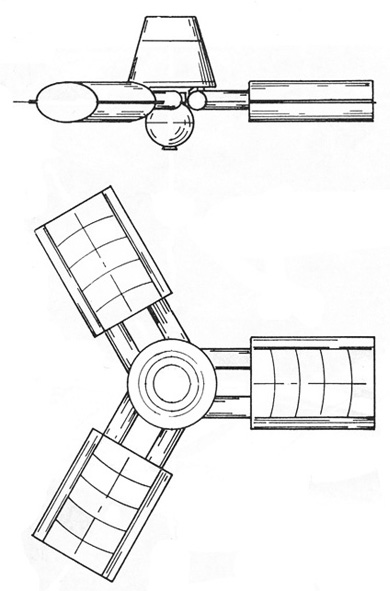
Meanwhile, in Houston, Texas, Edward Olling at the newly established Manned Spacecraft Center (MSC) was hard at work on a temporary space station program which he called Project Olympus. In April 1962, he circulated a draft planning document for comment; then, on 16 July 1962, he unveiled his Project Olympus “Summary Project Development Plan” to top-level MSC managers.

Olling explained that Project Olympus space stations would for the first time provide NASA with a large usable volume and enough scientific equipment, astronauts, and electrical power to carry out wide-ranging basic and applied research in space. Early station research would seek to answer basic questions about piloted spaceflight; for example, could humans work effectively for long periods in space? New objectives would be added over time. Beginning even with the first station, the Project Olympus stations would become space-environment research facilities, “national laboratories” for research into meteorology, geophysics, communications systems, navigation systems, and astronomy, and “orbital operations” facilities (that is, sites for assembling spacecraft bound for points beyond space station orbit). Each 138,600-pound Project Olympus station would comprise a large central hub with three evenly spaced arms. Each arm would include a pressurized crew module of oval cross-section nested between two cylindrical access tunnels. Apollo-derived logistics spacecraft (typical mass, 31,700 pounds), each bearing six astronauts, supplies, and equipment, would dock at the zero-gee central hub. The 150-foot-wide Project Olympus stations would spin four times per minute to create acceleration in their arms. On each station, the crew deck farthest from the hub would experience the greatest acceleration: the equivalent of one-quarter of Earth’s gravitational pull, or about midway between lunar and martian surface gravity. Crew decks closer to the hub would experience less acceleration. Olling hinted that the different levels of acceleration the astronauts would experience on decks at varying distances from the hub might be useful for scientific research, but he provided no specifics. (via Project Olympus (1962) – Wired Science)

Read more

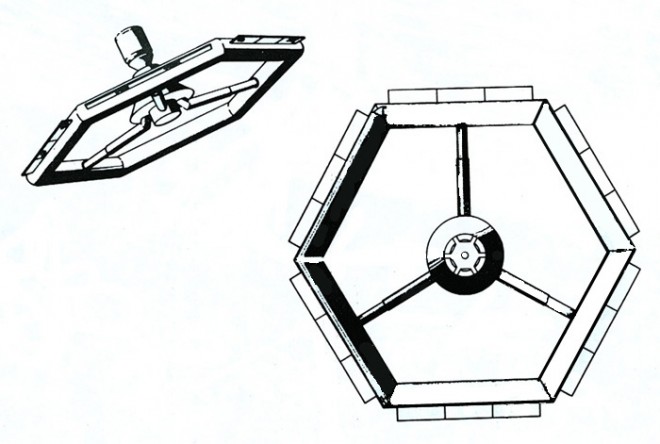
Langley Research Center (LaRC) was the early leader in NASA space station studies. A pioneering player in station work at the Hampton, Virginia-based laboratory was engineer Rene Berglund. He often designed stations that took advantage of existing or planned space hardware. In 1960, for example, Berglund designed a one-man space station comprising a metal-walled core, an inflatable fabric torus, a dish-shaped solar array, and a Mercury capsule at one end. At the time, Project Mercury had only recently begun flight testing. In May 1962, Berglund filed a patent for an “erectable” artificial-gravity space station that would reach orbit on a single two-stage Saturn C-5 (as the planned Saturn V rocket was then known). Folded atop its launch vehicle, Berglund’s station would measure just 33 feet across (the diameter of the rocket’s second stage, to which the station would joined as it ascended to orbit). The station would unfold in orbit into a hexagon 150 feet wide. Three spokes would link the hexagon to a central hub where piloted Apollo-derived logistics spacecraft would dock. The hexagon would revolve like a merry-go-round to create acceleration, which the crew inside would feel as gravity. “Down” would be away from the hub, toward the hexagon’s outer rim. (via Project Olympus (1962) – Wired Science)

Read more

todaysdocument:

Letter from Richard Nixon to Ronald Reagan, 08/13/1987

Former president Nixon comments on Reagan’s speech on the Iran-Contra affair, delivered to a national television audience the night before.

Read more