Read moreIn 2012, Dr. Paabo and his colleagues took samples from the bone to search for DNA. To their surprise, it held a number of genetic fragments.
“This is an amazing and shocking and unique sample,” said David Reich, a geneticist at Harvard Medical School and co-author of the new study.
The researchers used the DNA fragments to recreate a high-resolution copy of the man’s complete genome. A Y chromosome revealed that the thighbone belonged to a man.
The scientists then compared the genome of the so-called Ust’-Ishim man to those of ancient and living people.
They found that his DNA was more like that of non-Africans than that of Africans. But the Ust’-Ishim man was no more closely related to ancient Europeans than he was to East Asians.
He was part of an earlier lineage, the scientists concluded — a group that eventually gave rise to all non-African humans.
Homo sapiens, our own species, appeared in Africa around 200,000 years ago. Previous studies — both on genes and fossils — have suggested that they then expanded through the Near East to the rest of the Old World.
The Ust’-Ishim man’s genome suggests he belonged to a group of people who lived after the African exodus, but before the split between Europeans and Asians.
Dr. Paabo and his colleagues also found that the Ust’-Ishim man had pieces of Neanderthal DNA in his genome, just as living non-Africans do. But his Neanderthal DNA has some important differences.
Fossils indicate that Neanderthals spread across Europe and Asia before becoming extinct an estimated 40,000 years ago. Today, the Neanderthal DNA in each living non-African human is broken up into short segments sprinkled throughout the genome.
Dr. Paabo and his colleagues have hypothesized that this arrangement is the result of how cells divide.
During the development of eggs and sperm, each pair of chromosomes swaps pieces of their DNA. Over the generations, long stretches of DNA get broken into smaller ones, like a deck of cards repeatedly shuffled.
Over thousands of generations, the Neanderthal DNA became more fragmented. Dr. Paabo and his colleagues predicted, however, that Neanderthal DNA in the Ust’-Ishim man’s genome would form longer stretches.
And that’s exactly what they found. “It was very satisfying to see that,” Dr. Paabo said.
By comparing the Ust’-Ishim man’s long stretches of Neanderthal DNA to shorter stretches in living humans, Dr. Paabo and his colleagues estimated the rate at which they fragmented. They used that information to determine how long ago Neanderthals and humans interbred.
Previous studies — based on only living humans — had yielded an estimate between 37,000 and 86,000 years. Dr. Paabo and his colleagues have now narrowed down that estimate dramatically: Humans and Neanderthals interbred between 50,000 and 60,000 years ago, according to the new data.
hominid evolution
“Severe” Ice Age event could have killed off Neanderthals 39,000 years ago, say experts
Significant interbreeding between Neanderthals and early modern humans had probably already occurred in Asia more than 50,000 years ago, so the dating evidence now indicates that the two populations could have been in some kind of contact with each other for up to 20,000 years, first in Asia then later in Europe.
This may support the idea that some of the changes in Neanderthal and early modern human technology after 60,000 years ago can be attributed to a process of acculturation between these two human groups.
Of course, samples from some sites did not produce dates at all, and the coverage did not extend to eastern regions such as Uzbekistan and Siberia, where Neanderthals are also known to have lived, so it is still possible Neanderthals lingered later in some areas.
But the overall pattern seems clear – the Neanderthals had largely, and perhaps entirely, vanished from their known range by 39,000 years ago.
A severe Heinrich event, characterised by cold and dry conditions, hit Europe between 39-40,000 years ago, and it remains to be seen whether that event delivered the coup de grâce to a Neanderthal population that was already low in numbers and genetic diversity, and trying to cope with economic competition from incoming groups of Homo sapiens.”
“Severe” Ice Age event could have killed off Neanderthals 39,000 years ago, say experts
Read more "“Severe” Ice Age event could have killed off Neanderthals 39,000 years ago, say experts"Read moreSubstitute any disturbance for El Niño, including those linked to human activity, and we have a way to think about other hybrids, like the coywolves or grolar bears or, in fact, ourselves. Some argue that Homo sapiens left Africa when its northern deserts were passable — that is, at a moment when the climate changed. We bumped into long-lost relatives in Eurasia, the equivalent of today’s polar bears in the grolar bears’ story, and mated.
We may, in turn, have adapted to Eurasian conditions by borrowing genes from these “locals.” Everyone except sub-Saharan Africans carry a small quantity of Neanderthal DNA that includes traits possibly important for survival in Eurasian environments — immune-system and skin-pigmentation genes, among others. And our current genome warehouses DNA from archaic humans that have otherwise disappeared. A recent study estimated that, in the same way that coywolves can be said to store wolf DNA that might have otherwise vanished from the Northeast, one-fifth of the Neanderthal genome endures, dispersed throughout humanity.
Read moreIn the past, some researchers have tried to explain the demise of the Neanderthals by suggesting that the newcomers were superior to Neanderthals in key ways, including their ability to hunt, communicate, innovate and adapt to different environments.
But in an extensive review of recent Neanderthal research, CU-Boulder researcher Paola Villa and co-author Wil Roebroeks, an archaeologist at Leiden University in the Netherlands, make the case that the available evidence does not support the opinion that Neanderthals were less advanced than anatomically modern humans. Their paper was published today in the journal PLOS ONE.
“The evidence for cognitive inferiority is simply not there,” said Villa, a curator at the University of Colorado Museum of Natural History. “What we are saying is that the conventional view of Neanderthals is not true.”
Villa and Roebroeks scrutinized nearly a dozen common explanations for Neanderthal extinction that rely largely on the notion that the Neanderthals were inferior to anatomically modern humans. These include the hypotheses that Neanderthals did not use complex, symbolic communication; that they were less efficient hunters who had inferior weapons; and that they had a narrow diet that put them at a competitive disadvantage to anatomically modern humans, who ate a broad range of things.The researchers found that none of the hypotheses were supported by the available research. For example, evidence from multiple archaeological sites in Europe suggests that Neanderthals hunted as a group, using the landscape to aid them.
Researchers have shown that Neanderthals likely herded hundreds of bison to their death by steering them into a sinkhole in southwestern France. At another site used by Neanderthals, this one in the Channel Islands, fossilized remains of 18 mammoths and five woolly rhinoceroses were discovered at the base of a deep ravine. These findings imply that Neanderthals could plan ahead, communicate as a group and make efficient use of their surroundings, the authors said.
Other archaeological evidence unearthed at Neanderthal sites provides reason to believe that Neanderthals did in fact have a diverse diet. Microfossils found in Neanderthal teeth and food remains left behind at cooking sites indicate that they may have eaten wild peas, acorns, pistachios, grass seeds, wild olives, pine nuts and date palms depending on what was locally available.Additionally, researchers have found ochre, a kind of earth pigment, at sites inhabited by Neanderthals, which may have been used for body painting. Ornaments have also been collected at Neanderthal sites. Taken together, these findings suggest that Neanderthals had cultural rituals and symbolic communication.
Villa and Roebroeks say that the past misrepresentation of Neanderthals’ cognitive ability may be linked to the tendency of researchers to compare Neanderthals, who lived in the Middle Paleolithic, to modern humans living during the more recent Upper Paleolithic period, when leaps in technology were being made.
“Researchers were comparing Neanderthals not to their contemporaries on other continents but to their successors,” Villa said. “It would be like comparing the performance of Model T Fords, widely used in America and Europe in the early part of the last century, to the performance of a modern-day Ferrari and conclude that Henry Ford was cognitively inferior to Enzo Ferrari.”Although many still search for a simple explanation and like to attribute the Neanderthal demise to a single factor, such as cognitive or technological inferiority, archaeology shows that there is no support for such interpretations, the authors said.
But if Neanderthals were not technologically and cognitively disadvantaged, why didn’t they survive?
The researchers argue that the real reason for Neanderthal extinction is likely complex, but they say some clues may be found in recent analyses of the Neanderthal genome over the last several years. These genomic studies suggest that anatomically modern humans and Neanderthals likely interbred and that the resulting male children may have had reduced fertility. Recent genomic studies also suggest that Neanderthals lived in small groups. All of these factors could have contributed to the decline of the Neanderthals, who were eventually swamped and assimilated by the increasing numbers of modern immigrants.

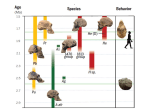
A large brain, long legs, the ability to craft tools and prolonged maturation periods were all thought to have evolved together at the start of the Homo lineage as African grasslands expanded and Earth’s climate became cooler and drier. However, new climate and fossil evidence analyzed by a team of researchers, including Smithsonian paleoanthropologist Richard Potts, Susan Antón, professor of anthropology at New York University, and Leslie Aiello, president of the Wenner-Gren Foundation for Anthropological Research, suggests that these traits did not arise as a single package. Rather, several key ingredients once thought to define Homo evolved in earlier Australopithecus ancestors between 3 and 4 million years ago, while others emerged significantly later.
The team’s research takes an innovative approach to integrating paleoclimate data, new fossils and understandings of the genus Homo, archaeological remains and biological studies of a wide range of mammals (including humans). The synthesis of these data led the team to conclude that the ability of early humans to adjust to changing conditions ultimately enabled the earliest species of Homo to vary, survive and begin spreading from Africa to Eurasia 1.85 million years ago.
Potts developed a new climate framework for East African human evolution that depicts most of the era from 2.5 million to 1.5 million years ago as a time of strong climate instability and shifting intensity of annual wet and dry seasons. This framework, which is based on Earth’s astronomical cycles, provides the basis for some of the paper’s key findings, and it suggests that multiple coexisting species of Homo that overlapped geographically emerged in highly changing environments.
“Unstable climate conditions favored the evolution of the roots of human flexibility in our ancestors,” said Potts, curator of anthropology and director of the Human Origins Program at the Smithsonian’s National Museum of Natural History. “The narrative of human evolution that arises from our analyses stresses the importance of adaptability to changing environments, rather than adaptation to any one environment, in the early success of the genus Homo.”
The team reviewed the entire body of fossil evidence relevant to the origin of Homo to better understand how the human genus evolved. For example, five skulls about 1.8 million years old from the site of Dmanisi, Republic of Georgia, show variations in traits typically seen in African H. erectus but differ from defining traits of other species of early Homo known only in Africa. Recently discovered skeletons of Australopithecus sediba (about 1.98 million years old) from Malapa, South Africa, also include some Homo-like features in its teeth and hands, while displaying unique, non-Homo traits in its skull and feet. Comparison of these fossils with the rich fossil record of East Africa indicates that the early diversification of the genus Homo was a period of morphological experimentation. Multiple species of Homo lived concurrently.
“We can tell the species apart based on differences in the shape of their skulls, especially their face and jaws, but not on the basis of size,” said Antón. “The differences in their skulls suggest early Homo divvied up the environment, each utilizing a slightly different strategy to survive.”
Even though all of the Homo species had overlapping body, brain and tooth sizes, they also had larger brains and bodies than their likely ancestors, Australopithecus. According to the study, these differences and similarities show that the human package of traits evolved separately and at different times in the past rather than all together.
In addition to studying climate and fossil data, the team also reviewed evidence from ancient stone tools, isotopes found in teeth and cut marks found on animal bones in East Africa.
“Taken together, these data suggest that species of early Homo were more flexible in their dietary choices than other species,” said Aiello. “Their flexible diet – probably containing meat – was aided by stone tool-assisted foraging that allowed our ancestors to exploit a range of resources.”
The team concluded that this flexibility likely enhanced the ability of human ancestors to successfully adapt to unstable environments and disperse from Africa. This flexibility continues to be a hallmark of human biology today, and one that ultimately underpins the ability to occupy diverse habitats throughout the world.
Read moreENIGMA MAN: A Stone Age Mystery
With Enigma Man we follow the groundbreaking research of Aussie paleoanthropologist Darren Curnoe and his Chinese colleague, paleontologist Ji Xueping.
Their study of ancient human remains found in a remote cave in South-west China looks at the idea there may have been another species of human existing alongside our ancestors as recently as 11,000 – 14,000 years ago.
Dubbed the ‘‘Red Deer Cave people’’, these ancient people, or, more precisely, their remains – so similar, yet so physically different from us – are much, much younger than our Neanderthal relatives, posing some seriously interesting questions. Were they really another human species? And if so, what happened to them? Why did they die out? How did they live? And what were their interactions with our own early relatives?
These are indeed big questions, Curnoe says, and that’s what makes the search for answers so fascinating.
“The documentary is about the process of deciding: do we have a new species or not?” Curnoe, who is Associate Professor of evolutionary biology in the School of Biological, Earth and Environmental Sciences at UNSW, explains.
“The fossils just don’t fit with the dominant view in science at the moment about who was around 11,000 years ago or 14,000 years ago, how they relate to us, and how we think of ourselves as humans in relation to nature.
“We tend to think of ourselves as special. So it raises some pretty deep and challenging questions.
“There are views, which I subscribe to, and quite a lot of other people do too, that there are at least 30 different species that are in the fossil record that would be relatives of ours in some sense – some may be ancestors, some may be side-branches that went extinct.
“The classic example is the Neanderthals – everyone has heard of them, even if you don’t know much about them. What we are proposing is that instead of the Neanderthals being the last of the other human-like creatures [before it was] just us, we are in fact saying, well, no, this other group survived until much more recently.”
(Source: https://www.youtube.com/)
Read more
[1404.7766] Genome-wide Scan of Archaic Hominin Introgressions in Eurasians Reveals Complex Admixture History
“
We found that detected introgressions shared more archaic-specific mutations with Altai Neanderthal than they shared with Denisovan, and 60.3% of archaic hominin introgressions were from Neanderthals. Furthermore, we detected more introgressions from two unknown archaic hominins whom diverged with modern humans approximately 859 and 3,464 thousand years ago. The latter unknown archaic hominin contributed to the genomes of the common ancestors of modern humans and Neanderthals. In total, archaic hominin introgressions comprised 2.4% of Eurasian genomes. Above results suggested a complex admixture history among hominins.
”
* translation: not only are we the product of cross breeding with Neanderthals and Denisovans, but two far older branches of the hominid tree.
The natural state of hominids has been expansion then separation into subspecies… like say from an Ice Age, or other heavy weather event or catastrophe… then hooking up again later and swapping genes. This is how it’s been done for millions of years.
Statistically, there being just one species of human on the planet has been “unnatural”. Remember, our current count for the end of the last Ice Age now stands at four.
Who knows what more genetic data mining will reveal? Our complex origins.
Extrapolate forwards for Mars and other off-world colonies at your leisure. (And sideways for cryptozoological fun times.)
Read more "[1404.7766] Genome-wide Scan of Archaic Hominin Introgressions in Eurasians Reveals Complex Admixture History"Read moreBut based on evidence from ancient bones, spears, and porridge, Speth believes our Stone Age cousins likely boiled their food. He suggests that Neanderthals boiled using only a skin bag or a birch bark tray by relying on a trick of chemistry: Water will boil at a temperature below the ignition point of almost any container, even flammable bark or hides…
Speth suggests that Neanderthals boiled foods in birch bark twisted into trays, a technology that prehistoric people used to boil maple syrup from tree sap.
Archaeologists have demonstrated that Neanderthals relied on birch tar as an adhesive for hafting spear points as long as 200,000 years ago. Making birch tar requires clever cooking in an oxygen-free container, says paleontologist Michael Bisson of Canada’s McGill University.
“I’ve burned myself trying to do it,” Bisson says, adding that Neanderthals were plenty clever when it came to manipulating birch. They likely ignited rolled-up birch bark “cigars” and plunged them into holes to cook the tar in an oxygen-free environment.
If the tar is exposed to oxygen in the air as it cooks, “it explodes,” Bisson adds.
Supporting the boiling idea, Speth said that animal bones found in Neanderthal settings are 98 percent free of scavenger’s gnawing marks, which he says suggests the fat had been cooked off.
And some grains found in the teeth of a Neanderthal buried in Iraq’s Shanidar Cave site appear to have been cooked, according to a 2011 Proceedings of the National Academies of Science report.
“It is speculative, but I think it is pretty likely that they knew how to boil,” Speth says.
In a separate talk at the meeting, University of Michigan paleontologist Andrew White noted recent evidence that Neanderthal mothers weaned their children at an earlier age than human mothers typically do. He said the early transition from milk to food supports the theory that Neanderthals boiled their youngsters’ food to make it more digestible.
Talking Neanderthals challenge the origins of speech
“To many, the Neanderthal hyoid discovered was surprising because its shape was very different to that of our closest living relatives, the chimpanzee and the bonobo. However, it was virtually indistinguishable from that of our own species. This led to some people arguing that this Neanderthal could speak,” A/Professor Wroe said.
“The obvious counterargument to this assertion was that the fact that hyoids of Neanderthals were the same shape as modern humans doesn’t necessarily mean that they were used in the same way. With the technology of the time, it was hard to verify the argument one way or the other.”
However advances in 3D imaging and computer modelling allowed A/Professor Wroe’s team to revisit the question.
“By analysing the mechanical behaviour of the fossilised bone with micro x-ray imaging, we were able to build models of the hyoid that included the intricate internal structure of the bone. We then compared them to models of modern humans. Our comparisons showed that in terms of mechanical behaviour, the Neanderthal hyoid was basically indistinguishable from our own, strongly suggesting that this key part of the vocal tract was used in the same way.
"From this research, we can conclude that it’s likely that the origins of speech and language are far, far older than once thought.”
Talking Neanderthals challenge the origins of speech
Read more "Talking Neanderthals challenge the origins of speech" The Committee to Nuke Elysium