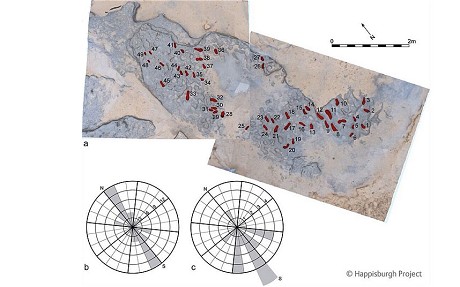
Footprints left behind by what may be one our first human ancestors to arrive in Britain have been discovered on a beach in Norfolk.
The preserved tracks, which consisted of 49 imprints in a soft sedimentary rock, are believed to be around 900,000 years old and could transform scientists understanding of how early humans moved around the world.
Anthropologists and evolutionary biologists from around the UK have been studying the tracks, and believe they may have been related to an extinct form of human ancestor known as Homo antecessor, or “Pioneer Man”.
The tracks include up to five different prints, indicating a group of both adults and children walked across the ancient wet estuary silt.
They are the earliest direct evidence of human ancestors in the area and may belong to some of the first ever Britons.
From their analysis of the prints, researchers believe the group were probably heading in a southerly direction over what would at the time have been an estuary surrounded by salt marsh and coniferous forest.
At the time Britain was connected to continental Europe by land and the site at Happisburgh would have been on the banks of a wide estuary several miles from the coast.
The estuary itself would have provided a rich array of plants, seaweed and shellfish. Fossils of mammoth, an extinct kind of horse and early forms of voles have also been found at the site Happisburgh.
The early humans could also have hunted or scavenged the grazing herds for meat.
The discovery of the footprints is particularly significant as there are few surviving tracks of human ancestors elsewhere in the world.
Scientists can glean large amounts of information about our ancestors, including the size of the groups they travelled in, how they walked, their size and weight.
The prints were discovered in deposits that have also revealed stone tools and fossilised bones dating to between 800,000 and one million years ago.
It is thought that the footprints may have belonged to a relative of a Homo antecessor – an extinct hominid species that may have been a common ancestor to both modern humans and Neanderthals, although such theories are still highly disputed.
Remains from Homo antecessor were discovered in the Atapuerca Mountains in Spain.
Professor Chris Stringer, an eminent anthropologist at the Natural History Museum in London who worked with the team, said: “The humans who made the Happisburgh footprints may well have been related to the people of similar antiquity fromi Atapuerca in Spain, assigned to the species Homo antecessor.
“These people were of a similar height to ourselves and were fully bipedal. They seem to have become extinct in Europe by 600,000 years ago and were perhaps replaced by the species Homo heidelbergensis.
“Neanderthals followed from about 400,000 years ago and eventually modern humans some 40,000 years ago.”
http://www.telegraph.co.uk/science/science-news/10623660/900000-year-old-footprints-of-earliest-northern-Europeans-discovered.html
Read more

 The Committee to Nuke Elysium