Mars Evolution video from MAVEN program
(Source: https://www.youtube.com/)
Read more
Read moreSince 1996, scientists have debated about whether the Martian meteorite ALH84001 contains evidence that life once existed on Mars. The rock holds some microscopic wormy-looking structures that some scientists have suggested could be fossilized remains of life on Mars, whereas others say the weird shapes derive from normal geochemical processes.
In a new study, physicists at University of Kent tested the hypothesis with a big gun. More specifically, they took powdered diatoms (a type of microscopic algae with a hard silica shell), packed them inside a nylon bullet, added water, and froze the sample. Then, they loaded the bullets inside a light gas gun and fired them at a sack of water at speeds ranging between 0.25 and 3.1 miles per second.
When they looked in the water afterwards, the researchers analyzed the whole and partial remains of the little diatom fossils. They concluded that small fossils could survive a meteorite impact, and that if they exist, then it’s possible to find them inside meteorites.
But there are a few important caveats. At impact speeds above 0.62 miles per second, none of the diatom fossils survived in one piece—they broke into tiny shards. And the faster they crashed into the water, the tinier the diatom bits became. That’s a problem for any potential fossils that would fall to Earth from other planets, because meteoroids enter the Earth’s atmosphere at speeds between 6.8 and 44.7 miles per second before they hit Earth, according to the American Meteor Society.
The other important limitation is that the diatoms were shot frozen in ice, meaning they potentially behave differently during impact than they would if they were encapsulated in rock.
So the jury is definitely still out on ALH84001, and it probably will be for many years. Even if tests provide stronger evidence that fossils can travel between planetary bodies, it doesn’t necessarily mean they did.
What is pretty neat is that, because meteorite impacts tend to be slower on the Moon, it looks like fossils that have been smashed off from Earth could survive a collision with our natural satellite. The authors conclude that the lunar surface could be a good place to scout for fossils, and those terrestrial transplants may be better preserved on the Moon than if they had remained on Earth.
The future of Congress has been on our minds. Recently, we considered how advances in technology and data analysis can and will change the way legislators do their work. There are places that are pushing the envelope in this arena. In Brazil official state hackers are building apps, games and data visualizations to help Brazilians […]
Read more
Nearly twice as tall as Mount Everest, Arsia Mons is the third tallest volcano on Mars and one of the largest mountains in the solar system. This new analysis of the landforms surrounding Arsia Mons shows that eruptions along the volcano’s northwest flank happened at the same time that a glacier covered the region around 210 million years ago. The heat from those eruptions would have melted massive amounts of ice to form englacial lakes — bodies of water that form within glaciers like liquid bubbles in a half-frozen ice cube.
The ice-covered lakes of Arsia Mons would have held hundreds of cubic kilometers of meltwater, according to calculations by Kat Scanlon, a graduate student at Brown who led the work. And where there’s water, there’s the possibility of a habitable environment.
“This is interesting because it’s a way to get a lot of liquid water very recently on Mars,” Scanlon said.
While 210 million years ago might not sound terribly recent, the Arsia Mons site is much younger than the habitable environments turned up by Curiosity and other Mars rovers. Those sites are all likely older than 2.5 billion years. The fact that the Arsia Mons site is relatively young makes it an interesting target for possible future exploration.
“If signs of past life are ever found at those older sites, then Arsia Mons would be the next place I would want to go,” Scanlon said
Based on the sizes of the formations, Scanlon could estimate how much lava would have interacted with the glacier. Using basic thermodynamics, she could then calculate how much meltwater that lava would produce. She found that two of the deposits would have created lakes containing around 40 cubic kilometers of water each. That’s almost a third of the volume of Lake Tahoe in each lake. Another of the formations would have created around 20 cubic kilometers of water.
Even in the frigid conditions of Mars, that much ice-covered water would have remained liquid for a substantial period of time. Scanlon’s back-of-the-envelope calculation suggests the lakes could have persisted or hundreds or even a few thousand years.
That may have been long enough for the lakes to be colonized by microbial life forms, if in fact such creatures ever inhabited Mars.
“There’s been a lot of work on Earth — though not as much as we would like — on the types of microbes that live in these englacial lakes,” Scanlon said. “They’ve been studied mainly as an analog to [Saturn’s moon] Europa, where you’ve got an entire planet that’s an ice covered lake.”
In light of this research, it seems possible that those same kinds of environs existed on Mars at this site in the relatively recent past.
There’s also possibility, Head points out, that some of that glacial ice may still be there. “Remnant craters and ridges strongly suggest that some of the glacial ice remains buried below rock and soil debris,” he said. “That’s interesting from a scientific point of view because it likely preserves in tiny bubbles a record of the atmosphere of Mars hundreds of millions of years ago. But an existing ice deposit might also be an exploitable water source for future human exploration.”
Read more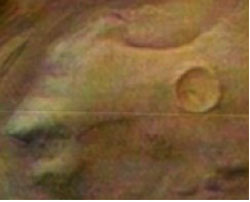
The irregular rims of these craters reveal that they are not the result of impacts by objects from space but rather have resulted from the act of creating the faces themselves. These art objects, which Basiago has named orb craters, are numerous in the ESA image. “Paranormal researchers will recognize in these works of art the faces found inside of orbs in the orbs phenomenon on Earth. Faces like these are sometimes found staring silently out from the orbs that are captured by digital cameras. The ubiquitous nature of these land forms in the vicinity of Ruell Vallis indicates how… the surface of Mars has been terra-formed into works of art that show a child-like simplicity and spontaneity.” One of these orb craters can be seen on the neck of a large terra-form featuring a barking dog lunging toward the channel of the Ruell Vallis. (via EXOPOLITICS: Politics, Government, and Law in the Universe: A “New Cydonia” of ancient extraterrestrial monuments found on Mars)
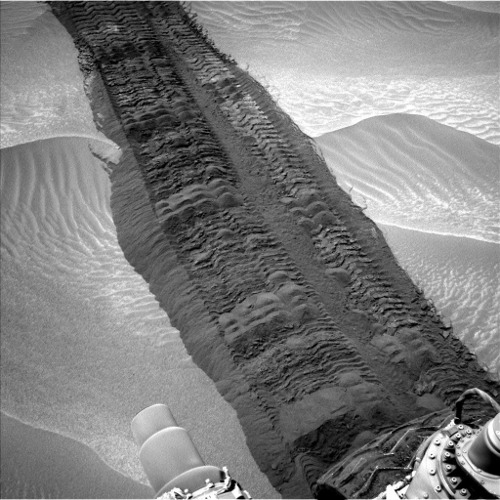
Read moreBest dashboard cam video ever: twelve months of Curiosity roving around Mars condensed into two minutes.
This is your reminder that we are a spacefaring, global civilization in the midst of a paradigm shift, communicating within a juvenile noosphere.

 The Committee to Nuke Elysium