
The Almaz (Russian: Алмаз, “Diamond”) program was a highly secretive Soviet military space station program, began in the early 1960s.
Three crewed military reconnaissance stations were launched between 1971 and 1974: Salyut 2, Salyut 3 and Salyut 5. To cover the military nature of the program the three launched Almaz stations were designated as civilian Salyut space stations. Salyut 2 failed shortly after achieving orbit, but Salyut 3 and Salyut 5 both conducted successful manned testing. Following Salyut 5, the Soviet Ministry of Defence judged in 1978 that the time consumed by station maintenance outweighed the benefits relative to automatic reconnaissance satellites.
The space stations cores were known internally as OPS (Russian: ОПС, GRAU index 11F71 and 11F71B), from “Orbital Piloted Station” (Russian: Орбитальная Пилотируемая Станция).[1]As part of the Almaz program several spacecraft for supportive roles were developed: The VA spacecraft, the Functional Cargo Block and the TKS spacecraft, which were to be used in several combinations.[2][3] The heritage of the Almaz program continues to this day with the ISS module Zarya being one example.
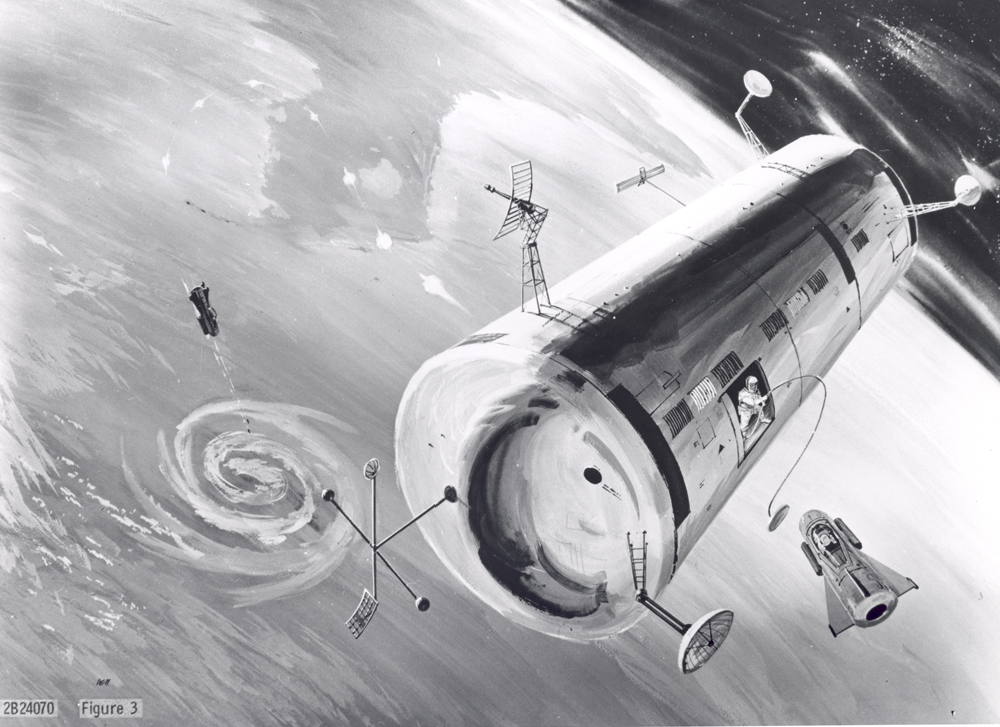
Almaz had been promoted by Vladimir Chelomei at the OKB-52 design bureau as a response to the US Air Force’s Manned Orbiting Laboratory (MOL) project – MOL had been widely published in the early 1960s in the US press, which provided plenty of material for Chelomei to lobby for a Soviet response to this perceived US threat.
The Almaz space station programme consisted of three major parts:
- The Orbital Piloted Station (OPS, 11F71) module that formed the space station itself.[1]
- The Functional Cargo Block (FGB, 11F77), intended as resupply craft for the stations.[2]
- The VA spacecraft (11F74, known in the West as the Merkur spacecraft), which was intended as a launch and return vehicle for the crew. It was intended to either launch the crew in a VA spacecraft together with an Almaz-OPS space station, or together with an FGB resupply craft – the later combination of VA and FGB would form the TKS spacecraft (11F72).[2]
Much like its counterpart MOL/Gemini, the initial Almaz APOS space station design would call for an Almaz-OPS space station to be launched together with its initial three man crew in a VA return capsule, mated together as OPS/VA atop Chelomei’s UR-500 Proton rocket.[3] Once in orbit, and same as MOL/Gemini, the crew would access the lab through a hatch in the heat shield at the bottom of the VA capsule. After an extended stay of 30 to 60 days of military observation and photography the crew would return to Earth by way of a reusable VA return vehicle – the capsule would have been reusable for a total of up to 10 flights.[4][5] The OPS basic design features are 4.15 metres (13.6 ft) in diameter, a weight of roughly 20 tonnes (20 long tons; 22 short tons) and 90 cubic metres (3,200 cu ft) total pressurized volume.
Unlike the American MOL design, the Almaz was designed to be recrewed and resupplied. For this the TKS resupply craft was created, which would be launched with the crew in its VA return craft – the launch vehicle would be again a Proton rocket. At the station, one docking port was available to receive the TKS craft, once the previous crew had left the station with their VA capsule.
While the MOL was canceled in 1969, the Almaz program would be integrated into the Salyut programme and result in three flown space stations, two of which were crewed successfully. As “man-rating” the VA spacecraft and the Proton rocket took longer, the first phase called for the launch of three Almaz stations without the VA spacecraft, with the crew instead launched separately with a Soyuz rocket and a modified Soyuz spacecraft. Plans called for the first three Almaz stations to be visited by 3 two-month-long expeditions each. This was realized fully by two missions and partially with one; however, the initial intention of launching Almaz APOS and the TKS spacecraft together with its crew in VA spacecraft would never materialize during the program, and neither would the TKS craft play a role as the intended resupply craft. The Almaz APOS design – without VA spacecraft – would evolve into the Almaz OPS station cores of the Salyut programme.
In addition to reconnaissance equipment, Almaz was equipped with a unique 23mm Rikhter (factory index 261P or 225P) rapid-fire cannon mounted on the forward belly of the station.[citation needed] This revolver cannon was modified from the tail-gun of the Tu-22 bomber and was capable of a theoretical rate of fire of 1800-2000 (up to 2600) rounds per minute. Each 168 gram (ammo 23-OFZ-D-R ) or 173 gram (ammo 23-OFZ-G-R) projectile flew at a speed of 850 m/s relative to the station. The cannon had supply of 32 rounds and was tested at the end of the mission, when the station was operating in unmanned mode. To aim the cannon, which was on a fixed mounting, the entire station would be turned to face the threat.
Salyut 3/OPS-2 conducted a successful remote test firing with the station unmanned due to concerns over excessive vibration and noise.
OPS-4 was to have featured two rockets instead of the aircraft cannon, but this system has not been shown publicly and may have never been fully manufactured despite it being used experimentally.
Read more
 The Committee to Nuke Elysium