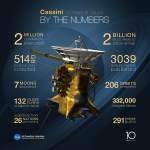
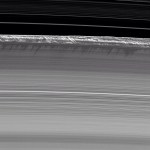

Read moreCassini recently celebrated a decade in orbit around Saturn. We have learned more about the complex ring structure and many moons of the ringed gas giant than ever expected.
Keep up the great work Cassini! Be on the lookout for more detailed information on these photos as well as the individual moons.
-ALT
moons of saturn

Read moreSaturn’s moon Prometheus by the F Ring, photographed by Cassini, 26 December 2009. See also the first few frames of this sequence inverted by AgeOfDestruction.
Read moreDue to global warming, the glacial lake is also rapidly changing, ideal circumstances for a robot being taught to recognize shifts in a fluid environment.
…
The prototype robot has spent the last two years exploring its surroundings, determining the lake’s size and depth, measuring its pH, and observing all meteorological phenomena.
It’s not ready yet: The lander’s instruments are designed for a terrestrial environment, and the current version is far too heavy to be sent into space. But those evolutions will come, said Cabrol.
“Right now we’re at the same place we were 10 or 15 years ago, when we were starting to test Mars rovers in the desert,” she said.
…
Until now, extraplanetary robotic explorers have been micromanaged from Earth.
But communication between Earth and Titan would take hours each direction, so the robot must be built with some decision-making and problem-solving capacity. Also, since rain and other weather phenomena occur on Titan, an exploration robot would need to know when something unusual is happening so it can stop what it’s doing and pay attention.
To do this, the robot will have to become familiar with its “normal” environment, and detect when something abnormal happens. For example, if the robot floats near shore, it will be able to recognize that and begin taking photographs and a series of scientific measurements.
This scientific autonomy is an evolution that is likely to take hold in all future extraplanetary robots, not just those that go to Titan, Cabrol said.
“We’re not only building a robot, but a new generation of robots,” she said. “The new generation will not just be sitting around waiting for us to tell them what to do.”


