For years, astronomers have been scanning nearby asteroids, the moon, Mars, and deeper space for evidence of the building blocks of life.

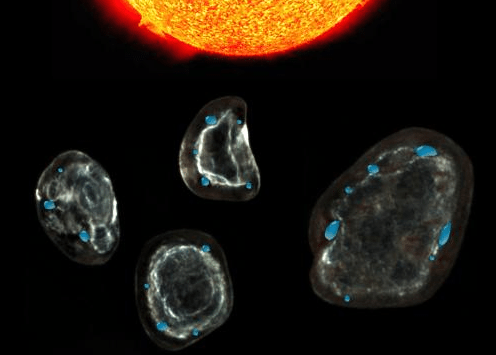
Now, a new study in the Proceedings of the National Academy of Sciences finds that both water and organic material could actually have our planet surrounded, floating around space on ubiquitous interplanetary dust particles that constantly rain down on Earth and the other bodies in our solar system.

“It is a thrilling possibility that this influx of dust has acted as a continuous rainfall of little reaction vessels containing both the water and organics needed for the eventual origin of life on Earth and possibly Mars,” researcher and study co-author Hope Ishii of the Hawaii Institute of Geophysics and Planetology said in a release.

In the case of comets, the icy space rocks import frozen water from beyond the solar system when they come to visit, but the traces of water on interplanetary dust particles are actually a product of the solar wind that blasts them with hydrogen ions, shaking up the atoms of the silicate mineral crystals in the dust particles. This process leaves behind some oxygen to react with hydrogen and create water molecules.

“Perhaps more exciting,” Ishii said, “interplanetary dust, especially dust from primitive asteroids and comets, has long been known to carry organic carbon species that survive entering the Earth’s atmosphere, and we have now demonstrated that it also carries solar-wind-generated water. So we have shown for the first time that water and organics can be delivered together.”

(via Ingredients for life hitching ride on space dust, study says | Crave – CNET)

Read more

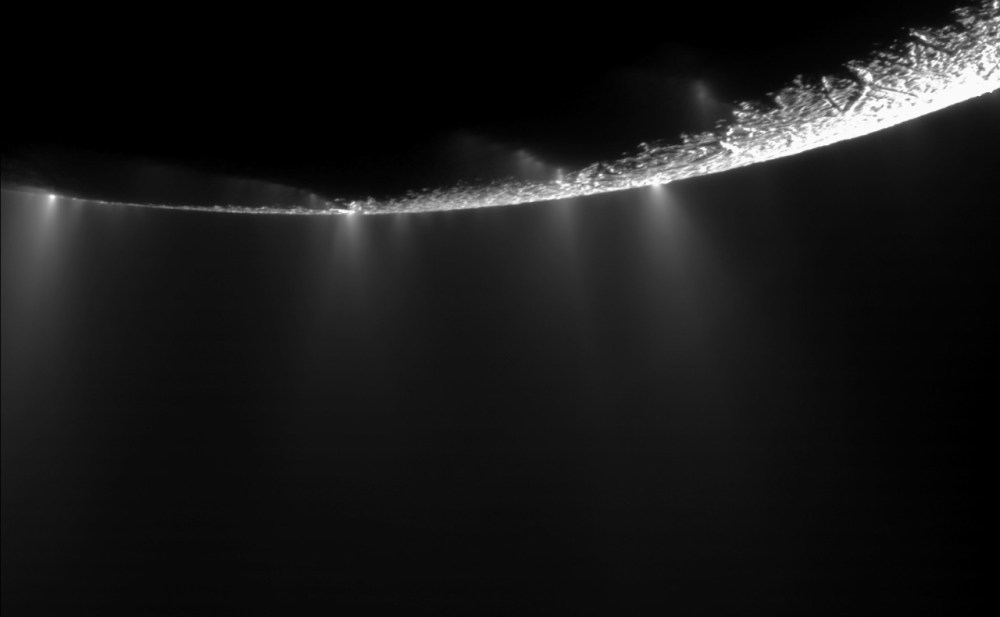
Enceladus seems to have liquid water under its icy surface. Cryovolcanoes at the south pole shoot large jets of water vapor, other volatiles and some solid particles (ice crystal, NaCl etc) into space (total approximately 200 kg per second).[14] Some of this water falls back onto the moon as “snow”, some of it adds to Saturn’s rings, and some of it reaches Saturn. The whole of Saturn’s E Ring is believed to have been made from these ice particles. Because of the apparent water at or near the surface, Enceladus may be one of the best places for humans to look for extraterrestrial life.

Read more

Behold the Superhabitable World

Superhabitability describes a perfect storm of life-friendly factors. In their recent paper, astrobiologists René Heller and John Armstrong describe no fewer than 18 of them. First and foremost, superhabitability arises on terrestrial planets with masses two to three times that of Earth. Planets that size have a number of things working for them, including: Long […]

Read more "Behold the Superhabitable World"

Today, Alexei Sharov at the National Institute on Ageing in Baltimore and his mate Richard Gordon at the Gulf Specimen Marine Laboratory in Florida, have taken a similar to complexity and life.

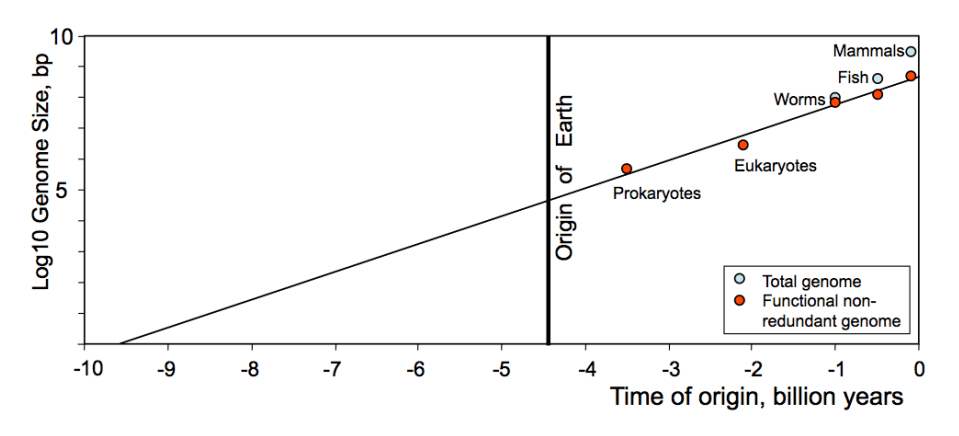
These guys argue that it’s possible to measure the complexity of life and the rate at which it has increased from prokaryotes to eukaryotes to more complex creatures such as worms, fish and finally mammals. That produces a clear exponential increase identical to that behind Moore’s Law although in this case the doubling time is 376 million years rather than two years.

That raises an interesting question. What happens if you extrapolate backwards to the point of no complexity–the origin of life?

Sharov and Gordon say that the evidence by this measure is clear. “Linear regression of genetic complexity (on a log scale) extrapolated back to just one base pair suggests the time of the origin of life = 9.7 ± 2.5 billion years ago,” they say.

And since the Earth is only 4.5 billion years old, that raises a whole series of other questions. Not least of these is how and where did life begin.

Of course, there are many points to debate in this analysis. The nature of evolution is filled with subtleties that most biologists would agree we do not yet fully understand.

For example, is it reasonable to think that the complexity of life has increased at the same rate throughout Earth’s history? Perhaps the early steps in the origin of life created complexity much more quickly than evolution does now, which will allow the timescale to be squeezed into the lifespan of the Earth.

Sharov and Gorden reject this argument saying that it is suspiciously similar to arguments that squeeze the origin of life into the timespan outlined in the biblical Book of Genesis.

Let’s suppose for a minute that these guys are correct and ask about the implications of the idea. They say there is good evidence that bacterial spores can be rejuvenated after many millions of years, perhaps stored in ice.

They also point out that astronomers believe that the Sun formed from the remnants of an earlier star, so it would be no surprise that life from this period might be preserved in the gas, dust and ice clouds that remained. By this way of thinking, life on Earth is a continuation of a process that began many billions of years earlier around our star’s forerunner.

Sharov and Gordon say their interpretation also explains the Fermi paradox, which raises the question that if the universe is filled with intelligent life, why can’t we see evidence of it.

However, if life takes 10 billion years to evolve to the level of complexity associated with humans, then we may be among the first, if not the first, intelligent civilisation in our galaxy. And this is the reason why when we gaze into space, we do not yet see signs of other intelligent species.

Ref: arxiv.org/abs/1304.3381: Life Before Earth

Read more

Could this be the year we make contact with aliens? – Telegraph         

The year also saw growing evidence for a puzzling slowdown in global warming (almost certainly explained by the function of the world’s oceans as a gigantic heat sink), the suggestion that our galaxy may be home to a billion or more “Earths” (making the continuing non-appearance of ET ever more mysterious), and China’s further advance into space, with a successful landing on the Moon of a wheeled robotic rover. India, too, has entered the space premier league with the launch of the Mars Orbiter spacecraft on November 5.

Our machines have so far made successful landings on the Moon, the planets Mars and Venus, and Saturn’s moon Titan. Next November a small robotic probe called Philae will detach from the Rosetta spacecraft (a European mission to explore comet Churyumov-Gerasimenko) and land on its surface.

Comets are deeply mysterious objects. Though often called “dirty snowballs” due to their composition of various ices, including water, they are actually lumps of complex chemistry, including organic compounds. It should be stressed here that “organic” in the chemical sense means “contains carbon” rather than “alive”, but that has not stopped some scientists speculating that comets, and objects like them, may act as cosmic dispersal systems for primordial microbes throughout the universe (a hypothesis called panspermia, which sounds crazy yet which has never been entirely discredited). Philae, some of whose components were built in Britain, may answer the question of whether comets supplied the early Earth with the bulk of its oceanic water. And it will provide some spectacular images.

In April 2013 an instrument aboard the ISS called the Alpha Magnetic Spectrometer (AMS), a particle detector, picked up an anomaly in the cosmic rays it was analysing – an unexpectedly large number of antimatter particles. This is interesting because one mechanism to explain this involves interaction between high-energy cosmic rays and a good candidate for the “dark matter particle”, the neutralino – a heavy, stable critter that in theory has all the properties needed to explain dark matter.

If the AMS confirms in 2014 that it has indeed found dark matter – a large component of the “missing mass” of the Universe (the other being “dark energy”) – that would be a spectacular triumph for the ISS, and a rebuttal of those critics who have dubbed it the ultimate white elephant. It would also probably mean a second Nobel for the instrument’s lead investigator, MIT’s Samuel Ting.

Nasa’s Mars mega-rover, Curiosity, which landed in Gale Crater in August 2012 and has been trundling around since, has made a number of interesting scientific discoveries. These include finding conglomerate rocks that were probably laid down in an ancient river, and recent confirmation that “life-friendly” conditions (ie, warmish weather and liquid water) pertained on this part of the Red Planet’s surface billions of years ago.

But Curiosity has not found microbial life on Mars, nor evidence of past life. Its critics say it was a mistake not to equip it with a life-detector (such as was fitted to the twin Viking landers of 1976) and that Curiosity represents a missed opportunity. Perhaps, but there is a chance that the nuclear-powered machine could detect something interesting in 2014 as it begins its long ascent up the flanks of 18,000ft Mount Sharp, which lies in the middle of the crater. If Mars was ever home to microbial life, or even something bigger, then Curiosity might – just might – be able to spot the fossil evidence in the rocks. And it is possible – just possible – that it could even spot something alive: a very long shot, perhaps, but Mars is a very strange place and may yet surprise us.

The longest shot of all, and there is no reason to believe that it is any more likely to happen in 2014 than the year after or indeed a thousand years hence. But that said, the more we learn about the universe the more, not less, curious it seems that we are apparently alone. When scientists including Enrico Fermi and Frank Drake first started seriously speculating about the possibility of extraterrestrial civilisations more than half a century ago, astronomers knew of only one solar system in the whole of the cosmos – ours. Now we know of more than a thousand, several containing apparently Earthlike planets, a handful of which may lie in their stars’ “habitable zone”, an orbit in which it is neither too hot nor too cold for liquid water to exist.

All this raises the question: where the heck is everybody? Given that we have the technology today (but not as yet the money) to build telescopes big enough to spot signs of life spectroscopically on nearby “Earth analogues”, if intelligent life is as common as some suspect then it is certain that by now the aliens have used their telescopes to detect us. Maybe a signal is overdue. Or maybe someone is on their way. Or, of course, there is simply no one out there. The wonderful thing is that any of these possibilities is equally awe-inspiring.

Could this be the year we make contact with aliens? – Telegraph         

Read more "Could this be the year we make contact with aliens? – Telegraph         "
planetary scientists increasingly suspect that comets (frozen balls of dust and ice) and ice-laden meteorites crashing into the primordial Earth probably provided most of the planet’s water—and perhaps much of the organic material—necessary for life.

Organic molecules have been detected in comets such as the Hale-Bopp, and, in a recent study, researchers simulated those cosmic crash landings by using a gas gun to fire metal projectiles at 16,000 miles per hour into blocks of ice containing some of the same chemicals that make up comets. The shock wave and heat generated by the impact created molecules that formed amino acids, the building blocks of proteins.

Yet the very same objects that gave this planet life could also spell its demise. Astronomers predict that a comet or asteroid large enough to cause global devastation will smash into the Earth about every 100 million years or so.

Fortunately, if such a comet or asteroid were to arrive sooner than expected, we are constructing observational systems to discover and track near-Earth objects, conceivably providing us with sufficient time to pre-empt catastrophe.

Read more

Dinosaur asteroid ‘sent life to Mars’

The early Martian atmosphere appears to have been warm and wet – prime conditions for the development of life.

And if Martian microbes ever did exist, transfer to Earth is “highly probable” due to the heavy traffic of meteorites between our planets, Ms Worth told BBC News.

“Billions have fallen on Earth from Mars since the dawn of our planetary system. It is even possible that life on Earth originated on Mars.”

While her team are not the first to calculate that panspermia is possible, their 10-million-year simulation is the most extended yet, said astrobiologist Prof Jay Melosh, of Purdue University.

“The study strongly reinforces the conclusion that, once large impacts eject material from the surface of a planet such as the Earth or Mars, the ejected debris easily finds its way from one planet to another,” he told BBC News.

“The Chicxulub impact itself might not have been a good candidate because it occurred in the ocean (50 to 500m deep water) and, while it might have ejected a few sea-surface creatures, like ammonites, into space, it would not likely have ejected solid rocks.

"I sometimes joke that we might find ammonite shells on the Moon from that event.

"But other large impacts on the Earth may indeed have ejected rocks into interplanetary space.”

Another independent expert on panspermia, Mauricio Reyes-Ruiz of the National Autonomous University of Mexico, said the new findings were “very significant”.

“The fact such different pathways exist for the interchange of material between Earth and bodies in the Solar System suggests that if life is ever found, it may very well turn out to be our very, very distant relatives,” he said.

Dinosaur asteroid ‘sent life to Mars’

Read more "Dinosaur asteroid ‘sent life to Mars’"