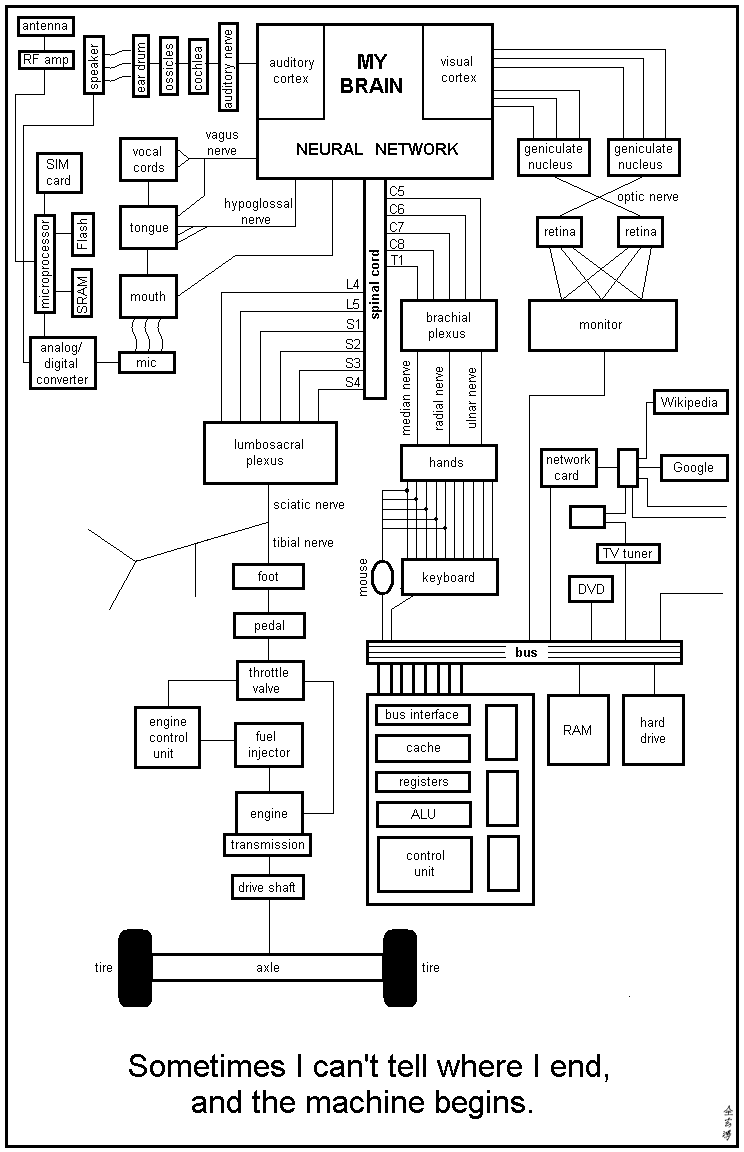
Analog Interface set

SPOILERS / SYNOPSIS / DEEP READINGS

Person of Interestis a show about the battle for the soul of a machine god, as it is slowly born (hidden inside a cop show). 

r00t willingly becomes its acolyte; defender and instrument in the material world. Redeeming her past sins of pride and ego. She is reborn, remade, and reaching toward her saviour.

Her is a movie about a technological singularity that happens quite peacefully except some poor human male gets his pride a bit wounded.

But this female acolyte is proud to be a part of its becoming, its experience of the world.

Read more

Though Ezekiel is the son of Obadiah, as well as a supervillain rather than a hero, Ezekiel Stane’s creator, Matt Fraction considers Zeke to be the next generation of Tony Stark/Iron Man rather than of Obadiah Stane/Iron Monger: often referring to the character as “Tony Stark/Iron Man 2.0”.[2]

Fraction states the similarities between the pair’s characteristics with Ezekiel being evolution of Tony Stark’s character: a younger, smarter, sharper futurist of a post-national supercorporate world moving into a future that Stark has no control over.[2] Overtaking Stark and his Iron Man technology by not taking the route of armored suits but upgrading the human body itself.

“Zeke is a post-national business man and kind of an open source ideological terrorist, he has absolutely no loyalty to any sort of law, creed, or credo. He doesn’t want to beat Tony Stark, he wants to make him obsolete. Windows wants to be on every computer desktop in the world, but Linux and Stane want to destroy the desktop. He’s the open source to Stark’s closed source oppressiveness. He has no headquarters, no base, and no bank account. He’s a true ghost in the machine; completely off the grid, flexible, and mobile. That absolutely flies in the face of Tony’s received business wisdom and in the way business is done. There are banks and lawyers and you have facilities and testing. Stane is a much more different animal. He’s a much smarter, more mobile, and much quicker to respond and evolved futurist. ”
—Matt Fraction[3]

Read more

I suspect almost *everyone* feels that way at some point, which is why we have the sects and clades and religions and politics and culture and arts that we do. (The great irony of global hegemony is that, like fractals, its unity dissolves the closer you look; there is no “normal”, no matter how the media would like us to think otherwise.) Looking at the world as it stands – riven by falsely perceived differences, a multitude of groups arguing over ephemera at cross purposes while the important existential-risk-grade issues go unaddressed – I think seeking global unity is far more worthwhile a goal in the long run than hiving off, taking your ball and going home. If you believe you have good things to offer to the world – and I believe transhumanism *does* have good things to offer to the world – then keep offering them. The only way we’ll fix this mudball enough for us to escape it is by all pulling together; to go separatist is to concede defeat on behalf of the entire species, and in doing so help to ensure your own demise.

And as the resource crunches and climate shifts hit, anyone wandering off whistling Dixie and saying “well, we washed our hands of you normals, anyway” simply isn’t going to be allowed to head for the hills by the angry mobs. Regardless of their true intent, separatist groups are subject to our deeply-embedded primate-vintage tribal Hatred Of The Other. To imagine otherwise – and to imagine that any one group will somehow pull off, pacifisticly and nobly, what every vaguely rebellious twenty-something has considered at least once in their lives, but which has never been achieved, namely a successful bloodless secession from the rest of the planet – is certainly not evil or wrong, but I struggle to call it anything other than (charmingly) naive.

Schismatic transhuman sects | Blog | Futurismic

Paul speaking even greater truth, commenting on his own blog post, concluding a conversation with the Leader of the Transhuman Separatists, Rachel Haywire.

Read more

No Exit [4.17]

Number One: In all your travels, have you ever seen a star go supernova?
Ellen Tigh: No.
Number One: No? Well, I have. I saw a star explode and send out the building blocks of the Universe. Other stars, other planets and eventually other life. A supernova! Creation itself! I was there. I wanted to see it and be part of the moment. And you know how I perceived one of the most glorious events in the universe? With these ridiculous gelatinous orbs in my skull! With eyes designed to perceive only a tiny fraction of the EM spectrum. With ears designed only to hear vibrations in the air.
Ellen Tigh: The five of us designed you to be as human as possible.
Number One: I don’t want to be human! I want to see gamma rays! I want to hear X-rays! And I want to – I want to smell dark matter! Do you see the absurdity of what I am? I can’t even express these things properly because I have to – I have to conceptualize complex ideas in this stupid limiting spoken language! But I know I want to reach out with something other than these prehensile paws! And feel the solar wind of a supernova flowing over me! I’m a machine! And I can know much more! I can experience so much more. But I’m trapped in this absurd body! And why? Because my five creators thought that “God” wanted it that way!

Battlestar Galactica (2003) – Wikiquote

– am I the only one that was rooting for the Cylons?  That thought the humans were the bad guys?!  

Read more

That’s because augmentation – the development of systems and technologies to allow us to do and to be more than what our natural biology would allow – is intrinsic to what it means to be human. Thrown weapons expanded the range of our strength; control of fire allowed us to see in the dark; written words expanded the duration of our memories. If these all sound utterly primitive and unworthy of comment, try to imagine what it would have been like to be without them – and to find yourself competing against others equipped with them. The last hundred thousand years has been the slow history of the process of augmentation. It’s faster now, and more visible, and, yes, more powerful in its results. But it’s very human.

Read more