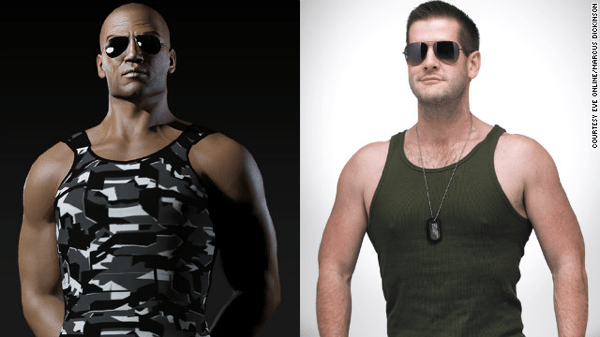
Marcus Dickinson, 40, was very overweight and unhealthy when he created his EVE Online character Roc Wieler, the tough guy seen above left. Eventually, Dickinson became so inspired by Roc that he hit the gym to be more like him. Above right is Dickinson now. “I’m a role player inherently,” Dickinson says. “I take it seriously.” Virtual reality: Avatar inspires gamer to hit the gym (CNN) (via Man cultivates healthy lifestyle to be more like his avatar – Boing Boing)

Read more

Trying to find yourself is a staple of the self-help literature, along with the striving for authenticity and building up your self-esteem. I probably wrote about authenticity and how you needed to practice it in my book** because way back in 2007, I thought it was a good thing, a necessary thing.

Now I’m convinced that’s all wrong. The self that matters isn’t some tightly defined, self-loving, individuated thing in the world. The self that matters is the mashed-up self, the networked self — the self made up of relationships and experiences and interactions and ideas. It’s way bigger and more powerful than the un-networked you.

These are some ideas I want to explore: combinatorial creativity, connectivist learning, the third person perspective in the creative process, and self-transcendence. What all these have in common is they all overturn the idea that the individuated self is primary…

…So we need to stop thinking so much about our individual selves — we need to transcend ourselves. Interesting that some of the most satisfied people combine a love of the new with persistence and self-transcendence. These seem like exactly the traits you’d need to succeed in a networked world. Neophilia (novelty-seeking, love of the new) draws you to new ideas, new people, and new experiences, giving you more material for the mashup that is you and the mashups you create. Persistence keeps you from being merely a dilettante, flitting from one new thing to another. And self-transcendence stops you from thinking that it’s all about you.

Read more

many of the characters in the second volume of Phonogram spend a lot of time worrying about who they are. They’d be doing this even without the magic stuff, of course– because they’re 19- and 20-year-olds stress-testing the identities they’ve been building. But there’s an enjoyably literal element to it in Phonogram– the kids are choosing or being given their magical names: Laura Heaven, The Marquis, Mr. Logos. Which could as easily be fanzine names, and are only a step or two away from the ones pop stars give themselves.

The pop identity– the glamorous, codename-ready mirror-self you summon by making music or loving it– is an idea with deep roots and great power. In Britain it arrived when a teen-market entrepreneur Larry Parnes turned boys into stars by giving them totemic stage names– Vince Eager, Billy Fury, Lance Fortune. It came back in the glam era, more clumsily, and then was part of what punk borrowed from rock’n’roll. By the 1980s and 90s these identities had left the stage and entered fan culture, with zine writers cut-and-pasting new selves in a storm of glue and typewriter ribbons.

Read more

The psychotic outlaw-addict and the man in the gray flannel suit. Both hell bent on that great American pastime: reinvention. But the artistry of the addict betrays the poetry in his soul. And the Marlboro Man has a cancer at his core.  Neither Burroughs/Lee nor Don Draper can escape the one thing they’re trying to outrun: themselves. As William Faulkner put it,“the past isn’t dead, it’s not even past.” Or to quote Dr. Buckaroo Banzai, “No matter where you go, there you are.” (via Don Draper Eats A Naked Lunch)

Read more

seej500:

Brit Awards 2010.

This year the show was completely and deservedly dominated by Teh GaGa.  Do watch that whole performance, please.  You need to see the sampler/guitar/keyboard thing in the second half.  And watch it quick, since I suspect the video will probably get taken down again soon when TV people start shrieking and flapping about copyright.

<snip>

OK, so back to GaGa.  Last year she performed with The Pet Shop Boys, and most people only had a vague notion who she was.  This year she’s one of the biggest popstars on the planet, with a reputation for wildly eccentric and ruthlessly inventive work.  Personally, I want my popstars to be larger than life.  I want them to really fucking live their persona; to really commit to their ideal.  GaGa does that better than anyone else.  She understands that her performance lasts longer than the time that her record’s playing, and she understands that we want to deify our stars, not know that they’re just like us.

And she’s utterly bloody talented.  Prior to the death of Alexander McQueen, her performance was supposed to be something involving a Rolls-Royce on stage.  Clearly, at the eleventh hour, when faced with a need to give tribute to her friend, she dramatically revised her plans, came up with a new arrangement and modified lyric for one of her songs, and put together a new performance.  Most acts would struggle to do something like that, but she’s flicked from one tower of brilliance and lunacy to another and made it look easy.  She won all three awards she was nominated for and, really, was there ever any doubt?

 Seej500 speaks the truth

Read more
One way that today’s media “personalities” differ from nineteenth-century fictional characters, or from twentieth-century selves with interiority, is that media personalities today function so directly as personifications, or embodiments, of impersonal, impalpable, and unrepresentable forces. Indeed, this is not anything really new. It is what Marx already said about capitalists in his own time: that they were not real individuals, but personifications of capital.

Read more