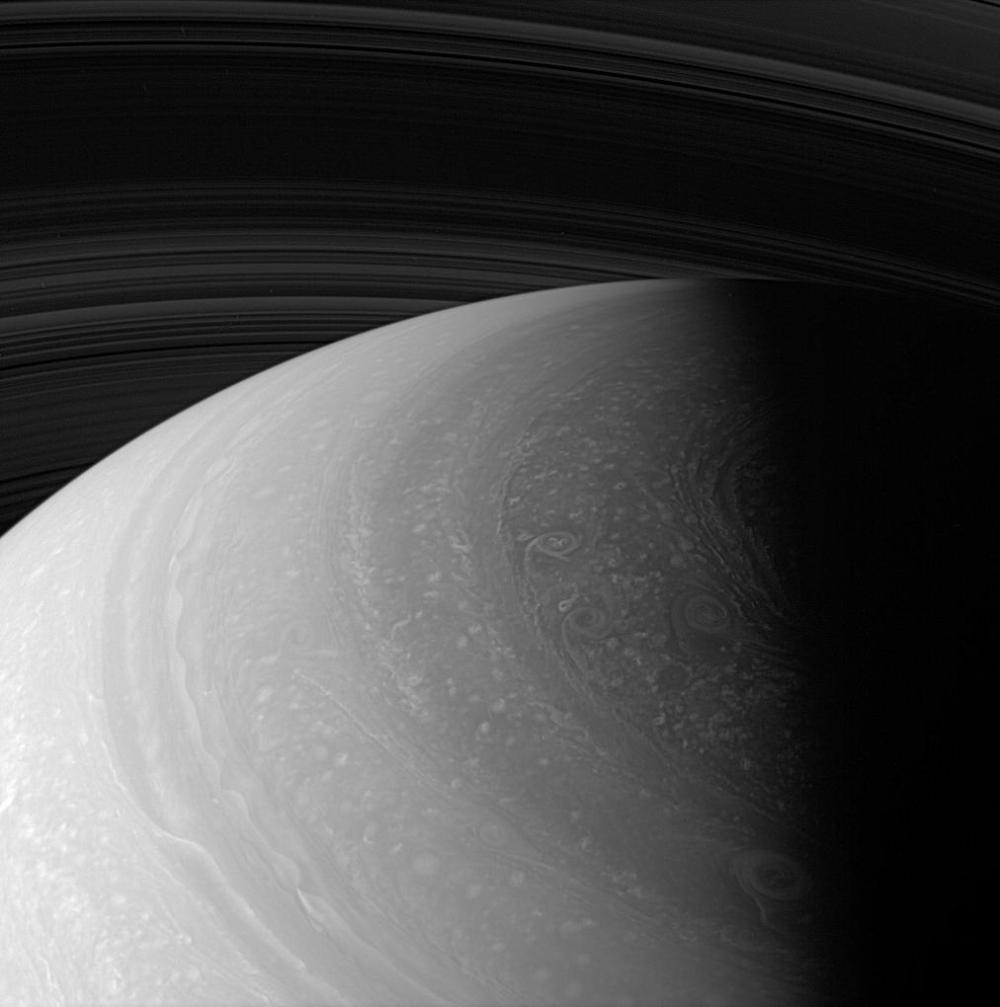
This scene reveals many features in Saturn’s dynamic and beautiful atmosphere, including a detail largely obscured from the imaging cameras until now. On the terminator at center right is part of the polar hexagon, which was previously observed by Cassini’s Visible and Infrared Mapping Spectrometer (VIMS) and Composite Infrared Spectrometer (CIRS). These instruments used heat radiated from Saturn to observe the polar hexagon (rather than reflected sunlight, as is the case in this view). The hexagon was first imaged by the Voyager spacecraft more than 25 years ago.

Read more

Simulated views from the Cassini spacecraft in orbit around Saturn in 2014—along with the real images its cameras captured at the very moments shown in the simulations

Read more

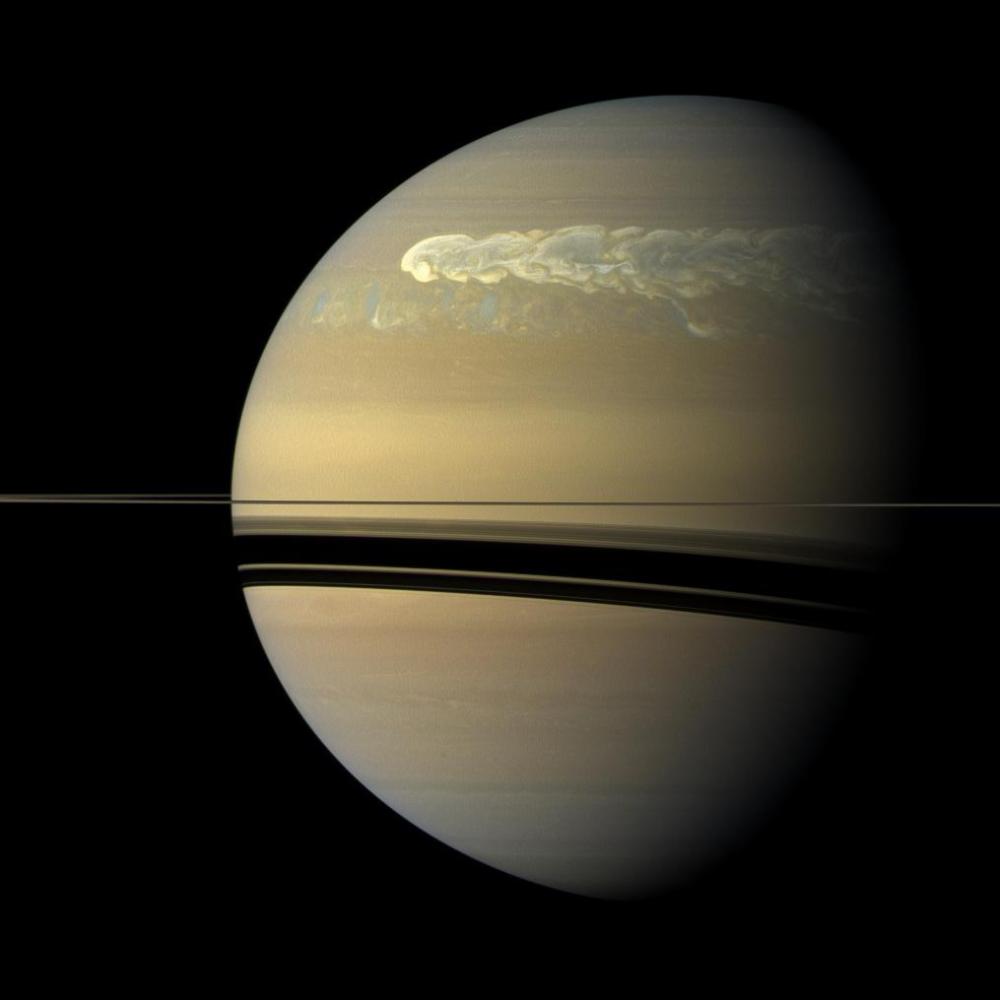
The huge storm churning through the atmosphere in Saturn’s northern hemisphere overtakes itself as it encircles the planet in this true-color view from NASA’s Cassini spacecraft.

This picture, captured on Feb. 25, 2011, was taken about 12 weeks after the storm began, and the clouds by this time had formed a tail that wrapped around the planet. Some of the clouds moved south and got caught up in a current that flows to the east (to the right) relative to the storm head. This tail, which appears as slightly blue clouds south and west (left) of the storm head, can be seen encountering the storm head in this view.

This storm is the largest, most intense storm observed on Saturn by NASA’s Voyager or Cassini spacecraft. It is still active today. As scientists have tracked this storm over several months, they have found it covers 500 times the area of the largest of the southern hemisphere storms observed earlier in the Cassini mission (see PIA06197). The shadow cast by Saturn’s rings has a strong seasonal effect, and it is possible that the switch to powerful storms now being located in the northern hemisphere is related to the change of seasons after the planet’s August 2009 equinox.

Read more
Dance of Saturn’s Auroras.

ultraviolet and infrared images of the auroras of Saturn recorded by Cassini and Hubble.

Read more

For the uninitiated, Saturn’s uncannily symmetric cloud system measures roughly 20,000-miles across, and is utterly unique in our solar system. Its dimensions and dynamics are just bizarre. At the hexagon’s center whirls a tightly wound hurricane roughly fifty-times larger than the average hurricane-eye on Earth. About it spins an assortment of smaller vortices, caught up in the hexagon’s jet stream, that rotate clockwise, even as the central hurricane, and the outer hexagon, rotate in the opposite direction. These smaller storms are visible in the image above as reddish ovals. The largest of the smaller vortices, appearing white in the lower right corner of the hexagon, spans about 2,200 miles – roughly twice the size of Earth’s largest hurricanes. (via New Hi-Res Footage Shows Saturn’s Mysterious Hexagon Like Never Before)

Read more