orbitdecay:

The expanding debris cloud from the explosion of a massive star is captured in this multiwavelength composite, combining x-ray and optical images from the Chandra and Hubble telescopes. Identified as E0102-72, the supernova remnant lies about 190,000 light-years away in our neighboring galaxy, the Small Magellanic Cloud. A strong cosmic source of x-rays, E0102 was imaged by the Chandra X-ray Observatory shortly after its launch in 1999. In celebration of Chandra’s 10th anniversary, this colorful view of E0102 and its environs was created, including additional Chandra data. An analysis of all the data indicates that the overall shape of E0102 is most likely a cylinder that is viewed end-on rather than a spherical bubble. The intriguing result implies that the massive star’s explosion has produced a shape similar to what is seen in some planetary nebulae associated with lower mass stars. At the distance of the Small Magellanic Cloud, this field of view spans about 150 light-years.

Read more

orbitdecay:

In the Martian winter, carbon dioxide freezes out of the air (and you thought it was cold where you are). In the summer, that CO2 sublimates; that is, turns directly from a solid to a gas. When that happens the sand gets disturbed, and falls down the slopes in little channels, which spreads out when it hits the bottom. But this disturbs the red dust, too, which flows with the sand. When it’s all done, you get those feathery tendrils. Note that at the tendril tips, you see blotches of red; that’s probably from the lighter dust billowing a bit before settling down.

Now, you might think I’m making this all up. How do we know this stuff is flowing downhill like that? Ah, because in this picture we’ve caught it in the act! In this image, a closeup of a region just to the left of center of the big image, you can actually see the cloud of dust from an avalanche as it occurs.

Oh, baby. The cloud is only a few dozen meters across, and can’t be more than a few seconds old.

Read more

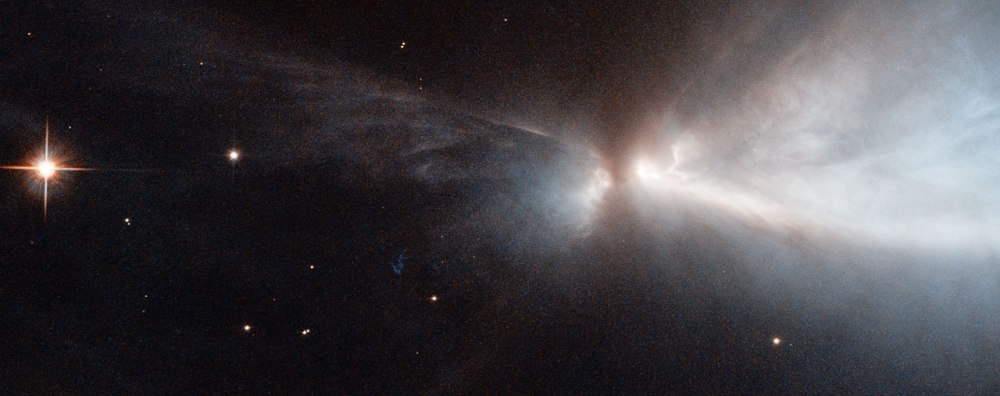
This striking new image, captured by the NASA/ESA Hubble Space Telescope, reveals a star in the process of forming within the Chamaeleon cloud. This young star is throwing off narrow streams of gas from its poles — creating this ethereal object known as HH 909A. These speedy outflows collide with the slower surrounding gas, lighting up the region.

The Chameleon cloud is located in the southern constellation of Chameleon, just over 500 light-years from Earth. Astronomers have found numerous Herbig-Haro objects embedded in this stellar nursery, most of them emanating from stars with masses similar to that of the Sun. A few are thought to be tied to less massive objects such as brown dwarfs, which are “failed” stars that did not hit the critical mass to spark reactions in their centres.

Read more

Clarkean Magix

Magic from Technology “Any sufficiently advanced technology is indistinguishable from magic.” — Arthur C. Clarke’s Third Law The science-fiction equivalent of magic. Magic does not derive from an actual mystical or spiritual source; rather, it is technology in disguise. The characters using this magic may or may not be aware of its true origins.

Read more "Clarkean Magix"