Space Communications Networks: Past, Present & Fictional

An antenna built for interplanetary connection. The Soviet Union was planning to build bases on other planets, and prepared facilities for connection which were never used and now lie dormant.

From – Wreckage in the snow: Russia’s forgotten future

Meanwhile, in Cloud Atlas:

vlcsnap-2013-12-23-22h10m43s126

And in reality – a snapshot of our current Earth-Space Comms Network:

Read more "Space Communications Networks: Past, Present & Fictional"

The first dog space crews were formed of stray mongrels: tough yet grateful, they knew what the struggle for survival was all about, and were quick to make friends with people.

The dogs were tested and trained at the Research Institute of Aviation Medicine in a red-brick building of the abandoned former Mauritania hotel just behind Dynamo Stadium north of central Moscow. Small animals weighing 6-7 kilos (13-15 lbs) were selected were selected for the first missions, because spaceships could not carry heavy payloads.

The first eligible passengers, aged two to six, had exemplary health and immunity to diseases and harsh environments, and had benign and patient dispositions. Females were preferred because their hygienic suits were easier to make.

Potential publicity mattered no less than scientific expediency, and so healthy, light-colored dogs, with clever looking faces were selected so that they would look good when televised or photographed for cover stories.

The training for short rocket flights and longer satellite expeditions started with the space suits. The dogs got accustomed to the protective and hygienic suits. Then, they learned to eat from an automated feeding system that used a conveyor belt to deliver food boxes on a schedule. The most difficult part was training the dogs to get used to confinement for up to three weeks, which was done using isolated cubicles.

The dogs also had to exercise, use the centrifuge, and be trained for the pod ejection process. The training finished with comprehensive tests, during which the dogs stayed in a sealed capsule for many days and were exposed to simulated adversities they could encounter during a space flight.

The first dog crew was launched at the Kapustin Yar space center on July 22, 1951. All told, there were 29 flights with dogs to the stratosphere at a height of 100-150 km (60-90 miles) between July 1951 and September 1962. Eight of them ended tragically due to hull breaches, parachute failures or life-support system failures.

The first returnable space vehicle with a comprehensive life-support system was built early in 1960, but the first flight ended in a crash.

The second, triumphant launch was made at the Baikonur space center at 3:44 pm on August 19, 1960, to study the space ray effect on animals and test air, food and water supply and waste disposal systems. The satellite weighed 4,600 kilos (more than 10,000 lbs), not including the carrier rocket, and consisted of a tight landing section and equipment bay.

Compressed gas containers for trajectory adjustment, jet engines, gauges, aerials, temperature regulators and solar batteries that turned toward the Sun automatically were all attached to the outside.

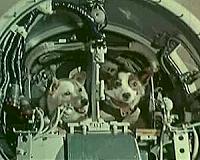
The two canine passengers – Belka and Strelka (whose names meant “Squirrel” and “Arrow”) – wore their own space suits, one red and the other green. There were a dozen caged mice, insects, plants, fungi, microbe cultures, corn, wheat grains, peas and onions with them in the ejection pod, whose instruments recorded their physical state throughout the flight. More animals – 28 mice and two rats – were traveling in the landing section outside the capsule.

The equipment bay was doomed to burn in the dense atmosphere during reentry, while the ejection pod and landing section had separate parachutes to reduce the speed to 6-8 and 10 meters/second (20-26 and 33 feet/second), respectively.

The landing section had heat-resistant windows and tight rapid-opening hatches. The pod was ejected through a hatch at a height of about 7-8 km (4-5 miles) above the ground, as triggered by the barometer gauges.

The landing section returned to the appointed spot on August 20, 1960. All the animals were safe and sound. The world’s first cosmonauts spent 25 hours in space, circling the Earth 17 times and bringing home valuable information on the impact of space flight on animal physiology, genes and cells.

The dogs became big stars. They faced a press conference the day after landing, and appeared on television a few days later. Footage of their somersaults in weightlessness was also shown – Strelka rigid in apprehension, and Belka rolling and tossing with joyful barks.

Read more

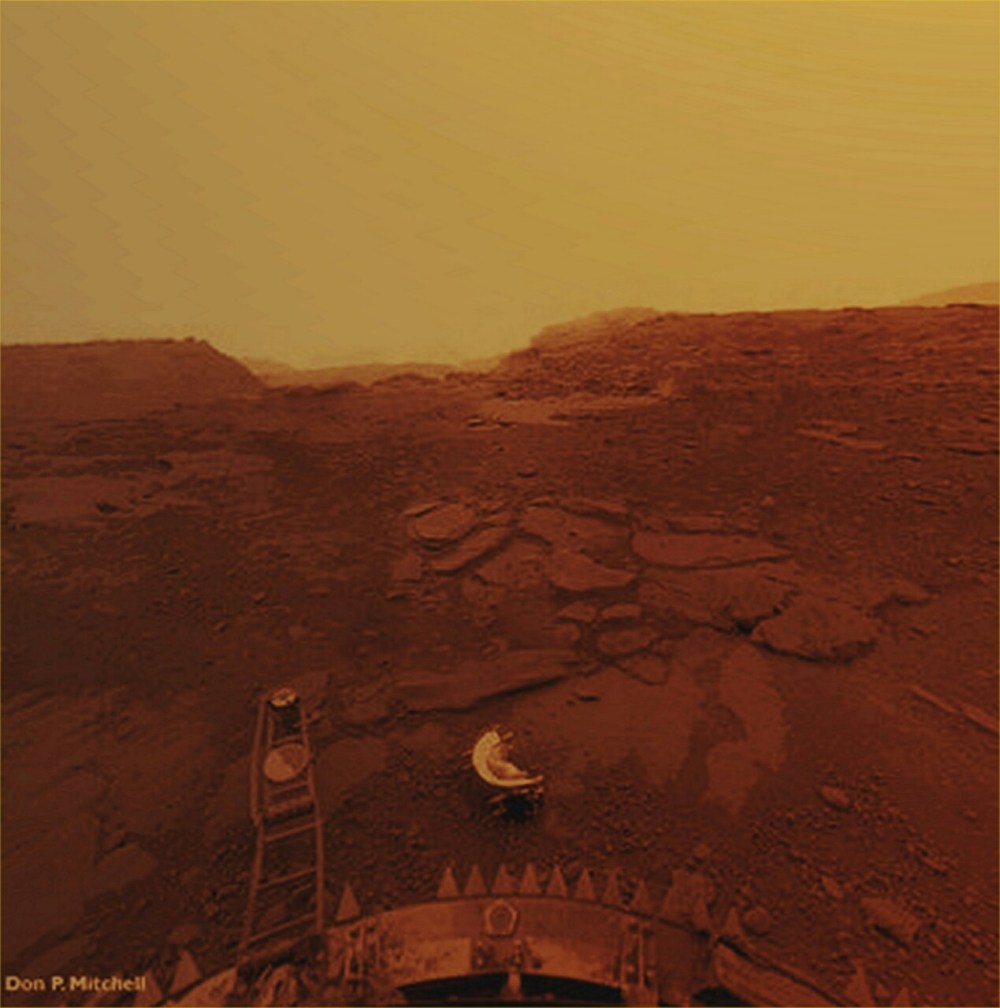
Venusian Surface and Sky, from Venera 13 (1982)

Credits: Soviet Space Agency – Credits for the additional process. and color.: Dr Don P. Mitchell and Dr Paolo C. Fienga/Lunar Explorer Italia/IPF

Read more

Venera 13, a Soviet spacecraft, was the first lander to transmit color images from the surface of Venus. Although other landers arrived before and after it, pictures from Venera 13 tend to be more widely circulated because they are in color.

The spacecraft was designed to last about half an hour on Venus’ harsh surface, but sent back data for more than two hours after its landing March 1, 1982.

Since no lander has ventured on to Venus since the 1980s, the Venera program’s images of the surface stand as the best close-up record of the planet today.

Read more

The Almaz (RussianАлмаз, “Diamond”) program was a highly secretive Soviet military space station program, began in the early 1960s.

Three crewed military reconnaissance stations were launched between 1971 and 1974: Salyut 2Salyut 3 and Salyut 5. To cover the military nature of the program the three launched Almaz stations were designated as civilian Salyut space stations. Salyut 2 failed shortly after achieving orbit, but Salyut 3 and Salyut 5 both conducted successful manned testing. Following Salyut 5, the Soviet Ministry of Defence judged in 1978 that the time consumed by station maintenance outweighed the benefits relative to automatic reconnaissance satellites.

The space stations cores were known internally as OPS (RussianОПСGRAU index 11F71 and 11F71B), from “Orbital Piloted Station” (RussianОрбитальная Пилотируемая Станция).[1]As part of the Almaz program several spacecraft for supportive roles were developed: The VA spacecraft, the Functional Cargo Block and the TKS spacecraft, which were to be used in several combinations.[2][3] The heritage of the Almaz program continues to this day with the ISS module Zarya being one example.

Almaz had been promoted by Vladimir Chelomei at the OKB-52 design bureau as a response to the US Air Force’s Manned Orbiting Laboratory (MOL) project – MOL had been widely published in the early 1960s in the US press, which provided plenty of material for Chelomei to lobby for a Soviet response to this perceived US threat.

The Almaz space station programme consisted of three major parts:

  • The Orbital Piloted Station (OPS, 11F71) module that formed the space station itself.[1]
  • The Functional Cargo Block (FGB, 11F77), intended as resupply craft for the stations.[2]
  • The VA spacecraft (11F74, known in the West as the Merkur spacecraft), which was intended as a launch and return vehicle for the crew. It was intended to either launch the crew in a VA spacecraft together with an Almaz-OPS space station, or together with an FGB resupply craft – the later combination of VA and FGB would form the TKS spacecraft (11F72).[2]

Much like its counterpart MOL/Gemini, the initial Almaz APOS space station design would call for an Almaz-OPS space station to be launched together with its initial three man crew in a VA return capsule, mated together as OPS/VA atop Chelomei’s UR-500 Proton rocket.[3] Once in orbit, and same as MOL/Gemini, the crew would access the lab through a hatch in the heat shield at the bottom of the VA capsule. After an extended stay of 30 to 60 days of military observation and photography the crew would return to Earth by way of a reusable VA return vehicle – the capsule would have been reusable for a total of up to 10 flights.[4][5] The OPS basic design features are 4.15 metres (13.6 ft) in diameter, a weight of roughly 20 tonnes (20 long tons; 22 short tons) and 90 cubic metres (3,200 cu ft) total pressurized volume.

Unlike the American MOL design, the Almaz was designed to be recrewed and resupplied. For this the TKS resupply craft was created, which would be launched with the crew in its VA return craft – the launch vehicle would be again a Proton rocket. At the station, one docking port was available to receive the TKS craft, once the previous crew had left the station with their VA capsule.

While the MOL was canceled in 1969, the Almaz program would be integrated into the Salyut programme and result in three flown space stations, two of which were crewed successfully. As “man-rating” the VA spacecraft and the Proton rocket took longer, the first phase called for the launch of three Almaz stations without the VA spacecraft, with the crew instead launched separately with a Soyuz rocket and a modified Soyuz spacecraft. Plans called for the first three Almaz stations to be visited by 3 two-month-long expeditions each. This was realized fully by two missions and partially with one; however, the initial intention of launching Almaz APOS and the TKS spacecraft together with its crew in VA spacecraft would never materialize during the program, and neither would the TKS craft play a role as the intended resupply craft. The Almaz APOS design – without VA spacecraft – would evolve into the Almaz OPS station cores of the Salyut programme.

In addition to reconnaissance equipment, Almaz was equipped with a unique 23mm Rikhter (factory index 261P or 225P) rapid-fire cannon mounted on the forward belly of the station.[citation needed] This revolver cannon was modified from the tail-gun of the Tu-22 bomber and was capable of a theoretical rate of fire of 1800-2000 (up to 2600) rounds per minute. Each 168 gram (ammo 23-OFZ-D-R ) or 173 gram (ammo 23-OFZ-G-R) projectile flew at a speed of 850 m/s relative to the station. The cannon had supply of 32 rounds and was tested at the end of the mission, when the station was operating in unmanned mode. To aim the cannon, which was on a fixed mounting, the entire station would be turned to face the threat.

Salyut 3/OPS-2 conducted a successful remote test firing with the station unmanned due to concerns over excessive vibration and noise.

OPS-4 was to have featured two rockets instead of the aircraft cannon, but this system has not been shown publicly and may have never been fully manufactured despite it being used experimentally.

Read more