Russian astronomers spot second planet in Alpha Centauri system   

It is located outside the so-called habitable zone, or the orbital region around a star in which an Earth-like planet can possess liquid water on its surface and possibly support life.

“We believe that this planet may be located at a distance of 80 astronomical units /a unit of length, roughly the distance from the Earth to the Sun, which is 150 million kilometers/ and is orbiting around the centre of the binary star system Alpha Centauri AB with an orbital period of about 100 years,” Ivan Shevchenko, the head of the laboratory of planets and small bodies dynamics at the Pulkovo Observatory, told ITAR-TASS.

Russian astronomers spot second planet in Alpha Centauri system   

Read more "Russian astronomers spot second planet in Alpha Centauri system   "

Water clouds tentatively detected just 7 light-years from Earth

“It’s tentative,” he says, but “it’s the first evidence for water clouds” outside our solar system. Even within the solar system, observers can see water clouds on only Earth and Mars; the giant planets are so cold that ammonia ice clouds cover the water clouds on Jupiter and Saturn while the atmospheres of Uranus and Neptune block the view there.

Observers have previously discerned water vapor in the atmospheres of extrasolar planets, but Fortney says water clouds are a new phenomenon. “One of the things we don’t really know is how common partly cloudiness is,” he says. Venus, whose clouds consist of sulfuric acid, is totally cloudy, whereas Earth is partly cloudy. Faherty says the brown dwarf is also partly cloudy: About half is obscured by clouds.

Verifying the discovery will require spectra. Because the object is so dim, this will likely await the James Webb Space Telescope, which will be launched later this decade.

Water clouds tentatively detected just 7 light-years from Earth

Read more "Water clouds tentatively detected just 7 light-years from Earth"

So why don’t we see advanced civilizations swarming across the Universe? One problem may be climate change. It is not that advanced civilizations always destroy themselves by over-heating their biospheres (although that is a possibility). Instead, because stars become brighter as they age, most planets with an initially life-friendly climate will become uninhabitably hot long before intelligent life emerges.

The Earth has had four billion years of good weather despite our Sun burning a lot more fuel than when Earth was formed. We can estimate the amount of warming this should have produced thanks to the scientific effort to predict the consequences of man-made greenhouse-gas emissions.

These models predict that our planet should warm by a few degrees centigrade for each percentage increase in heating at Earth’s surface. This is roughly the increased heating produced by carbon dioxide at the levels expected for the end of the 21st century. (Incidentally, that is where the IPCC prediction of global warming of around three degrees Celsius comes from.)

Over the past half-billion years, a time period for which we have reasonable records of Earth’s climate, the Sun’s surface temperature increased by four percent, and terrestrial temperatures should have risen by roughly 10 degrees Celsius. But the geological record shows that, if anything, on average temperatures fell.

Simple extrapolations show that over the whole history of life, temperatures should have risen by almost 100 degrees Celsius. If that were true, early life must have emerged upon a completely frozen planet. Yet, the young Earth had liquid water on its surface. So what’s going on?

The answer is that it’s not only the Sun that has changed. The Earth also evolved, with the appearance of land plants around 400 million years ago changing atmospheric composition and the amount of heat Earth reflects back into space. There has also been geological change with the continental area steadily growing through time as volcanic activity added to the land-mass. This too had an effect on the atmosphere and Earth’s reflectivity.

Remarkably, biological and geological evolution have generally produced cooling, and this has compensated for the warming effect of our aging Sun. There have been times when compensation was too slow or too fast, and the Earth warmed or cooled, but not once since life first emerged has liquid water completely disappeared from the surface.

Our planet has therefore miraculously moderated climate change for four billion years. This observation led to the development of the Gaia hypothesis that a complex biosphere automatically regulates the environment in its own interests. However, Gaia lacks a credible mechanism and has probably confused cause and effect: a reasonably stable environment is a precondition for a complex biosphere, not the other way around.

Other inhabited planets in the Universe must also have found ways to prevent global warming. Watery worlds suitable for life will have climates that, like the Earth, are highly sensitive to changing circumstances. The repeated canceling of star-induced warming by “geobiological” cooling, required to keep such planets habitable, will have needed many coincidences, and the vast majority of such planets will have run out of luck long before sentient beings evolved.

http://arstechnica.com/science/2014/06/why-havent-we-encountered-aliens-yet-the-answer-could-be-climate-change/ (via fuckyeahdarkextropian)

A solar system full of dead worlds and moons.

Dried up sea beds of underground oceans rich in the fossils of life that lasted just a while. And the ones that made it in their own unique way.

Let’s go see.

Read more

“TrES-2b is considerably less reflective than black acrylic paint, so it’s truly an alien world,” said astronomer David Kipping of the Harvard-Smithsonian Center for Astrophysics (CfA), lead author on the paper reporting the research.

TrES-2b orbits its star at a distance of only three million miles. The star’s intense light heats TrES-2b to a temperature of more than 1,800° Fahrenheit – much too hot for ammonia clouds. Instead, its exotic atmosphere contains light-absorbing chemicals like vaporized sodium and potassium, or gaseous titanium oxide. Yet none of these chemicals fully explain the extreme blackness of TrES-2b.

“It’s not clear what is responsible for making this planet so extraordinarily dark,” stated co-author David Spiegel of Princeton University. “However, it’s not completely pitch black. It’s so hot that it emits a faint red glow, much like a burning ember or the coils on an electric stove.”

Read more

Has the Weirdest Star in the Universe Been Found?

According to Thorne and Żytkow, it is possible for a red supergiant star to collide with a superdense neutron star, the remnant of a supernova, swallowing it. A red supergiant can merge with a binary partner neutron star, or that both occupied a dense globular cluster.

Once the neutron star is eaten, it settles in the core of the supergiant, interrupting normal fusion processes inside the star’s guts. This, according to the theorists, should create a very specific chemical signature in the “host” star’s chemical make up. What’s more, there should be a few dozen Thorne-Żytkow object specimens in our galaxy.

Has the Weirdest Star in the Universe Been Found?

Read more "Has the Weirdest Star in the Universe Been Found?"

Eventually, commercial moon landers may help carry a diverse library of cultural and biological records to the lunar surface, where they would be preserved in case Earth suffers a pandemic plague, nuclear holocaust or lethal asteroid strike.

The first artefacts to shoot for the moon could be three religious and philosophical texts. The Torah on the Moon project, based in Tel Aviv, Israel, has been courting private firms to deliver a handwritten Jewish scroll, the Sefer Torah, to the lunar surface. If they succeed, later flights will carry Hindu scriptures called the Vedas and the ancient Chinese philosophical work, the I-Ching.

Each document will be housed in a space-ready capsule designed to protect it from harsh radiation and temperature changes on the moon for at least 10,000 years.

The texts would join a Bible left on the moon in 1971 by Apollo 15 commander David Scott. The red leather Bible sits on the control console of an Apollo moon buggy.

“I don’t think these religions are claiming the moon. It’s about saving our culture, saving the humanities,” says Naveen Jain, CEO of the California-based X Prize hopeful Moon Express.

Jain thinks future projects should find a representative sample of humanity, perhaps a million people, take their DNA and store it on the moon. “So in case of an asteroid strike that wipes us out like the dinosaurs, humanity can be saved.”

Jain’s idea may become a reality: New Scientist has learned that a UK-based venture is quietly developing a mission to store human, animal and plant genomes on the moon – although flaws in this plan are turning up in seed banks on Earth (see “Banked seeds are plants out of time”).

Such off-planet backup missions are proliferating, says Joanne Wheeler, a lawyer specialising in space issues at CMS Cameron McKenna in London. “There are several missions planned to put religious and spiritual icons on the moon and also to preserve some trace of humanity on it,” she says.

Evolutionary biologist Richard Dawkins says that the moon could even become a “cosmic tombstone” if humans become extinct.

“We should be using it to store the best humanity has ever had to offer, like the works of Michelangelo, Beethoven, Schubert and Shakespeare,” he says.

Meanwhile, Roger Launius at the Smithsonian Institution in Washington DC thinks it apt that such space flight projects should be tied to religion, because space flight advocacy itself has many of the hallmarks of a religion. “There is salvation theology, in that they believe the human race will be saved by space flight’s ability to make us a multi-planetary species,” he says. “And we have pilgrimages at gatherings like launches, which are like a euphoric religious experience.”

Read more

Giant elliptical galaxies are the most puzzling type of galaxy in the Universe. Since they mysteriously shut down their star-forming activity and remain home only to the longest-lived of their stars – which are low-mass ones and appear red – astronomers often call these galaxies ‘red and dead’.

Up until now, it was thought that red-and-dead galaxies were poor in cold gas – the vital raw material from which stars are born. While cold gas is abundant in spiral galaxies with lively star formation, the lack of it in giant ellipticals seemed to explain the absence of new stars.

While the six galaxies with plenty of cold gas harbour moderately active black holes at their centres, the other two show a marked difference. In the two galaxies without cold gas, the central black holes are accreting matter at frenzied pace, as confirmed by radio observations showing powerful jets of highly energetic particles that stem from their cores.

The jets could be an effect of the hot gas cooling down, and flowing towards the centre of the galaxies. This inflow of cold gas can boost the black hole’s accretion rate, launching the jets that are observed at radio wavelengths.

The jets, in turn, have the potential to reheat the galaxy’s reservoir of cold gas – or even to push it beyond the galaxy’s reach. This scenario can explain the absence of star formation in all the galaxies observed in this study and, at the same time, the lack of cold gas in those with powerful jets.

“These galaxies are red, but with the giant black holes pumping in their hearts, they are definitely not dead,” comments Werner.

Read more

orbitdecay:

The expanding debris cloud from the explosion of a massive star is captured in this multiwavelength composite, combining x-ray and optical images from the Chandra and Hubble telescopes. Identified as E0102-72, the supernova remnant lies about 190,000 light-years away in our neighboring galaxy, the Small Magellanic Cloud. A strong cosmic source of x-rays, E0102 was imaged by the Chandra X-ray Observatory shortly after its launch in 1999. In celebration of Chandra’s 10th anniversary, this colorful view of E0102 and its environs was created, including additional Chandra data. An analysis of all the data indicates that the overall shape of E0102 is most likely a cylinder that is viewed end-on rather than a spherical bubble. The intriguing result implies that the massive star’s explosion has produced a shape similar to what is seen in some planetary nebulae associated with lower mass stars. At the distance of the Small Magellanic Cloud, this field of view spans about 150 light-years.

Read more

heythereuniverse:

New Star System Similar to Ours —“We Cannot Stress Just How Important This Discovery Is”  | The Daily Galaxy

A team of European astrophysicists has discovered the most extensive planetary system to date that orbit  star KOI-351 – with seven planets, more than in other known planetary systems arranged in a similar fashion to the eight planets in the Solar System, with small rocky planets close to the parent star and gas giant planets at greater distances. Although the planetary system around KOI-351 is packed together more tightly, “We cannot stress just how important this discovery is. It is a big step in the search for a ‘twin’ to the Solar System, and thus also in finding a second Earth,” said Juan Cabrera, an astrophysicist at the DLR Institute of Planetary Research in Berlin-Adlershof.

[Read more]

Read more

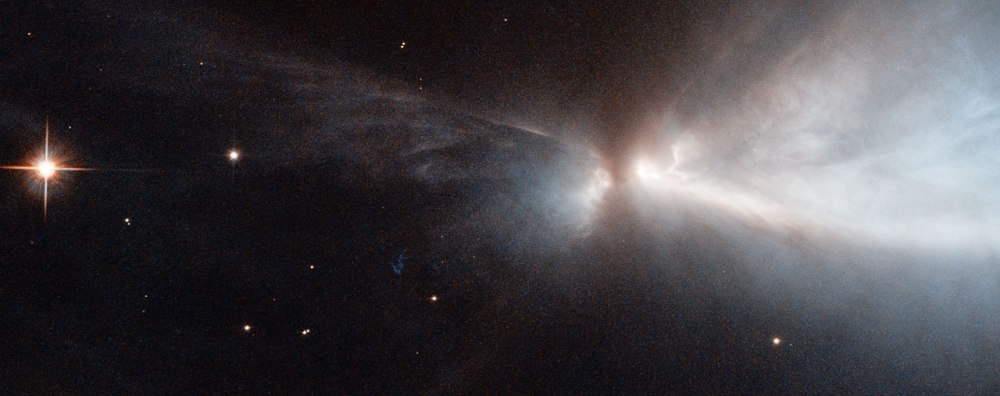
This striking new image, captured by the NASA/ESA Hubble Space Telescope, reveals a star in the process of forming within the Chamaeleon cloud. This young star is throwing off narrow streams of gas from its poles — creating this ethereal object known as HH 909A. These speedy outflows collide with the slower surrounding gas, lighting up the region.

The Chameleon cloud is located in the southern constellation of Chameleon, just over 500 light-years from Earth. Astronomers have found numerous Herbig-Haro objects embedded in this stellar nursery, most of them emanating from stars with masses similar to that of the Sun. A few are thought to be tied to less massive objects such as brown dwarfs, which are “failed” stars that did not hit the critical mass to spark reactions in their centres.

Read more