Read moreIn the interview embedded above he tells the story of when Armstrong was a guest of honour at the White House in 1994. At the end of his speech he turns to the assembled high school students and says: “There are wonders beyond belief on the moon for those who can remove truth’s protective layers.”
Two things. Officially there aren’t wonders beyond belief on the moon. It’s boring. And since when does truth practice safe sex?
space shamanism
“Alien Electromagnetic Signals Will Be Discovered by 2040” –SETI’s Chief Astronomer
Writing in Acta Astronautica, Shostak says that the odds favour detecting such alien AI rather than “biological” life. Seti researchers have long argued that nature may have solved the problem of life using different designs or chemicals, suggesting extraterrestrials would not only not look like us, but that they will not be carbon based life forms, but be bound to follow “at least some rules of biochemistry, live for a finite period of time, procreate, and above all be subject to the processes of evolution.”
“If you look at the timescales for the development of technology, at some point you invent radio and then you go on the air and then we have a chance of finding you,” he told BBC News.“But within a few hundred years of inventing radio – at least if we’re any example – you invent thinking machines; we’re probably going to do that in this century. So you’ve invented your successors and only for a few hundred years are you… a ‘biological’ intelligence.”
From a probability point of view, if AI-powered machines evolved, we would be more likely to spot signals from them than from the “biological” life that invented them.
“But having now looked for signals for 50 years, Seti is going through a process of realizing the way our technology is advancing is probably a good indicator of how other civilisations – if they’re out there – would’ve progressed. Certainly what we’re looking at out there is an evolutionary moving target.”
Dr Shostak says that artificially intelligent alien life would be likely to migrate to places where both matter and energy – the only things he says would be of interest to the machines – would be in plentiful supply. That means the Seti hunt may need to focus its attentions near hot, young stars or even near the centers of galaxies.
“I think we could spend at least a few percent of our time… looking in the directions that are maybe not the most attractive in terms of biological intelligence but maybe where sentient machines are hanging out.” Shostak thinks SETI ought to consider expanding its search to the energy- and matter-rich neighborhoods of hot stars, black holes and neutron stars.
Data centers like this generate a lot of heat, and keeping them cool is a major challenge for modern computing. Intelligent computers would likely seek out a low-temperature habitat. Bok globules (image at top of page) are another search target for sentient machines. These dense regions of dust and gas are notorious for producing multiple-star systems. At around negative 441 degrees Fahrenheit, they are about 160 degrees F colder than most of interstellar space.
This climate could be a major draw because thermodynamics implies that machinery will be more efficient in cool regions that can function as a large “heat sink”. A Bok globule’s super-cooled environment might represent the Goldilocks Zone for the AI powered machines, says Shostak. But because black holes and Bok globules are not hospitable to life as we know it, they are not on SETI’s prime target list.
“Machines have different needs,” he says. “They have no obvious limits to the length of their existence, and consequently could easily dominate the intelligence of the cosmos. In particular, since they can evolve on timescales far, far shorter than biological evolution, it could very well be that the first machines on the scene thoroughly dominate the intelligence in the galaxy. It’s a “winner take all” scenario.”
“Alien Electromagnetic Signals Will Be Discovered by 2040” –SETI’s Chief Astronomer
Read more "“Alien Electromagnetic Signals Will Be Discovered by 2040” –SETI’s Chief Astronomer"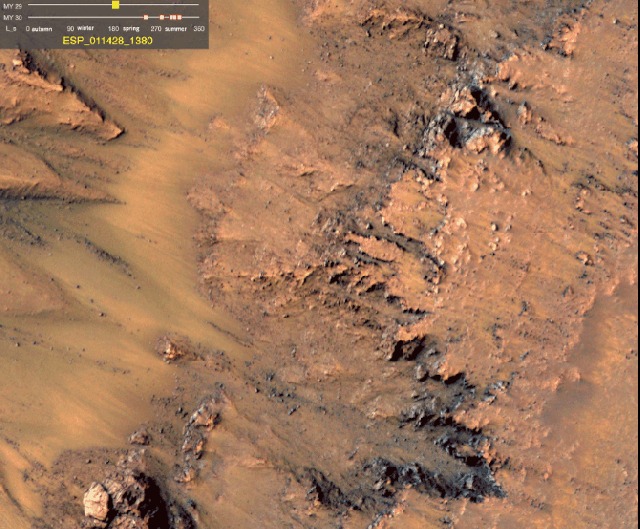
Researchers have long theorized that Mars had at one point held flowing water, and probably even held frozen water still. But, the presence of darkening lines moving downwards along a slope as the temperatures rise in the warmer months, suggests that there could be water flowing even now — and also suggests a mechanism for how it might be able to do it.
So, how does water flow in the frigid Martian temperatures that are present, even in the summer months? Researchers think that there may be a naturally-occurring anti-freeze in the water, caused by the high-iron content…
More details and pix http://io9.com/are-these-pictures-of-water-flowing-on-mars-right-now-1520115138
Read more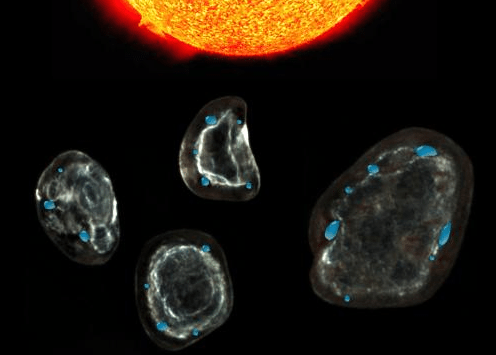
For years, astronomers have been scanning nearby asteroids, the moon, Mars, and deeper space for evidence of the building blocks of life.
Now, a new study in the Proceedings of the National Academy of Sciences finds that both water and organic material could actually have our planet surrounded, floating around space on ubiquitous interplanetary dust particles that constantly rain down on Earth and the other bodies in our solar system.
“It is a thrilling possibility that this influx of dust has acted as a continuous rainfall of little reaction vessels containing both the water and organics needed for the eventual origin of life on Earth and possibly Mars,” researcher and study co-author Hope Ishii of the Hawaii Institute of Geophysics and Planetology said in a release.
…
In the case of comets, the icy space rocks import frozen water from beyond the solar system when they come to visit, but the traces of water on interplanetary dust particles are actually a product of the solar wind that blasts them with hydrogen ions, shaking up the atoms of the silicate mineral crystals in the dust particles. This process leaves behind some oxygen to react with hydrogen and create water molecules.
“Perhaps more exciting,” Ishii said, “interplanetary dust, especially dust from primitive asteroids and comets, has long been known to carry organic carbon species that survive entering the Earth’s atmosphere, and we have now demonstrated that it also carries solar-wind-generated water. So we have shown for the first time that water and organics can be delivered together.”
(via Ingredients for life hitching ride on space dust, study says | Crave – CNET)
Read moreYour Boring, Crowded Universe: The Whisky Rant (Part 6)

Here’s where to look in the sky for star Y1194, twin to our sun, found to have at least one planet.
From The Apocalypse Trialogue, Pt2 (via Psychedelic Salon podcast)
Read moreRupert Sheldrake: “Interplanetary Morphic Resonance… planets of the species Gaia will be in resonance with ours. And planets of the species Venus will resonate with those, and so on…
If there is indeed morphic resonance between the planets, so that when a new form appears on Earth, it’s vastly more likely to appear on other planets, ‘til others caught up.”
Ralpha Abrahams: “A Cosmic Synchronization Principle.
…A spatial version of the God Whistle. A Cosmic Synchronization of God Whistles.”
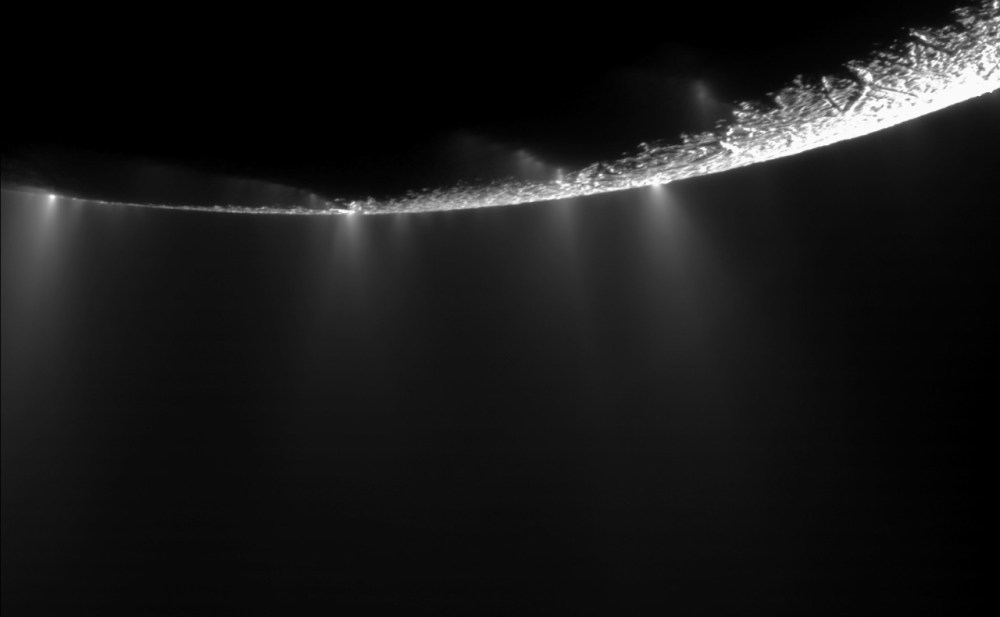
Enceladus seems to have liquid water under its icy surface. Cryovolcanoes at the south pole shoot large jets of water vapor, other volatiles and some solid particles (ice crystal, NaCl etc) into space (total approximately 200 kg per second).[14] Some of this water falls back onto the moon as “snow”, some of it adds to Saturn’s rings, and some of it reaches Saturn. The whole of Saturn’s E Ring is believed to have been made from these ice particles. Because of the apparent water at or near the surface, Enceladus may be one of the best places for humans to look for extraterrestrial life.
Read moreBehold the Superhabitable World
Superhabitability describes a perfect storm of life-friendly factors. In their recent paper, astrobiologists René Heller and John Armstrong describe no fewer than 18 of them. First and foremost, superhabitability arises on terrestrial planets with masses two to three times that of Earth. Planets that size have a number of things working for them, including: Long […]
Read more "Behold the Superhabitable World"Podcast discussing the Pig-Chimp Hybrid hypothesis in more depth. Which is basically this: Dr. Eugene McCarthy is a Ph.D. geneticist who has made a career out of studying hybridization in animals. He now curates a biological information website called Macroevolution.net where he has amassed an impressive body of evidence suggesting that human origins can be best explained […]
Read more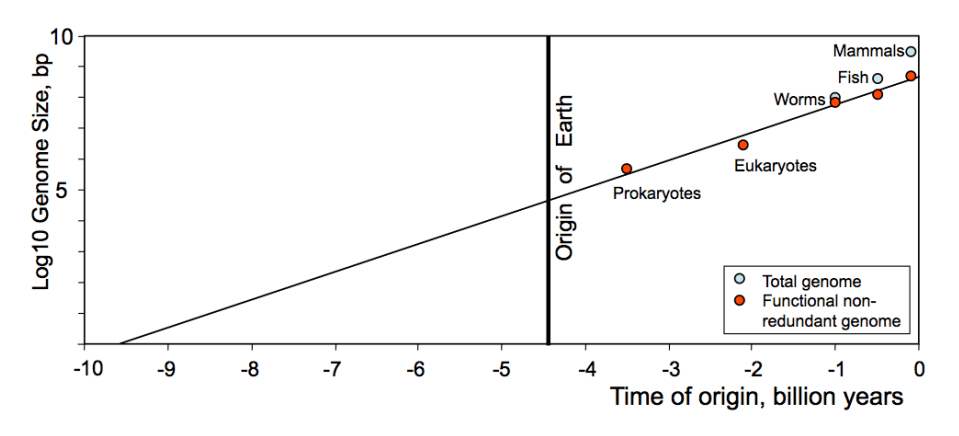
Today, Alexei Sharov at the National Institute on Ageing in Baltimore and his mate Richard Gordon at the Gulf Specimen Marine Laboratory in Florida, have taken a similar to complexity and life.
These guys argue that it’s possible to measure the complexity of life and the rate at which it has increased from prokaryotes to eukaryotes to more complex creatures such as worms, fish and finally mammals. That produces a clear exponential increase identical to that behind Moore’s Law although in this case the doubling time is 376 million years rather than two years.
That raises an interesting question. What happens if you extrapolate backwards to the point of no complexity–the origin of life?
Sharov and Gordon say that the evidence by this measure is clear. “Linear regression of genetic complexity (on a log scale) extrapolated back to just one base pair suggests the time of the origin of life = 9.7 ± 2.5 billion years ago,” they say.
And since the Earth is only 4.5 billion years old, that raises a whole series of other questions. Not least of these is how and where did life begin.
Of course, there are many points to debate in this analysis. The nature of evolution is filled with subtleties that most biologists would agree we do not yet fully understand.
For example, is it reasonable to think that the complexity of life has increased at the same rate throughout Earth’s history? Perhaps the early steps in the origin of life created complexity much more quickly than evolution does now, which will allow the timescale to be squeezed into the lifespan of the Earth.
Sharov and Gorden reject this argument saying that it is suspiciously similar to arguments that squeeze the origin of life into the timespan outlined in the biblical Book of Genesis.
Let’s suppose for a minute that these guys are correct and ask about the implications of the idea. They say there is good evidence that bacterial spores can be rejuvenated after many millions of years, perhaps stored in ice.
They also point out that astronomers believe that the Sun formed from the remnants of an earlier star, so it would be no surprise that life from this period might be preserved in the gas, dust and ice clouds that remained. By this way of thinking, life on Earth is a continuation of a process that began many billions of years earlier around our star’s forerunner.
Sharov and Gordon say their interpretation also explains the Fermi paradox, which raises the question that if the universe is filled with intelligent life, why can’t we see evidence of it.
However, if life takes 10 billion years to evolve to the level of complexity associated with humans, then we may be among the first, if not the first, intelligent civilisation in our galaxy. And this is the reason why when we gaze into space, we do not yet see signs of other intelligent species.
Ref: arxiv.org/abs/1304.3381: Life Before Earth
Read more The Committee to Nuke Elysium