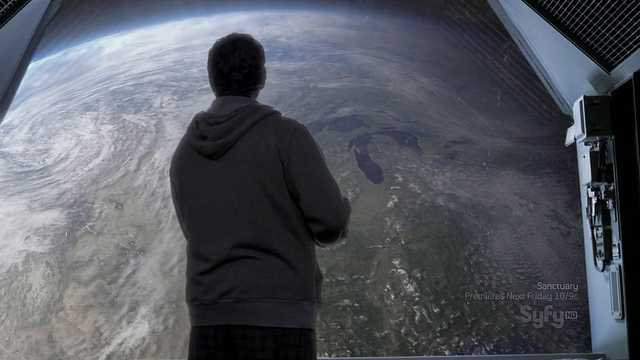
Behold the healing power of the Upsized #OverviewEffect! In this case a glimpse of a whole solar system. For Eli’s mother who’s been missing him terribly and is super depressed without her reason for being, and has stopped taking her meds because she has HIV donchaknow, but after a bit of Clarkean magix she’s transported to be with her boy via a loaner body, on the other side of the universe, and VOILÀ: from sad in hospital to beatific believer of the gospel of spaaace.
Read morespace shamanism
Titus-Bode Law
The Titius–Bode law (sometimes termed just Bode’s law) is a hypothesis that the bodies in some orbital systems, including the Sun’s, orbit at semi-major axes in a function of planetary sequence. The hypothesis correctly predicted the orbits of Ceres and Uranus, but failed as a predictor of Neptune’s orbit. … When originally published, the law was approximately satisfied by all the known planets — Mercury through Saturn — with […]
Read more "Titus-Bode Law"Dinosaur asteroid ‘sent life to Mars’
The early Martian atmosphere appears to have been warm and wet – prime conditions for the development of life.
And if Martian microbes ever did exist, transfer to Earth is “highly probable” due to the heavy traffic of meteorites between our planets, Ms Worth told BBC News.
“Billions have fallen on Earth from Mars since the dawn of our planetary system. It is even possible that life on Earth originated on Mars.”
While her team are not the first to calculate that panspermia is possible, their 10-million-year simulation is the most extended yet, said astrobiologist Prof Jay Melosh, of Purdue University.
“The study strongly reinforces the conclusion that, once large impacts eject material from the surface of a planet such as the Earth or Mars, the ejected debris easily finds its way from one planet to another,” he told BBC News.
“The Chicxulub impact itself might not have been a good candidate because it occurred in the ocean (50 to 500m deep water) and, while it might have ejected a few sea-surface creatures, like ammonites, into space, it would not likely have ejected solid rocks.
"I sometimes joke that we might find ammonite shells on the Moon from that event.
"But other large impacts on the Earth may indeed have ejected rocks into interplanetary space.”
Another independent expert on panspermia, Mauricio Reyes-Ruiz of the National Autonomous University of Mexico, said the new findings were “very significant”.
“The fact such different pathways exist for the interchange of material between Earth and bodies in the Solar System suggests that if life is ever found, it may very well turn out to be our very, very distant relatives,” he said.
Dinosaur asteroid ‘sent life to Mars’
Read more "Dinosaur asteroid ‘sent life to Mars’"
12:18 a.m. Greenwich Mean Time on Aug. 2, 1971, Commander David Scott of Apollo 15 placed a 3 ½-inch-tall aluminum sculpture onto the dusty surface of a small crater near his parked lunar rover. At that moment the moon transformed from an airless ball of rock into the largest exhibition space in the known universe.
…
Between mouthfuls, van Hoeydonck and Scott discovered shared obsessions with archaeology and Mayan mythology. At the end of the evening, van Hoeydonck praised Scott and Irwin: “ ‘You guys are like the knights that existed in medieval time—the astronauts of the Holy Grail,’ I told them. They toasted me, ‘Look what this guy says! Let’s get him a sculpture on the moon!’
…
Two days after the NASA press conference, van Hoeydonck wrote to the Apollo 15 crew: “To open the way to the Stars is the most important mission of man in this century.” In a separate letter, sent directly to Scott the same day, he added, “Sorry you didn’t find an ancient temple but … the experience of walking on the moon must be out of our dimensions.”
Read more
For the uninitiated, Saturn’s uncannily symmetric cloud system measures roughly 20,000-miles across, and is utterly unique in our solar system. Its dimensions and dynamics are just bizarre. At the hexagon’s center whirls a tightly wound hurricane roughly fifty-times larger than the average hurricane-eye on Earth. About it spins an assortment of smaller vortices, caught up in the hexagon’s jet stream, that rotate clockwise, even as the central hurricane, and the outer hexagon, rotate in the opposite direction. These smaller storms are visible in the image above as reddish ovals. The largest of the smaller vortices, appearing white in the lower right corner of the hexagon, spans about 2,200 miles – roughly twice the size of Earth’s largest hurricanes. (via New Hi-Res Footage Shows Saturn’s Mysterious Hexagon Like Never Before)
Read moreC-SPAN: Buzz Aldrin Reveals Existence of Monolith on Mars Moon (by C-SPAN)
Introduction to Space Shamanism: the Mysteries of Spaaaaaaaaace
Thing is… you show me an astronomer who thinks he or she knows what’s going on in this solar system and I will show you a fucking liar. Our own moon: Is almost a billion years older than the earth, and may even be older than the sun. Lunar dust on the 5.3 billion year old […]
Read more "Introduction to Space Shamanism: the Mysteries of Spaaaaaaaaace"
Eli’s #overvieweffect initiation into the Space Mysteries on Flickr.
Via Flickr:
Stargate: Universe pilot

The Picard uses the #overvieweffect to convince a local alien leader he isn’t a spacegod on Flickr.
Via Flickr:
Star Trek TNG – Who Watches the Watchers?