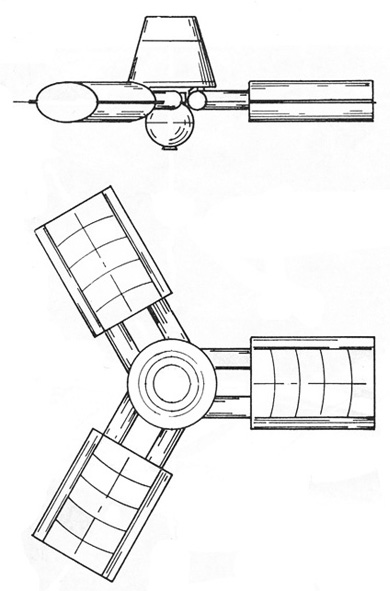
Meanwhile, in Houston, Texas, Edward Olling at the newly established Manned Spacecraft Center (MSC) was hard at work on a temporary space station program which he called Project Olympus. In April 1962, he circulated a draft planning document for comment; then, on 16 July 1962, he unveiled his Project Olympus “Summary Project Development Plan” to top-level MSC managers.
Olling explained that Project Olympus space stations would for the first time provide NASA with a large usable volume and enough scientific equipment, astronauts, and electrical power to carry out wide-ranging basic and applied research in space. Early station research would seek to answer basic questions about piloted spaceflight; for example, could humans work effectively for long periods in space? New objectives would be added over time. Beginning even with the first station, the Project Olympus stations would become space-environment research facilities, “national laboratories” for research into meteorology, geophysics, communications systems, navigation systems, and astronomy, and “orbital operations” facilities (that is, sites for assembling spacecraft bound for points beyond space station orbit). Each 138,600-pound Project Olympus station would comprise a large central hub with three evenly spaced arms. Each arm would include a pressurized crew module of oval cross-section nested between two cylindrical access tunnels. Apollo-derived logistics spacecraft (typical mass, 31,700 pounds), each bearing six astronauts, supplies, and equipment, would dock at the zero-gee central hub. The 150-foot-wide Project Olympus stations would spin four times per minute to create acceleration in their arms. On each station, the crew deck farthest from the hub would experience the greatest acceleration: the equivalent of one-quarter of Earth’s gravitational pull, or about midway between lunar and martian surface gravity. Crew decks closer to the hub would experience less acceleration. Olling hinted that the different levels of acceleration the astronauts would experience on decks at varying distances from the hub might be useful for scientific research, but he provided no specifics. (via Project Olympus (1962) – Wired Science)
Read more
 The Committee to Nuke Elysium