Read moreThe team discovered that in order to shape Titan’s dunes, the moon’s westerly winds must be about 50 percent stronger than previously predicted. Though these westerlies only prevail about two percent of the time on Titan, they are the driving forces shaping the moon’s dunes. “That’s what does all the geomorphic work,” Burr confirmed.
The findings are further proof that Titan is a world of extremes, in which brief periods of seasonally-driven unrest can have more influence than the moon’s “normal” weather during the rest of the Saturnian year. It also demonstrates how a discarded, antiquated piece of equipment can be reinvented to resolve modern questions.
Along those lines, Burr plans to use Ames wind tunnel to investigate Titan’s past. “We just had some new work funded, and we get to go back now and experiment with different paleoclimates on Titan,” she told me. “There’s the thought that Titan has gone through some very significant climatic shifts over the age of the solar system, and the atmosphere we see there now may be unusual.”
Given that the moon supports such a variety of bizarre features, it wouldn’t be surprising to find out that it’s an atypical place not just by the solar system’s standards, but by its own as well. If that’s true, then we are just lucky enough to catch it during its more dynamic episodes, when rivers are flowing, winds are blowing, and sand is formed in its skies.
space weather

“If our hypothesis for Mount Sharp holds up, it challenges the notion that warm and wet conditions were transient, local, or only underground on Mars,” said Ashwin Vasavada, Curiosity deputy project scientist at NASA’s Jet Propulsion Laboratory in Pasadena, California. “A more radical explanation is that Mars’ ancient, thicker atmosphere raised temperatures above freezing globally, but so far we don’t know how the atmosphere did that.”
Why this layered mountain sits in a crater has been a challenging question for researchers. Mount Sharp stands about 3 miles (5 kilometers) tall, its lower flanks exposing hundreds of rock layers. The rock layers – alternating between lake, river and wind deposits – bear witness to the repeated filling and evaporation of a Martian lake much larger and longer-lasting than any previously examined close-up.
“We are making headway in solving the mystery of Mount Sharp,” said Curiosity Project Scientist John Grotzinger of the California Institute of Technology in Pasadena. “Where there’s now a mountain, there may have once been a series of lakes.”
Curiosity currently is investigating the lowest sedimentary layers of Mount Sharp, a section of rock 500 feet (150 meters) high, dubbed the Murray formation. Rivers carried sand and silt to the lake, depositing the sediments at the mouth of the river to form deltas similar to those found at river mouths on Earth. This cycle occurred over and over again.
“The great thing about a lake that occurs repeatedly, over and over, is that each time it comes back it is another experiment to tell you how the environment works,” Grotzinger said. “As Curiosity climbs higher on Mount Sharp, we will have a series of experiments to show patterns in how the atmosphere and the water and the sediments interact. We may see how the chemistry changed in the lakes over time. This is a hypothesis supported by what we have observed so far, providing a framework for testing in the coming year.”
After the crater filled to a height of at least a few hundred yards, or meters, and the sediments hardened into rock, the accumulated layers of sediment were sculpted over time into a mountainous shape by wind erosion that carved away the material between the crater perimeter and what is now the edge of the mountain.
On the 5-mile (8-kilometer) journey from Curiosity’s 2012 landing site to its current work site at the base of Mount Sharp, the rover uncovered clues about the changing shape of the crater floor during the era of lakes.
Read more
This is the background for an emerging aspect of the space weather discipline: planetary space weather. In this article, we explore what characterizes planetary space weather, using some examples throughout the solar system. We consider energy sources and timescales, the characteristics of solar system objects and interaction processes. We discuss several developments of space weather interactions including the effects on planetary radiation belts, atmospheric escape, habitability and effects on space systems. We discuss future considerations and conclude that planetary space weather will be of increasing importance for future planetary missions.
What characterizes planetary space weather?
Read more

Just as water-based snowfalls occur during winter in Mars’ northern hemisphere, carbon dioxide snowfalls occur in the planet’s southern hemisphere during the south pole’s own winter. Frozen CO2 persists in the southern region all year round, but how it got there is still a mystery. (via Does it snow on Mars? | Spaceanswers.com)
Read moreWater clouds tentatively detected just 7 light-years from Earth
“It’s tentative,” he says, but “it’s the first evidence for water clouds” outside our solar system. Even within the solar system, observers can see water clouds on only Earth and Mars; the giant planets are so cold that ammonia ice clouds cover the water clouds on Jupiter and Saturn while the atmospheres of Uranus and Neptune block the view there.
Observers have previously discerned water vapor in the atmospheres of extrasolar planets, but Fortney says water clouds are a new phenomenon. “One of the things we don’t really know is how common partly cloudiness is,” he says. Venus, whose clouds consist of sulfuric acid, is totally cloudy, whereas Earth is partly cloudy. Faherty says the brown dwarf is also partly cloudy: About half is obscured by clouds.
Verifying the discovery will require spectra. Because the object is so dim, this will likely await the James Webb Space Telescope, which will be launched later this decade.
Water clouds tentatively detected just 7 light-years from Earth
Read more "Water clouds tentatively detected just 7 light-years from Earth"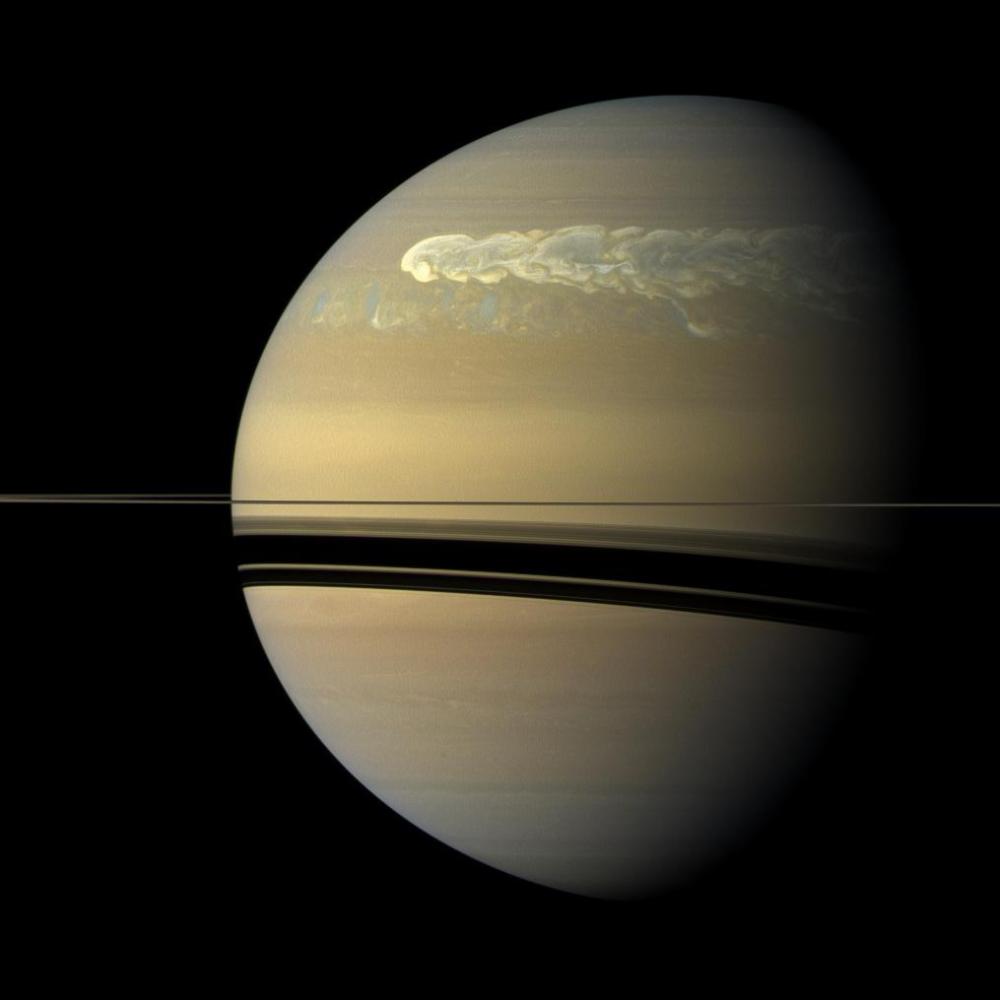
The huge storm churning through the atmosphere in Saturn’s northern hemisphere overtakes itself as it encircles the planet in this true-color view from NASA’s Cassini spacecraft.
This picture, captured on Feb. 25, 2011, was taken about 12 weeks after the storm began, and the clouds by this time had formed a tail that wrapped around the planet. Some of the clouds moved south and got caught up in a current that flows to the east (to the right) relative to the storm head. This tail, which appears as slightly blue clouds south and west (left) of the storm head, can be seen encountering the storm head in this view.
This storm is the largest, most intense storm observed on Saturn by NASA’s Voyager or Cassini spacecraft. It is still active today. As scientists have tracked this storm over several months, they have found it covers 500 times the area of the largest of the southern hemisphere storms observed earlier in the Cassini mission (see PIA06197). The shadow cast by Saturn’s rings has a strong seasonal effect, and it is possible that the switch to powerful storms now being located in the northern hemisphere is related to the change of seasons after the planet’s August 2009 equinox.
Read more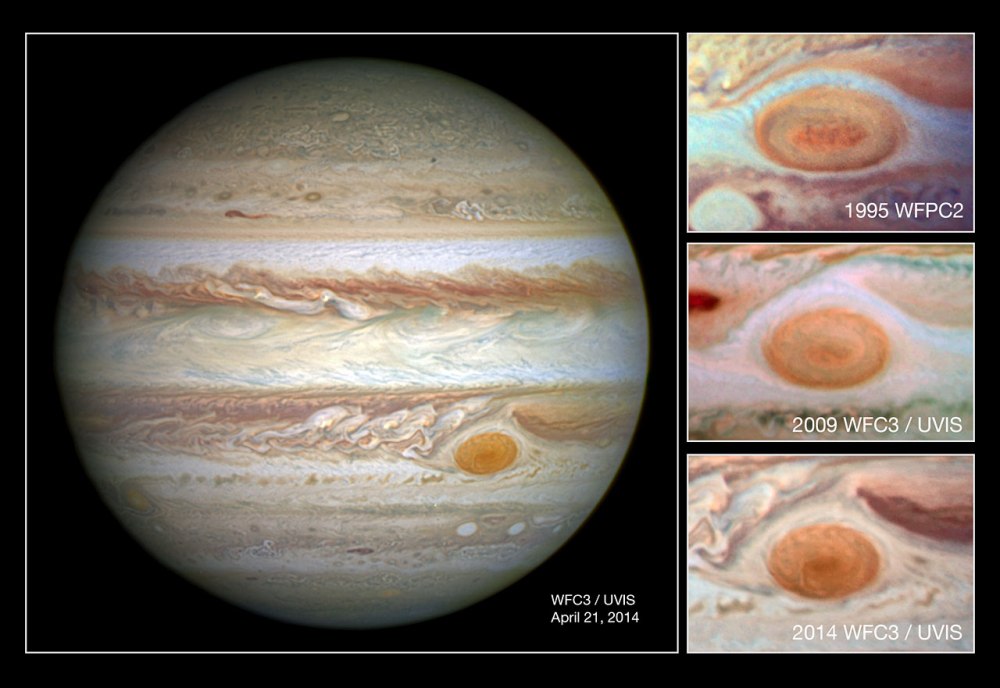
Read moreThe first definitive observation of the spot in Earth telescopes was done by Samuel Heinrich Schwabe in 1831, so we know its been around at least that long, but it may have been observed as far back as the late 1600s. When Schwabe saw it, the Great Red Spot was gauged to be more than 25,000 miles across, large enough for three planet Earths to sit side by side within it.
But sightings since the 1930s have shown the spot shrinking. A recent Hubble photo (seen above) observes the Great Red Spot at its smallest size yet —- just over 10,000 miles across, barely big enough for 1.3 Earths to fit inside. Scientists are studying small eddies at the edge of the storm that may somehow be sapping it of its strength. Will this monstrous cyclone continue to downsize? Researchers can’t say for sure.
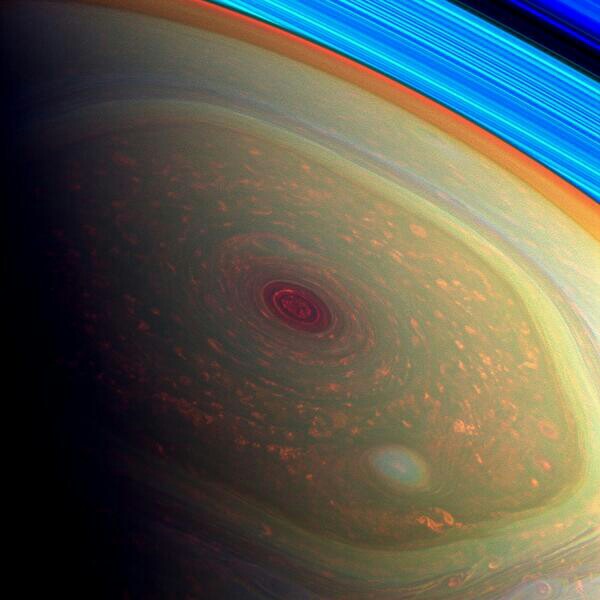
Dance of Saturn’s Auroras.
ultraviolet and infrared images of the auroras of Saturn recorded by Cassini and Hubble.
(Source: https://www.youtube.com/)
Read more
 The Committee to Nuke Elysium