futurescope:

DARPA funds 100 Year Starship to develop human interstellar flight capabilities

An ambitious effort for an interstellar travel planning organization officially kicked off this week, after DARPA awarded $500,000 to form the 100-Year Starship initiative. Former astronaut Mae Jemison, whose proposal was selected earlier this year, will lead the new independent organization. The goal is to ensure that the capability for human interstellar travel exists within the next 100 years. […]

[read more @popsci | @gizmag] [100 Year Starship] [Project Icarus] [image credit: Adrian Mann]

Read more

cwnerd12:

dessertfox:

dancingcabman:

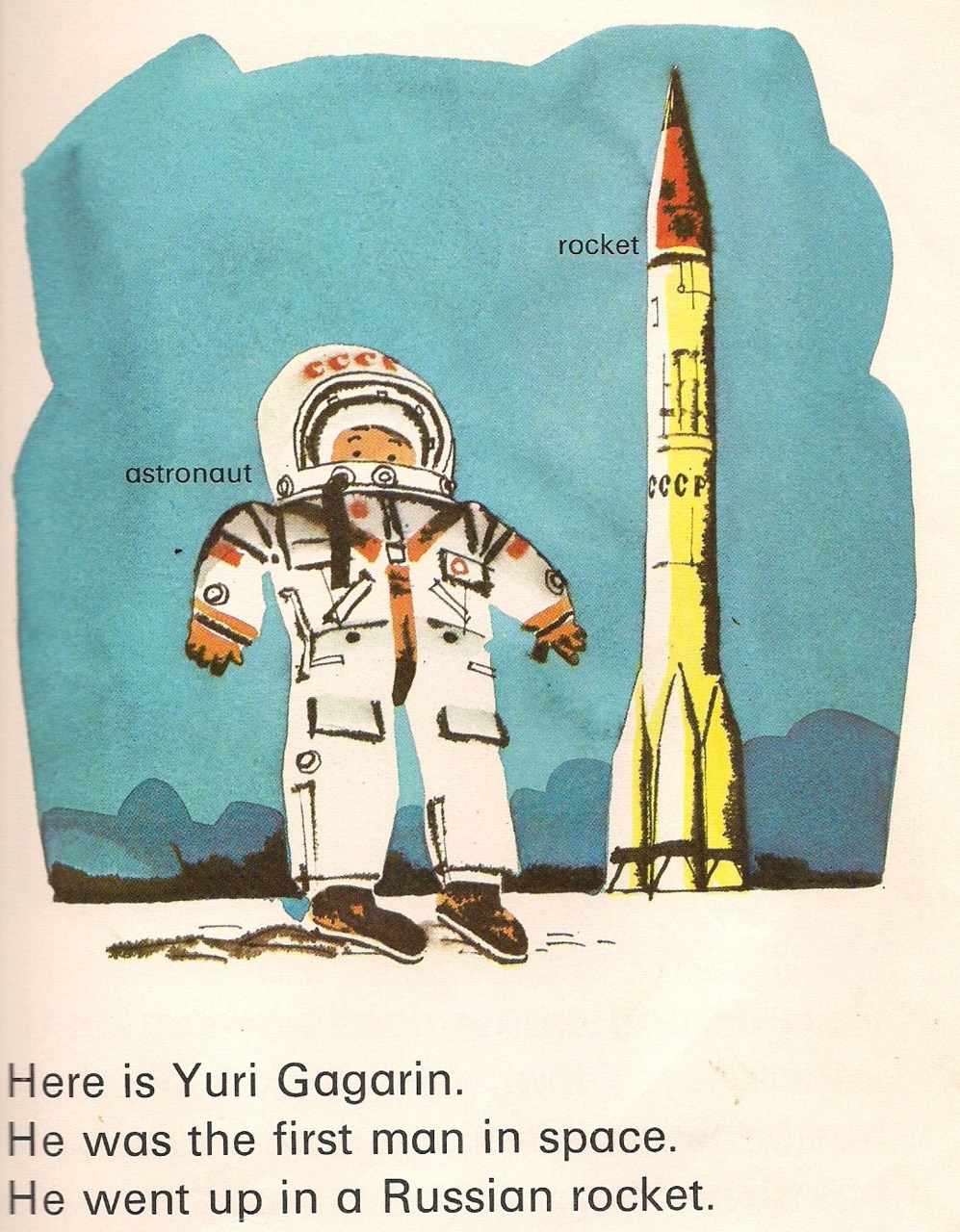
This is from the cutest book about Russia I own. 

Aww Yuri I will never tire of your cuteness

aw X3 

Read more

The second-most-massive asteroid in the solar system, Vesta circles the sun in the asteroid belt between Mars and Jupiter. Had Jupiter’s massive gravity not interfered, the millions of space rocks in the asteroid belt might have coalesced into another planet, scientists say.

Unlike rocket-powered craft sent to Mars, Jupiter and other planets, Dawn is driven by a weak-but-steady ion engine. Powered by solar panels, Dawn’s engines zap a gas, xenon, with an electrical charge. As the charged gas shoots out a nozzle, it imparts a gentle push — equivalent to the weight of a sheet of paper sitting on your hand, said Mark Rayman, chief engineer for Dawn at NASA’s Jet Propulsion Laboratory in Pasadena, Calif.

But what Dawn lacks in power, it makes up in stamina. Its engines have been thrusting for some 1,000 days, steadily adding speed.

Sipping just milligrams of xenon a day, the super-efficient engines leave Dawn with enough fuel to push itself toward a second asteroid. If all goes well, next summer the 65-foot-wide craft will depart Vesta and head toward the largest asteroid in the solar system, Ceres, with arrival scheduled for 2015. Ceres intrigues scientists because it apparently holds a huge reservoir of water, Russell said.

If successful, Dawn’s double-destination mission will mark the first time a spacecraft has orbited two bodies in the solar system.

via Destination asteroid: NASA probe arrives at ancient ‘mini moon’ – The Washington Post

Read more

The density of space junk peaks around 620 miles up, in the middle of so-called low-Earth orbit. That’s bad, because many weather, scientific, and reconnaissance satellites circle in various low-Earth orbits. But that height also offers an opportunity. Below about 560 miles, small objects start to feel a significant drag from the Earth’s upper atmosphere. This drag causes them to slowly spiral toward Earth, and they eventually burn up in the atmosphere. The tungsten cloud could theoretically provide extra drag on objects orbiting above the 600-mile mark, slowing the itty-bitty debris down enough to fall below the 560-mile threshold. Tungsten wouldn’t clear up space instantly—objects at 560 miles can still circle for decades. But that’s vastly better than the centuries-long orbits of fast-moving objects even a little higher.

That said, there could be a downside to sending 20 tons of heavy metal dust aloft. Eventually, the tungsten cloud would itself fall toward Earth. Tungsten isn’t acutely toxic, and Ganguli and friends argue that, spread over many years, all that dust would not amount to much, especially compared with the hundreds of tons of micro-meteors and other space dust that already flits down onto Earth each day. But their five-page paper outlining the tungsten cloud devotes 54 words to the potential environmental impact, hardly an exhaustive look. Astronomers might also object, because the dust could interfere to an unknown degree with light streaming toward Earth from space. Fighting through swarms of microscopic dust could give satellites fits, too, though again, the naval scientists argue the impact would be negligible. (Most satellites point their instruments either straight down toward Earth or straight out into space, and therefore away from what would be mostly horizontal streams of tungsten dust.)

These scenarios all assume, though, that the tungsten dust will behave, and that the ionosphere or solar wind or whatever else won’t interact with it in funny ways. For instance, what if the tungsten doesn’t disperse in nice soft poofs but clumps together? Something similar happened with Project West Ford, a Cold War operation in the early 1960s to improve the reliability of radio communication (in case the Soviets sabotaged our undersea cables) by giving transmitters something solid to bounce signals off in space. To howls worldwide, the U.S. injected 480 million inch-long copper needles into orbit, clusters of which still circle Earth. Or, some observers have suggested that the dust could swell outward—perhaps even form a Saturn-like ring of Element 74 around Earth.

So, yeah, the idea still needs polishing. But if the growing amount of space junk wipes out a few billion-dollar satellites soon, a silvery tungsten cloud could be the least of many evils.

Read more

The main purpose of the utilization era will be to support space-based scientific research and develop technologies for human exploration Beyond Earth Orbit (BEO).

Now that the US Segment of the ISS is completed (bar the addition of potential future modules such as a Bigelow inflatable), the ISS has extraordinary capabilities to conduct research in space, the likes of which have never been seen before.

Due to its huge solar arrays and Ku-band antennas, the ISS has power and data capabilities which are capable of supporting multiple payloads, while also providing them with a long-term, stable platform on which to attach.

The benefits of this is that scientific payloads can be attached to the ISS without needing their own power supply, data downlink capability, and attitude control system, thus significantly reducing the cost and time required to fly an experiment in space.

via Tech Demos: NASA preparing for full ISS utilization in post-Shuttle era | NASASpaceFlight.com

Read more

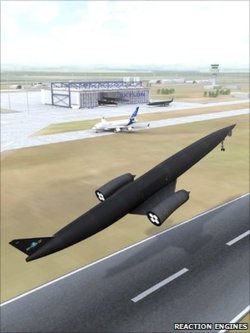
The proposed Skylon vehicle would do the job of a big rocket but operate like an airliner, taking off and landing at a conventional runway.

The European Space Agency’s propulsion experts have assessed the details of the concept and found no showstoppers.

They want the next phase of development to include a ground demonstration of its key innovation – its Sabre engine.

Realising the Sabre propulsion system is essential to the success of the project.

The engine would burn hydrogen and oxygen to provide thrust – but in the lower atmosphere this oxygen would be taken directly from the air.

This means the 84m-long spaceplane can fly lighter from the outset with a higher thrust-to-weight ratio, enabling it to make a single leap to orbit, rather than using and dumping propellant stages on the ascent – as is the case with current expendable rockets.

The price for launching a kilogram of payload into a geostationary orbit – the location for today’s big telecoms satellites – is currently more than $15,000 (£9,000). Skylon’s re-usability could bring that down to less than $1,000, claims REL.

Read more

The worms in question were of the species Caenorhabditis elegans, and were supplied by boffins at Nottingham uni having originally been found browsing a dump in Bristol. Many of C elegans’ genes perform the same function as those in humans, and the scientists wanted to see if RNA interference therapy (RNAi) could be used to fight the serious loss of muscle which astronauts are subject to during long spaceflights.

Some millions of the worms were sent up aboard space shuttle Atlantis on the STS-129 mission in 2009, and subsequently treated in the station’s Japanese-built “Kibo” lab podule. They were subsequently brought back to Earth on the next shuttle to visit, Endeavour (now retired), executing mission STS-130.

“It was really a quite straightforward experiment,” says Nottingham uni’s Dr Nathaniel Szewczyk. “Once the worms were in space the scientists onboard the International Space Station treated them with RNAi and then returned them to us for post flight analysis.

"These results are very exciting as they clearly demonstrate that RNAi can be used effectively to block proteins which are needed for muscle to shrink.”

Szewczyk’s colleague and fellow space garbage-worm gene therapy boffin, Dr Timothy Etheridge, added: “We were very pleased… our experiments allowed us to demonstrate that this form of gene therapy works effectively during spaceflight. The unexpected finding that RNAi can effectively block protein degradation in muscle in space was also a very welcome surprise.”

Brit rubbish-dump worms in space station science triumph

Garbage-scoffing creatures prove zero G therapy

Read more