Iridium Communications Inc. (Nasdaq:IRDM) and Space Exploration Technologies (SpaceX) are pleased to announce that the Falcon 9 will be a major provider of launch services for Iridium NEXT, Iridium’s next-generation satellite constellation. The $492 million contract, while being the largest single commercial launch deal ever signed, nonetheless represents a new benchmark in cost-effective satellite delivery to space.

Iridium operates the world’s largest commercial satellite constellation, and is the only communications company to offer mobile voice and data services across the entire globe. SpaceX’s Falcon 9 launch vehicle will carry multiple Iridium NEXT satellites per vehicle, inserting the satellites into a low-earth orbit (LEO) as Iridium replaces its current satellite constellation. The Iridium NEXT satellites are set to launch from Vandenberg Air Force Base (VAFB) in California between 2015 and 2017.

The contract stipulates that SpaceX will provide launch services to Iridium over a two-year period starting in early 2015. Iridium is also in discussions with, and expects to contract with, at least one additional launch services provider. Launch services are included in the total estimated cost of $2.9 billion for Iridium NEXT.

“This is the third major building block on the road to Iridium NEXT,” said Matt Desch, CEO of Iridium. “Two weeks ago, we announced our fixed-price contract with Thales Alenia Space. We also announced our Coface-backed financing plan, and today I am pleased to announce our partnership with SpaceX for extremely cost-effective launch services.”

Added Desch, “We are proud to be partnered with SpaceX, and want to congratulate Elon Musk and the entire SpaceX team on its successful inaugural Falcon 9 launch. Hands down, SpaceX offered us the best value coupled with an unwavering commitment to flawless performance and reliability. SpaceX has combined the best of aerospace and commercial best practices to design reliable and cost-effective access to space, and Iridium will be the beneficiary of that effort.”

Space Exploration Technologies Corporation – Press

– what up private space business!
Read more

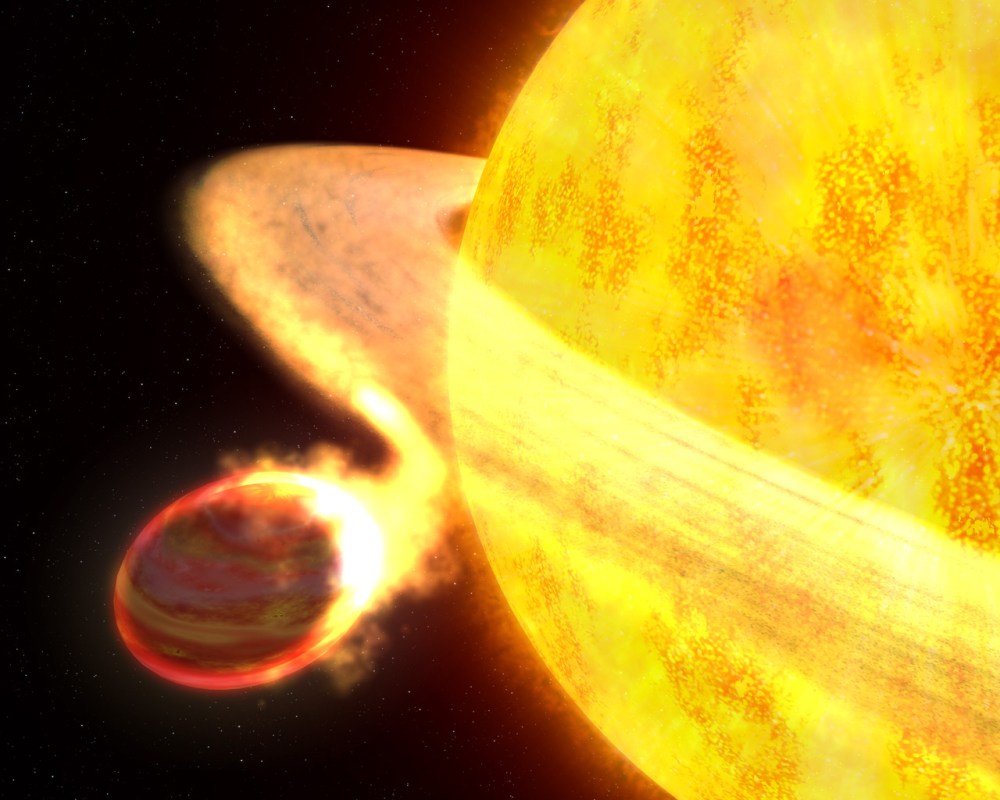
The hottest known planet in the Milky Way galaxy may also be its shortest-lived world. The doomed planet is being eaten by its parent star, according to observations made by a new instrument on NASA’s Hubble Space Telescope, the Cosmic Origins Spectrograph (COS). The planet may only have another 10 million years left before it is completely devoured.

The planet, called WASP-12b, is so close to its sunlike star that it is superheated to nearly 2,800 degrees Fahrenheit and stretched into a football shape by enormous tidal forces. The atmosphere has ballooned to nearly three times Jupiter’s radius and is spilling material onto the star. The planet is 40 percent more massive than Jupiter.

 HubbleSite – NewsCenter – Hubble Finds Star Eating a Planet (05/20/2010) – Release Images

Read more

The Obama space plan relies on private companies to fly to the space station, giving them almost $6 billion to build their own rockets and ships. It also extends the space station’s life by five years and puts billions into research to eventually develop new government rocket ships for future missions to a nearby asteroid, to the moon, to Martian moons or other points in space. Those stops would be stepping stones on an eventual mission to Mars itself.

Read more

itsfullofstars:

kellycascarones:

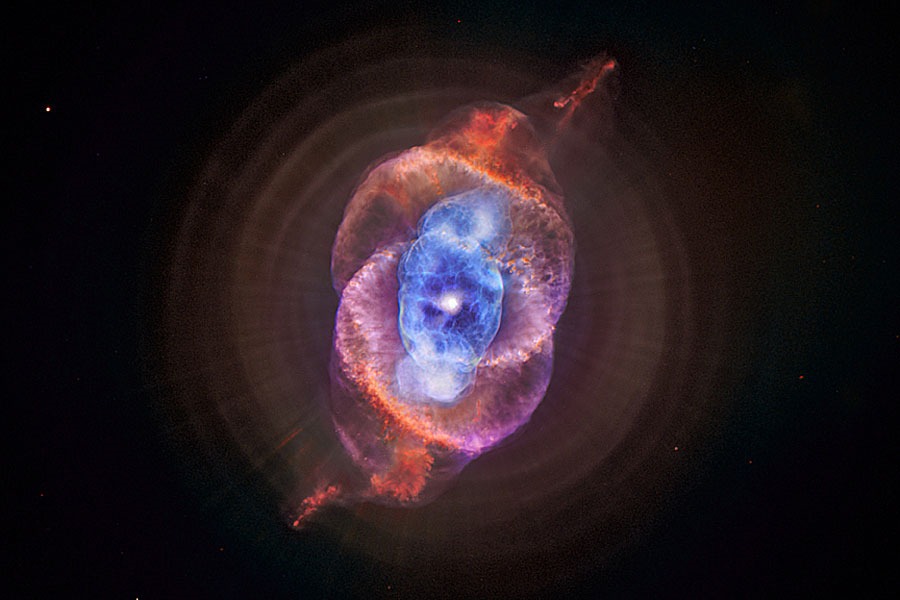
Cat’s Eye Nebula

Haunting patterns within planetary nebula NGC 6543 readily suggest its popular moniker — the Cat’s Eye nebula. Starting in 1995, stunning false-color optical images from the Hubble Space Telescope detailed the swirls of this glowing nebula, known to be the gaseous shroud expelled from a dying sun-like star about 3,000 light-years from Earth. This composite picture combines the latest Hubble optical image of the Cat’s Eye with new x-ray data from the orbiting Chandra Observatory and reveals surprisingly intense x-ray emission indicating the presence of extremely hot gas. X-ray emission is shown as blue-purple hues superimposed on the nebula’s center. The nebula’s central star itself is clearly immersed in the multimillion degree, x-ray emitting gas. Other pockets of x-ray hot gas seem to be bordered by cooler gas emitting strongly at optical wavelengths, a clear indication that expanding hot gas is sculpting the visible Cat’s Eye filaments and structures. Gazing into the Cat’s Eye, astronomers see the fate of our sun, destined to enter its own planetary nebula phase of evolution … in about 5 billion years.

Read more

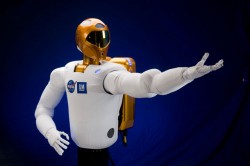
Another interesting piece of hardware scheduled to fly on the PMM is the Robonaut 2, NASA’s second generation of dexterous robots with a human-like torso that can work with tools and one day are envisioned to be able to do EVA work outside the ISS. But for now, R2 will be tested inside the station in zero-g. “It will be used on orbit for routine maintenance indoors only.” said Kinslow, “This is not an external unit.” It has a “head” with a vision system, with hands that can do work, controlled by virtual-reality-like operation. Any chance R2 could be programmed to serve drinks or bring food into the man cave? (via ISS to get ‘Man Cave’ Complete with Robot Butler | Universe Today)

Read more

China plans to launch an unmanned space module, Tiangong-1, in 2011, which is expected to accomplish the country’s first space docking and regarded as an essential step toward building a space station, an expert said Wednesday.

Tiangong, or the Heavenly Palace, would finally be transformed into a manned space lab after experimental dockings with three Shenzhou spacecraft, which are expected to be put into space within two years following the module’s launch, said Qi Faren, former chief designer of Shenzhou spaceships.

Read more