Eventually, commercial moon landers may help carry a diverse library of cultural and biological records to the lunar surface, where they would be preserved in case Earth suffers a pandemic plague, nuclear holocaust or lethal asteroid strike.
The first artefacts to shoot for the moon could be three religious and philosophical texts. The Torah on the Moon project, based in Tel Aviv, Israel, has been courting private firms to deliver a handwritten Jewish scroll, the Sefer Torah, to the lunar surface. If they succeed, later flights will carry Hindu scriptures called the Vedas and the ancient Chinese philosophical work, the I-Ching.
Each document will be housed in a space-ready capsule designed to protect it from harsh radiation and temperature changes on the moon for at least 10,000 years.
The texts would join a Bible left on the moon in 1971 by Apollo 15 commander David Scott. The red leather Bible sits on the control console of an Apollo moon buggy.
“I don’t think these religions are claiming the moon. It’s about saving our culture, saving the humanities,” says Naveen Jain, CEO of the California-based X Prize hopeful Moon Express.
Jain thinks future projects should find a representative sample of humanity, perhaps a million people, take their DNA and store it on the moon. “So in case of an asteroid strike that wipes us out like the dinosaurs, humanity can be saved.”
Jain’s idea may become a reality: New Scientist has learned that a UK-based venture is quietly developing a mission to store human, animal and plant genomes on the moon – although flaws in this plan are turning up in seed banks on Earth (see “Banked seeds are plants out of time”).
Such off-planet backup missions are proliferating, says Joanne Wheeler, a lawyer specialising in space issues at CMS Cameron McKenna in London. “There are several missions planned to put religious and spiritual icons on the moon and also to preserve some trace of humanity on it,” she says.
Evolutionary biologist Richard Dawkins says that the moon could even become a “cosmic tombstone” if humans become extinct.
“We should be using it to store the best humanity has ever had to offer, like the works of Michelangelo, Beethoven, Schubert and Shakespeare,” he says.
Meanwhile, Roger Launius at the Smithsonian Institution in Washington DC thinks it apt that such space flight projects should be tied to religion, because space flight advocacy itself has many of the hallmarks of a religion. “There is salvation theology, in that they believe the human race will be saved by space flight’s ability to make us a multi-planetary species,” he says. “And we have pilgrimages at gatherings like launches, which are like a euphoric religious experience.”
spaceistheplace

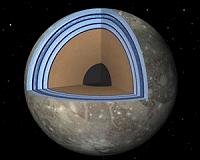
The results support the idea that primitive life might have possibly arisen on the icy moon. Scientists say that places where water and rock interact are important for the development of life; for example, it’s possible life began on Earth in bubbling vents on our sea floor.
Prior to the new study, Ganymede’s rocky sea bottom was thought to be coated with ice, not liquid – a problem for the emergence of life. The “club sandwich” findings suggest otherwise: the first layer on top of the rocky core might be salty water.
“This is good news for Ganymede,” said Vance. “Its ocean is huge, with enormous pressures, so it was thought that dense ice had to form at the bottom of the ocean. When we added salts to our models, we came up with liquids dense enough to sink to the sea floor.”
…
The results can be applied to exoplanets too, planets that circle stars beyond our sun. Some super-Earths, rocky planets more massive than Earth, have been proposed as “water worlds” covered in oceans. Could they have life? Vance and his team think laboratory experiments and more detailed modeling of exotic oceans might help find answers.
Ganymede is one of five moons in our solar system thought to support vast oceans beneath icy crusts. The other moons are Jupiter’s Europa and Callisto and Saturn’s Titan and Enceladus.
Read more
highlights from Report From Iron Mountain: on the possibility and desirability of peace
When you put it this way Star Trek is damn right utopic.
Our continuing mission… to distract the human race from its innate desire for self-destruction. And with some luck, grow up in the process.
Read moreAsteroid mining could be useful to space travel
“The question is, ‘What is the most efficient way of colonizing the solar system?’” he said. “And the notion of doing that might be so-called ‘living off the land.’ Instead of bringing resources that we need to colonize Mars, asteroids, etc. all the way from the Earth, what if we were able to actually extract those essential materials that are needed locally?”
With a current cost of about $10,000 per pound to send something into orbit, the possibility of using materials found in space, as opposed to bringing all supplies from Earth, would be the most cost- and energy-effective option available.
This would fit into what Engineering Prof. Brian Gilchrist said is a “resurgence and entrepreneurial mindset of new things we can do in space that haven’t been considered at all.”
Gilchrist’s research focuses on space tethering, which involves connecting two spacecraft with a conductive cable. As the spacecraft orbit in Earth’s electromagnetic field, the cable becomes charged. Solar power is used to add or leak charge from this circuit, causing the two spacecraft to move up or down. This theoretical system would allow the satellites to gain momentum without a propellant, and could have practical applications for tugging asteroids around in the Moon’s orbit.
Apart from colonization of the solar system, another potential purpose for mining asteroids is bringing materials back to Earth for environmental and commercial purposes.
“I think one of the best products from (asteroid mining), whether you’re mining for precious metals that are rare on earth or water for propulsion, is that there’s the opportunity for us to stop destroying the Earth’s environment,” said Engineering senior Bradley Costa.
Costa is currently engaged in a co-op with Planetary Resources, a leading private-sector company that conducts research on asteroid mining.
Along with sustainability benefits, corralling an asteroid could result in long-term economic benefits.
“One study I read says that one asteroid about a mile in diameter has enough precious metal on it to help humanity with all its needs for 10,000 years or so,” said Gallimore.
Asteroid mining could be useful to space travel
Read more "Asteroid mining could be useful to space travel"
Read moreThis artist’s conception illustrates a storm of comets around a star called Eta Corvi. Evidence for this barrage comes from NASA’s Spitzer Space Telescope, whose infrared detectors picked up indications that one or more comets was torn to shreds after colliding with a rocky body.
Afronnauts by Frances Bodomo
teaser trailer from the film
Help NASA Find Baby Solar Systems Forming Deep In Our Universe
This new citizen science project gives you access to images from the Wide-field Infrared Survey Explorer, or WISE, NASA’s satellite telescope peering deep into the far corners of our universe. Disk Detectives, as the name suggests, will search through WISE images for flattened disk shapes, which indicate the swirling clouds of particles that spin around forming stars and eventually become planetary systems.
Help NASA Find Baby Solar Systems Forming Deep In Our Universe
Read more "Help NASA Find Baby Solar Systems Forming Deep In Our Universe"