
Saturn’s Hexagon: Ornament View
Read more
For the uninitiated, Saturn’s uncannily symmetric cloud system measures roughly 20,000-miles across, and is utterly unique in our solar system. Its dimensions and dynamics are just bizarre. At the hexagon’s center whirls a tightly wound hurricane roughly fifty-times larger than the average hurricane-eye on Earth. About it spins an assortment of smaller vortices, caught up in the hexagon’s jet stream, that rotate clockwise, even as the central hurricane, and the outer hexagon, rotate in the opposite direction. These smaller storms are visible in the image above as reddish ovals. The largest of the smaller vortices, appearing white in the lower right corner of the hexagon, spans about 2,200 miles – roughly twice the size of Earth’s largest hurricanes. (via New Hi-Res Footage Shows Saturn’s Mysterious Hexagon Like Never Before)
Read more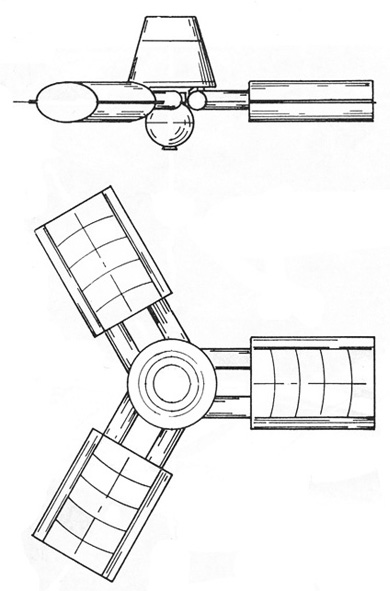
Meanwhile, in Houston, Texas, Edward Olling at the newly established Manned Spacecraft Center (MSC) was hard at work on a temporary space station program which he called Project Olympus. In April 1962, he circulated a draft planning document for comment; then, on 16 July 1962, he unveiled his Project Olympus “Summary Project Development Plan” to top-level MSC managers.
Olling explained that Project Olympus space stations would for the first time provide NASA with a large usable volume and enough scientific equipment, astronauts, and electrical power to carry out wide-ranging basic and applied research in space. Early station research would seek to answer basic questions about piloted spaceflight; for example, could humans work effectively for long periods in space? New objectives would be added over time. Beginning even with the first station, the Project Olympus stations would become space-environment research facilities, “national laboratories” for research into meteorology, geophysics, communications systems, navigation systems, and astronomy, and “orbital operations” facilities (that is, sites for assembling spacecraft bound for points beyond space station orbit). Each 138,600-pound Project Olympus station would comprise a large central hub with three evenly spaced arms. Each arm would include a pressurized crew module of oval cross-section nested between two cylindrical access tunnels. Apollo-derived logistics spacecraft (typical mass, 31,700 pounds), each bearing six astronauts, supplies, and equipment, would dock at the zero-gee central hub. The 150-foot-wide Project Olympus stations would spin four times per minute to create acceleration in their arms. On each station, the crew deck farthest from the hub would experience the greatest acceleration: the equivalent of one-quarter of Earth’s gravitational pull, or about midway between lunar and martian surface gravity. Crew decks closer to the hub would experience less acceleration. Olling hinted that the different levels of acceleration the astronauts would experience on decks at varying distances from the hub might be useful for scientific research, but he provided no specifics. (via Project Olympus (1962) – Wired Science)
Read more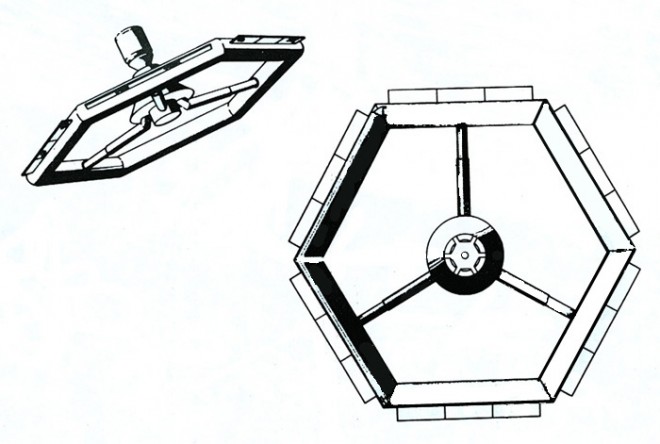
Langley Research Center (LaRC) was the early leader in NASA space station studies. A pioneering player in station work at the Hampton, Virginia-based laboratory was engineer Rene Berglund. He often designed stations that took advantage of existing or planned space hardware. In 1960, for example, Berglund designed a one-man space station comprising a metal-walled core, an inflatable fabric torus, a dish-shaped solar array, and a Mercury capsule at one end. At the time, Project Mercury had only recently begun flight testing. In May 1962, Berglund filed a patent for an “erectable” artificial-gravity space station that would reach orbit on a single two-stage Saturn C-5 (as the planned Saturn V rocket was then known). Folded atop its launch vehicle, Berglund’s station would measure just 33 feet across (the diameter of the rocket’s second stage, to which the station would joined as it ascended to orbit). The station would unfold in orbit into a hexagon 150 feet wide. Three spokes would link the hexagon to a central hub where piloted Apollo-derived logistics spacecraft would dock. The hexagon would revolve like a merry-go-round to create acceleration, which the crew inside would feel as gravity. “Down” would be away from the hub, toward the hexagon’s outer rim. (via Project Olympus (1962) – Wired Science)
Read moreRead moreThe seeding organisms need to survive and multiply in the target environments and establish a viable biosphere. Some of the new branches of life may develop intelligent beings who will further expand life in the galaxy. The messenger microorganisms may find diverse environments, requiring extremophile microorganisms with a range of tolerances, including thermophile (high temperature), psychrophile (low temperature), acidophile (high acidity), halophile (high salinity), oligotroph (low nutrient concentration), xerophile (dry environments) and radioresistant (high radiation tolerance) microorganisms. Genetic engineering may produce polyextremophile microorganisms with several tolerances. The target atmospheres will probably lack oxygen, so the colonizers should include anaerobic microorganisms. Colonizing anaerobic cyanobacteria may later establish atmospheric oxygen that is needed for higher evolution, as it happened on Earth. Aerobic organisms in the biological payload may be delivered to the planets later when the conditions are right, by comets that captured and preserved the capsules.
The development of eukaryote microorganisms was a major bottleneck to higher evolution on Earth. Including eukaryote microrganisms in the payload can bypass this barrier. Multicellular organisms are even more desirable, but being much heavier than bacteria, fewer can be sent. Hardy tardigrades (water-bears) may be suitable but they are similar to arthropods and would lead to insects. The body-plan of rotifers could lead to higher animals, if the rotifers can be hardened to survive interstellar transit.
Microorganisms or capsules captured in the accretion disc can be captured along with the dust into asteroids. During aqueous alteration the asteroids contain water, inorganic salts and organics, and astroecology experiments with meteorites showed that algae, bacteria, fungi and plant cultures can grow in the asteroids in these media. Microorganisms can then spread in the accreting solar nebula, and will be delivered to planets in comets and in asteroids. The microorganisms can grow on nutrients in the carrier comets and asteroids in the aqueous planetary environments, until they adapt to the local environments and nutrients on the planets.
Advanced missions
Significantly, panspermia missions can be launched by present or near-future technologies. However, more advanced technologies may be also used when these become available. The biological aspects of directed panspermia may be improved by genetic engineering to produce hardy polyextremophile microorganisms and multicellular organisms, suitable to diverse planetary environments. Hardy polyextremophile anaerobic multicellular eukaryots with high radiation resistance, that can form a self-sustaining ecosystem with cyanobacteria, would combine ideally the features needed for survival and higher evolution. For advanced missions, solar sails can use beam-powered propulsion accelerated by Earth-based lasers or ion thrusters propulsion to achieve speeds up to 0.01 c (3 x 10⁶ m/s), or by ion drives. Robots may provide in-course navigation, may control the reviving of the frozen microbes periodically during transit to repair radiation damage, and may also choose suitable targets. These propulsion methods and robotics are under development. Safeguards are needed against robot takeover, to assure that control remain in human control with a vested interest to continue our organic gene/protein life-form.
Microbial payloads may be also planted on hyperbolic comets bound for interstellar space. This strategy follows the mechanisms of natural panspermia by comets, as suggested by Hoyle and Wikramasinghe. The microorganisms would be frozen in the comets at interstellar temperatures of a few degrees Kelvin and protected from radiation for eons. It is unlikely that an ejected comet will be captured in another planetary system, but the probability can be increased by allowing the microbes to multiply during warm perihelion approach to the Sun, then fragmenting the comet. A 1 km radius comet would yield 4.2 x 10¹² one-kg seeded fragments, and rotating the comet would eject these shielded icy objects in random directions into the galaxy. This increases a trilion-fold the probability of capture in another planetary system, compared with transport by a single comet. Such manipulation of comets is a speculative long-term prospect.

Read moreThe Largest Discovered Structure in the Universe Contradicts Big-Bang Theory Cosmology
“While it is difficult to fathom the scale of this "large quasar group” (LQG), we can say quite definitely it is the largest structure ever seen in the entire universe,” said Dr Clowes of University of Central Lancashire’sJeremiah Horrocks Institute. “This is hugely exciting – not least because it runs counter to our current understanding of the scale of the universe. Even traveling at the speed of light, it would take 4 billion years to cross. This is significant not just because of its size but also because it challenges the Cosmological Principle, which has been widely accepted since Einstein. Our team has been looking at similar cases which add further weight to this challenge and we will be continuing to investigate these fascinating phenomena…”
http://www.dailygalaxy.com/my_weblog/2013/11/the-largest-discovered-structure-in-the-universe-contradicts-big-bang-theory-cosmology-weekend-featu.html

ISRO was founded in 1969. In the last 44 years, it has achieved remarkable feats on a shoe-string budget. India has its own satellites for communication, weather data, agricultural data, and military applications. ISRO’s R&D has not just helped India remain a technologically advanced country, it has also saved lives. In 1999, a fierce cyclone hit India’s east coast, killing more than 10,000 people. Earlier this year, an even more powerful cyclone hit the same region but caused only a handful deaths. One of the main reasons for this contrast is that India’s improved weather-monitoring systems provided accurate early warnings.
Read more“The rover will reach Venus in a relatively short time and will work there for several hours, unlike previous rovers they were sent to Venus in 1975 and 1978 and transmitted data for minutes”
ITAR-TASS : Russia to send exploration rover to Venus in mid-2020s
Read more "ITAR-TASS : Russia to send exploration rover to Venus in mid-2020s"
All of the planets discovered outside the Solar System, visualized – one of the the best infographics of the year.
LET’S GO
Read more
 The Committee to Nuke Elysium