Cinipix CEO Todd Slater said, “We knew we could approach this film in a new, non-traditional way and explore options that didn’t exist just a few years ago. Partnering with a privately owned commercial space company for an interstellar sci-fi film is now very logical and doable so we wanted to move fast and create something special. We certainly know it will add a fantastic and thrilling realism to our scenes.”

Read more

The upside of a major climate crisis is the prospect it offers to entirely liberate cities from their sordid heritage in the planet’s soil. A space colony is just a Dubai-style super-tall desert skyscraper – plus some zero-gravity bone depletion. A lunar colony is just a London mogul’s subterranean basement, without the crusties or the labour strikes.

Read more

sagansense:

It’s Time to Get Serious About Going to Mars, NASA Says

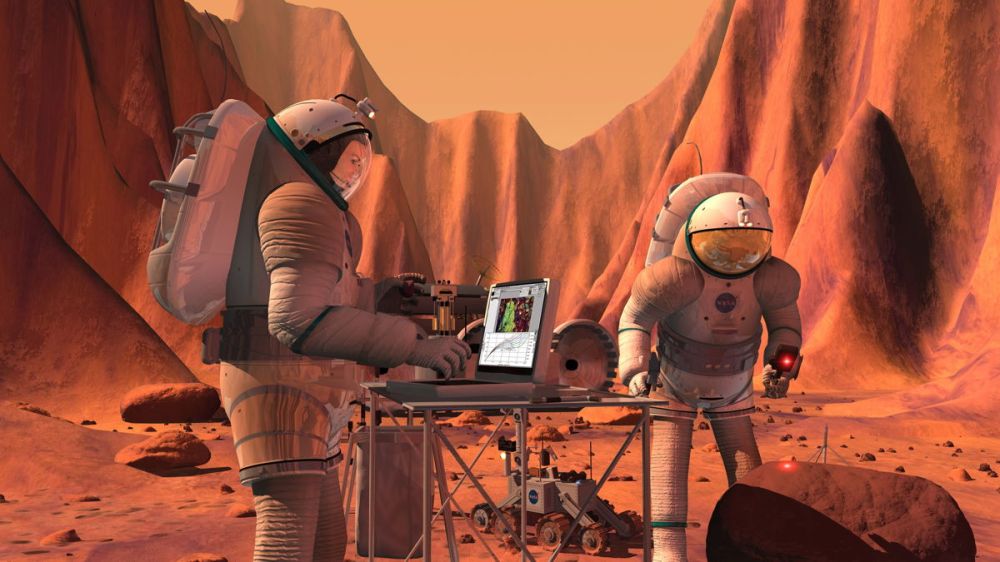
If NASA is to land humans on Mars by the 2030s, as President Barack Obama has directed, there’s not much time to settle on a plan and develop the technologies required, agency officials said Monday (May 6).

In the 1960s, America seized an opportunity to go to the moon, and succeeded. A second opportunity for a leap forward in space is upon us now, said NASA chief Charles Bolden at the Humans 2 Mars Summit here at George Washington University.

“Interest in sending humans to Mars I think has never been higher,” Bolden said. “We now stand on the precipice of a second opportunity to press forward to what I think is man’s destiny — to step onto another planet.” [Buzz Aldrin’s Visions for Mars Missions & More (Video)]

Yet the road to Mars is long and challenging, and the difficulties are scientific, technological, political and economic, experts said.

Of Launches and Landings
Sending astronauts to the Red Planet will likely require at least three missions: one to launch the crew and the vehicle that will take them to Mars, one to launch the habitat humans will live on at the planet’s surface, and one to launch the vehicle that will lift off from Mars to take the crew home, said Doug Cooke, a former NASA associate administrator for the Exploration Systems Mission Directorate who now heads a space consulting firm.

Overall, about 200 to 400 metric tons of equipment will have to be launched from Earth’s surface for the project — a mass roughly equivalent to that of the International Space Station. And about 40 metric tons of that mass will have to be delivered to the surface of Mars at one time. So far, NASA has been able to land only 1 metric ton at a time — a feat recently accomplished in nail-biting fashion when the agency landed the Curiosity rover last summer.

While this phase, called Mars entry, descent and landing, will be one of the most challenging elements of the mission, at least as difficult is the return, when the astronauts will have to lift off from the surface of Mars and travel home. [Missions to Mars: Robotic Invasion of Red Planet (Infographic)]

“To me this is one of the biggest challenges,” said Mike Raftery, director of space station utilization and exploration at Boeing, the primary contractor for NASA’s heavy-lift rocket being developed to go to Mars. “We have to essentially land a launch pad on the surface that’s then ready to launch the crew back to Earth.”

Watch: Flying To Mars – How Long Does It Take?

Living Off The Land
In addition to the launch system, Mars crews will have to bring their own life-support systems, medicine, food, communications systems and navigation equipment. Yet the space travelers won’t be able to pack everything they’ll need. Instead, they will have to take advantage of some of the resources on Mars, such as water and oxygen for breathing, drinking and other needs. However, the technologies needed to extract and use such resources don’t yet exist.

“We’re going to have to rely on being able to live off the land,” said James Reuther of NASA’s Office of the Chief Technologist. “Those will require significant technology investments in order to actually bring that about.”

Engineers must also develop a means of shielding astronauts from the dangerous radiation in space, both during the journey to the Red Planet and on the Martian surface, which lacks a strong enough atmosphere to protect from these damaging particles.

And to adequately plan for a human landing, additional precursor missions may also be necessary.

“It’s very likely that we’ll send some kind of lander or rover to the site we want to send people to first, to drill a couple meters down to tell us if we have fresh water,” said John Grunsfeld, associate administrator for NASA’s science mission directorate. Such a spacecraft could also serve as a beacon to guide the crewed lander down to the chosen spot on Mars.

Despite the complexity of all these challenges, NASA has a limited amount of time to plan its mission if it wants humans to arrive in the 2030s.

Ticking Clock
By 2020, engineers must choose an architecture for the mission, including what type of propulsion to use to get to Mars, and how many launches are required, said Sam Scimemi, NASA’s International Space Station director. It must also establish partnerships with any other nations it hopes to team with for the journey. By 2025, the design for all the major vehicles and technologies must be completed and frozen.

“That’s pencils down,” Scimemi said. “We don’t have a lot of time. If we’re going to get there we have to have a realistic approach from a budget, political and cultural standpoint.”

Still, many NASA and industry experts expressed confidence it can be done.

“In the coming days we have the opportunity to write history, to determine the future of humankind,” said Artemis Westenberg, president of Explore Mars Inc., the nonprofit space advocacy group that organized the conference. “We of Explore Mars give you this platform of this three-day summit. Now all you have to do is tell each other and the world the how” of getting to Mars.

You can watch the Humans 2 Mars Summit live on SPACE.com through May 8.

Read more

thescienceofreality:

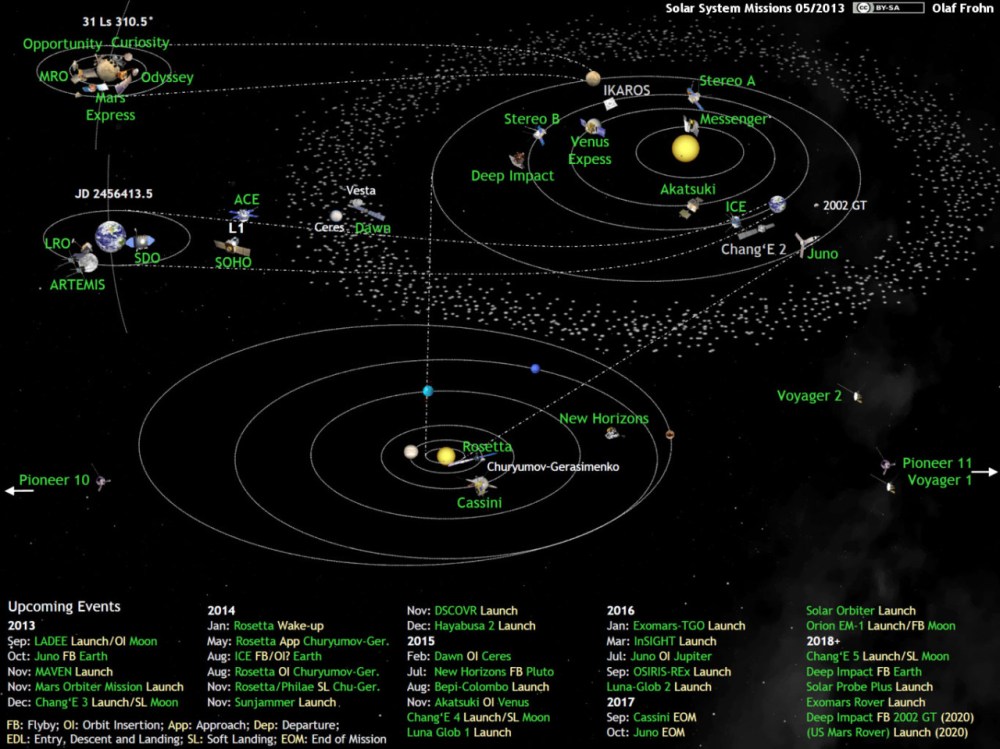
Humanity Explores the Solar System 

Illustration Credit & LicenseOlaf Frohn (The Planetary Society)

What spacecraft is humanity currently using to explore our Solar System? Presently, every inner planet has at least one robotic explorer, while several others are monitoring our Sun, some are mapping Earth’s Moon, a few are chasing asteroids and comets, one is orbiting Saturn, and several are even heading out into deep space. The above illustration gives more details, with the inner Solar System depicted on the upper right and the outer Solar System on the lower left. Given the present armada, our current epoch might become known as the time when humanity first probed its own star system. Sometimes widely separated spacecraft act together as an InterPlanetary Network to determine the direction of distant explosions by noting when each probe detects high energy photons. Future spacecraft milestones, as indicated along the bottom of the graphic, include Dawn reaching Ceres, the largest object in the asteroid belt, and New Horizons reaching Pluto, both in 2015.”

Read more

spaceplasma:

Jupiter’s Trojan Asteroids Show Their True Colors

Scientists using data from NASA’s Wide-field Infrared Survey Explorer, or WISE, have uncovered new clues in the ongoing mystery of the Jovian Trojans — asteroids that orbit the Sun on the same path as Jupiter. Like racehorses, the asteroids travel in packs, with one group leading the way in front of the gas giant, and a second group trailing behind.

The observations are the first to get a detailed look at the Trojans’ colors: both the leading and trailing packs are made up of predominantly dark, reddish rocks with a matte, non-reflecting surface. What’s more, the data verify the previous suspicion that the leading pack of Trojans outnumbers the trailing bunch.

The new results offer clues in the puzzle of the asteroids’ origins. Where did the Trojans come from? What are they made of? WISE has shown that the two packs of rocks are strikingly similar and do not harbor any “out-of-towners,” or interlopers, from other parts of the Solar System. The Trojans do not resemble the asteroids from the main belt between Mars and Jupiter, nor the Kuiper belt family of objects from the icier, outer regions near Pluto.

“Jupiter and Saturn are in calm, stable orbits today, but in their past, they rumbled around and disrupted any asteroids that were in orbit with these planets,” said Tommy Grav, a WISE scientist from the Planetary Science Institute in Tucson, Ariz. “Later, Jupiter re-captured the Trojan asteroids, but we don’t know where they came from. Our results suggest they may have been captured locally. If so, that’s exciting because it means these asteroids could be made of primordial material from this particular part of the Solar System, something we don’t know much about.” Grav is a member of the NEOWISE team, the asteroid-hunting portion of the WISE mission.

The first Trojan was discovered on Feb. 22, 1906, by German astronomer Max Wolf, who found the celestial object leading ahead of Jupiter. Christened “Achilles” by the astronomer, the roughly 220- mile-wide (350-kilometer-wide) chunk of space rock was the first of many asteroids detected to be traveling in front of the gas giant. Later, asteroids were also found trailing behind Jupiter. The asteroids were collectively named Trojans after a legend, in which Greek soldiers hid inside in a giant horse statue to launch a surprise attack on the Trojan people of the city of Troy.

“The two asteroid camps even have their own ‘spy,’” said Grav. “After having discovered a handful of Trojans, astronomers decided to name the asteroid in the leading camp after the Greek heroes and the ones in the trailing after the heroes of Troy. But each of the camps already had an ‘enemy’ in their midst, with asteroid ‘Hector’ in the Greek camp and ‘Patroclus’ in the Trojan camp.”

Other planets were later found to have Trojan asteroids riding along with them too, such as Mars, Neptune and even Earth, where WISE recently found the first known Earth Trojan.

Before WISE, the main uncertainty defining the population of Jupiter Trojans was just how many individual chunks were in these clouds of space rock and ice leading Jupiter, and how many were trailing. It is believed that there are as many objects in these two swarms leading and trailing Jupiter as there are in the entirety of the main asteroid belt between Mars and Jupiter.

To put this and other theories to bed requires a well-coordinated, well-executed observational campaign. But there were many things in the way of accurate observations — chiefly, Jupiter itself. The orientation of these Jovian asteroid clouds in the sky in the last few decades has been an impediment to observations. One cloud is predominantly in Earth’s northern sky, while the other is in the southern, forcing ground-based optical surveys to use at least two different telescopes. The surveys generated results, but it was unclear whether a particular result was caused by the problems of having to observe the two clouds with different instruments, and at different times of the year.

Enter WISE, which roared into orbit on Dec. 14, 2009. The spacecraft’s 16-inch (40-centimeter) telescope and infrared cameras scoured the entire sky looking for the glow of celestial heat sources. From January 2010 to February 2011, about 7,500 images were taken every day. The NEOWISE project used the data to catalogue more than 158,000 asteroids and comets throughout the Solar System.

“By obtaining accurate diameter and surface reflectivity measurements on 1,750 Jupiter Trojans, we increased by an order of magnitude what we knew about these two gatherings of asteroids,” said Grav. “With this information, we were able to more accurately than ever confirm there are indeed almost 40 percent more objects in the leading cloud.”

Trying to understand the surface or interior of a Jovian Trojan is also difficult. The WISE suite of infrared detectors was sensitive to the thermal glow of the objects, unlike visible-light telescopes. This means WISE can provide better estimates of their surface reflectivity, or albedo, in addition to more details about their visible and infrared colors (in astronomy “colors” can refer to types of light beyond the visible spectrum).

“Seeing asteroids with WISE’s many wavelengths is like the scene in ‘The Wizard of Oz,’ where Dorothy goes from her black-and-white world into the Technicolor land of Oz,” said Amy Mainzer, the principal investigator of the NEOWISE project at NASA’s Jet Propulsion Laboratory in Pasadena, Calif. “Because we can see farther into the infrared portion of the light spectrum, we can see more details of the asteroids’ colors, or, in essence, more shades or hues.”

The NEOWISE team has analyzed the colors of 400 Trojan asteroids so far, allowing many of these asteroids to be properly sorted according to asteroid classification schemes for the first time.

“We didn’t see any ultra-red asteroids, typical of the main belt and Kuiper belt populations,” said Grav. “Instead, we find a largely uniform population of what we call D-type asteroids, which are dark burgundy in color, with the rest being C- and P-type, which are more grey-bluish in color. More research is needed, but it’s possible we are looking at the some of the oldest material known in the Solar System.”

Scientists have proposed a future space mission to the Jupiter Trojans that will gather the data needed to determine their age and origins. Studying the Jupiter Trojans could provide astrobiologists with important information about how the Solar System has evolved over time, and the conditions that led Earth to become a habitable planet.

The results were presented at the 44th annual meeting of the Division for Planetary Sciences of the American Astronomical Society in Reno, Nev. Two studies detailing this research are accepted for publication in the Astrophysical Journal.

Source: JPL press release

Read more

NASA’s Transiting Exoplanet Survey Satellite (TESS), backed by Google and MIT, uses a set of onboard cameras to scan the skies for so-called exoplanets orbiting bright and nearby stars. Its objective is to discover terrestrial planets — ranging in size from Earth equivalents to gas giants — within habitable regions of space. TESS will deploy techniques similar to those used by the Kepler telescope, which has thus far identified more than 2,700 potential exoplanets, though its scope will be much broader.

“TESS will carry out the first space-borne all-sky transit survey, covering 400 times as much sky as any previous mission,” MIT’s George Ricker, TESS’ principle investigator, said in a statement. “It will identify thousands of new planets in the solar neighborhood, with a special focus on planets comparable in size to the Earth.”

Read more

breakingnews:

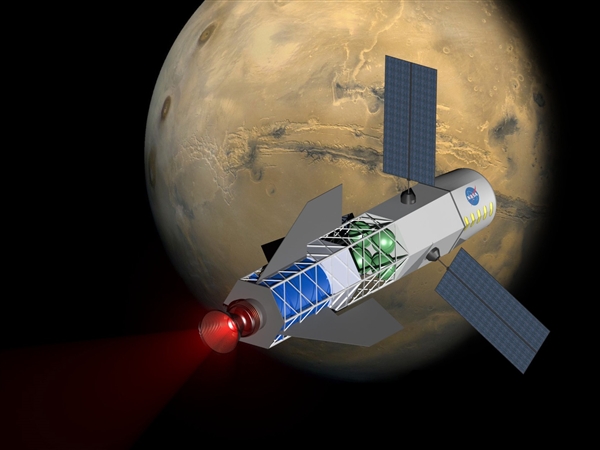
Scientists work on fusion rocket for Mars

NBC News: Researchers at the University of Washington say they’ve built all the pieces for a fusion-powered rocket system that could get a crew to Mars in 30 days. 

“If we can pull off a fusion demonstration in a year, with hundreds of thousands of dollars … there might be a better, cheaper, faster path to using fusion in other applications,” John Slough, a research assistant professor of aeronautics and astronautics, told NBC News. …

Timetables for the advent of fusion energy applications have repeatedly shifted to the right, reviving the old joke that the dawn of the fusion age will always be 30 years away.

Photo: An artist’s conception shows a spacecraft powered by a fusion-driven rocket. (UW / MSNW)

Read more

itsfullofstars:

sagansense:

NASA Mega-Rocket Could Lead to Skylab 2 Deep Space Station

NASA’s first manned outpost in deep space may be a repurposed rocket part, just like the agency’s first-ever astronaut abode in Earth orbit.

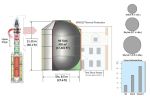
With a little tinkering, the upper-stage hydrogen propellant tank of NASA’s huge Space Launch System rocket would make a nice and relatively cheap deep-space habitat, some researchers say. They call the proposed craft “Skylab II,” an homage to the 1970s Skylab space station that was a modified third stage of a Saturn V moon rocket.

“This idea is not challenging technology,” said Brand Griffin, an engineer with Gray Research, Inc., who works with the Advanced Concepts Office at NASA’s Marshall Space Flight Center in Huntsville, Ala.

“It’s just trying to say, ‘Is this the time to be able to look at existing assets, planned assets and incorporate those into what we have as a destination of getting humans beyond LEO [low-Earth orbit]?’” Griffin said Wednesday (March 27) during a presentation with NASA’s Future In-Space Operations working group.

A roomy home in deep space
NASA is developing the Space Launch System (SLS) to launch astronauts toward distant destinations such as near-Earth asteroids and Mars. The rocket’s first test flight is slated for 2017, and NASA wants it to start lofting crews by 2021.

The SLS will stand 384 feet tall (117 meters) in its biggest (“evolved”) incarnation, which will be capable of blasting 130 metric tons of payload to orbit. Its upper-stage hydrogen tank is big, too, measuring 36.1 feet tall by 27.6 feet wide (11.15 m by 8.5 m).

The tank’s dimensions yield an internal volume of 17,481 cubic feet (495 cubic m) — roughly equivalent to a two-story house. That’s much roomier than a potential deep-space habitat derived from modules of the International Space Station (ISS), which are just 14.8 feet (4.5 m) wide, Griffin said.

The tank-based Skylab II could accommodate a crew of four comfortably and carry enough gear and food to last for several years at a time without requiring a resupply, he added. Further, it would launch aboard the SLS in a single piece, whereas ISS-derived habitats would need to link up multiple components in space.

Because of this, Skylab II would require relatively few launches to establish and maintain, Griffin said. That and the use of existing SLS-manufacturing infrastructure would translate into big cost savings — a key selling point in today’s tough fiscal climate.

“We will have the facilities in place, the tooling, the personnel, all the supply chain and everything else,” Griffin said.

He compared the overall concept with the original Skylab space station, which was built in a time of declining NASA budgets after the boom years of the Apollo program.

Skylab “was a project embedded under the Apollo program,” Griffin said. “In many ways, this could follow that same pattern. It could be a project embedded under SLS and be able to, ideally, not incur some of the costs of program startup.”

Living beyond the moon
Griffin and his colleagues envision placing Skylab II at the Earth-moon Lagrange point 2, a gravitationally stable location beyond the moon’s far side.

Over the past year or so, NASA has been drawing up plans for a possible manned outpost at EM-L2. A station there would establish a human presence in deep space, serve as a staging ground for lunar operations and help build momentum for exploring more distant destinations, such as asteroids and Mars, advocates say.

The Skylab II concept could also help ferry astronauts to these far-flung locales, Griffin said.

“You can build multiple vehicles,” he said. “If we were to send this one, the first one, out to Earth-moon L2, you could build another that that could be a transit hab. So rather than having to go back and use space station parts, you would be able to pick these off the line.”

I love Skylab.

Read more