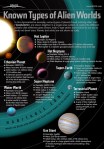
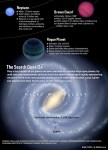
Read moreI’d argue about bundling brown dwarfs in with types of planet; even though they’re not massive enough to fuse hydrogen like true stars, they do fuse deuterium. Sometimes lithium too.
Read moreI’d argue about bundling brown dwarfs in with types of planet; even though they’re not massive enough to fuse hydrogen like true stars, they do fuse deuterium. Sometimes lithium too.

Read moreAlien Auroras
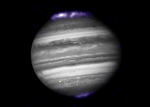
Earth’s auroras are created by charged particles from the sun interacting with our atmosphere, but they’re not just earthly phenomenon—Saturn and Jupiter have their own, although they’re not created in the same way. Jupiter spins on its axis once every 10 hours, dragging its magnetic field around to create a crackling swirl of electricity of over 10 million volts at both of its poles. Then charged particles of oxygen and sulfur shoot from Jupiter’s volcanic moon, Io, and interact with this storm of electricity, sparking a spectacular light show. Jupiter’s auroras are like Earth’s on asteroids—they’re 100 times brighter than ours, they never stop, and they’re so big they could envelop our entire planet. But auroras don’t just stop at our solar system—researchers have now found evidence of polar lights on alien planets orbiting distant stars. Using the Low-Frequency Array radio telescope based in the Netherlands, the researchers observed radio emissions they believe are caused by auroras on exoplanets. Since the emissions are powerful enough to be detectable over interstellar distances, the auroras causing them would be 100,000 times brighter than Jupiter’s. The findings suggest that these auroras are likely not formed by charged particles from solar wind—instead, the exoplanets detected so far may actually be dim, ultra-cool brown dwarfs, which are basically failed stars. Their auroras would likely behave more like Jupiter’s than Earth’s, and by studying them, researchers hope to gain insight into the exoplanets’ magnetic fields, moons, and even how they interacts with their parent star.
n-a-s-a:
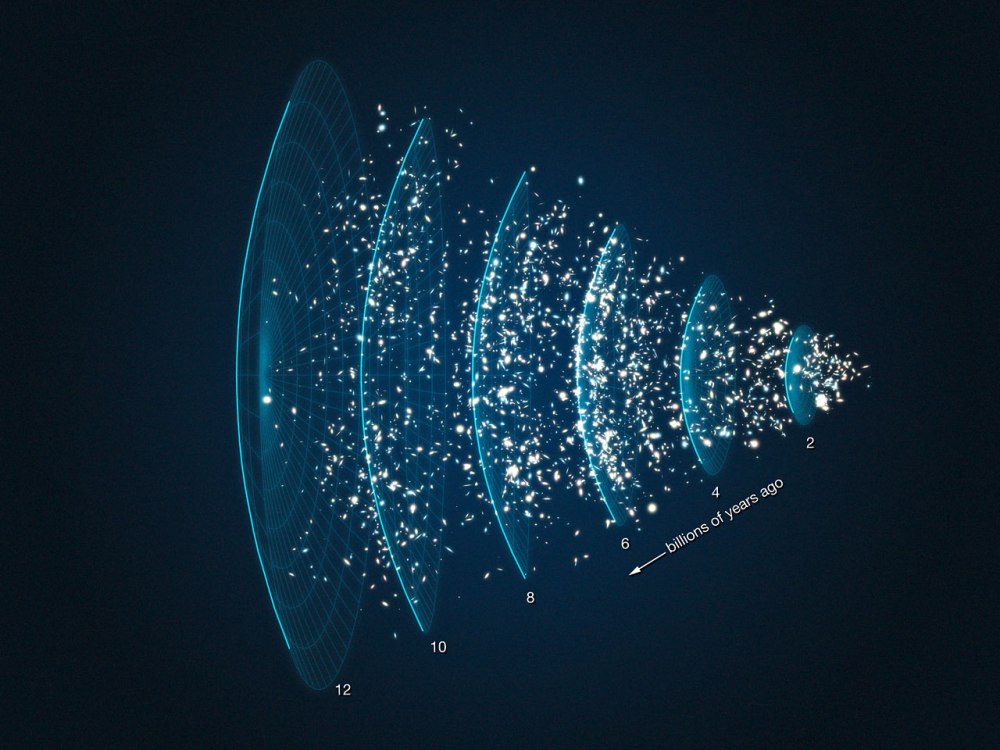
Visualisation of galaxies from the ESO GOODS spectroscopic campaign
Credit: ESO/L. Calçada/ESO-GOODS team
Read more

Read more‘Habitable Zone’ for Alien Planets, and Possibly Life, Redefined
One of the most important characteristics of an alien planet is whether or not it falls into what’s called the habitable zone — a Goldilocks-like range of not-too-close, not-too-far distances from the parent star that might allow the planet to host life.Now scientists have redefined the boundaries of the habitable zone for alien planets, potentially kicking out some exoplanaets that were thought to fall within it, and maybe allowing a few that had been excluded to squeeze in.
“This will have a significant impact on the number of exoplanets that are within habitable zone,” said research team leader Ravi Kumar Kopparapu of Penn State University.
The habitable zone defines the region where a planet might be able to retain liquid water on its surface. Any closer to the star and water would vaporize away; any farther, and it would freeze to ice. But water in its liquid state is what scientists are after, since that is thought to be a prerequisite for life.
The new definition of the habitable zone is based on updated atmospheric databases called HITRAN (high-resolution transmission molecular absorption) and HITEMP (high-temperature spectroscopic absorption parameters), which give the absorption parameters of water and carbon dioxide — two properties that strongly influence the atmospheres of exoplanets, determining whether those planets could host liquid water. [9 Exoplanets That Could Host Alien Life]
The scientists cautioned that the habitable zone definition still does not take into account feedback effects from clouds, which will also affect a planet’s habitability.
The previous habitable zone definitions were derived about 20 years ago by Penn State researcher James Kasting, who was also part of the team behind the updates.
“At the time when he wrote that paper no exoplanets were discovered,” Kopparapu told SPACE.com. “In 20 years, hundreds, maybe thousands have been discovered.”
The new definition isn’t radically different from the old one. For example, in our own solar system, the boundaries of the habitable zone have shifted from between 0.95 astronomical units (AU, or the distance between Earth and the sun) and 1.67 AU, to the new range of 0.99 AU to 1.7 AU.
“It’s a surprise that Earth is so close to the inner edge of the habitable zone,” said astronomer Abel Méndez of the University of Puerto Rico at Arecibo, who was not part of the team behind the redefinition.
Méndez manages a list, called the Habitable Exoplanet Catalog, off all the known planets beyond our solar system that could be habitable to life. The new study will necessitate some adjustments to the catalog, he said.
“Right now as I see it as a significant change,” Méndez said. “Many of those planets that we believe were inside are now outside. But on the other side, it extends the habitable zone’s outer edge, so a few planets that are farther away might fall inside the habitable zone now.”
He mentioned one planet in particular, Gliese 581d, was thought to lie at the outer edge of its star’s habitable zone. With the new definition, though, it falls almost smack in the middle, making it perhaps a better candidate for extraterrestrial life.
“That will be a big change for that particular planet,” Méndez said. “That means the prospects for life on the planet will be much better.”
The researchers detail their new habitable zone definition in a paper to be published in an upcoming issue of the Astrophysical Journal.
To explore the Habitable Planet Catalog directy, visit: http://phl.upr.edu/projects/habitable-exoplanets-catalog
image 1: A new definition of the habitable zone around planets, denoting where liquid water could exist, shifts Earth toward the very edge of the solar system’s own habitable zone.
CREDIT: PHL @ UPR Arecibo, Rogelio Bernal Andreo
image 2: The graphic shows habitable zone distances around various types of stars, according to an updated habitable zone definition. Some of the known extrasolar planets that are considered to be in the habitable zone of their stars are also shown. On this scale, Earth-Sun distance is 1 astronomical unit, which is roughly 150 million kilometers.
CREDIT: Chester Herman
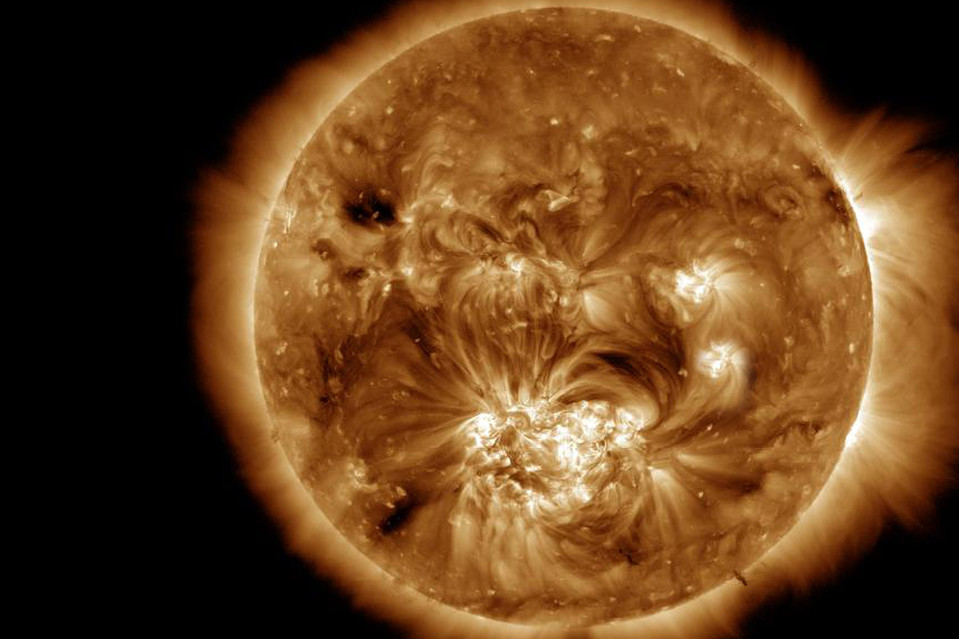
Read moreIN WHICH WE BURN A solar eruption, imaged by NASA’s Solar Dynamics Observatory, reveals evidence of magnetic “braids” caused by the swirling of plasma on the Sun’s surface. (Photo: NASA / National News / Zuma Press via The Wall Street Journal)
Read moreOnce the Dragon is attached to the forward Harmony module, the station’s robot arm will be used to pull the BEAM pallet from the cargo craft’s unpressurized payload bay and attach it to the aft hatch of the port-side Tranquility module, 90 degrees up from the familiar multi-window Earth-facing cupola compartment. The space station crew then will activate the BEAM’s pressurization system to inflate it.
Over the course of its two-year test run, instruments will measure its structural integrity and leak rate, along with temperature and radiation levels. The hatch leading into the module will remain mostly closed except for periodic visits by space station crew members for inspections and data collection. Following the test run, the module will be detached and jettisoned from the station.
Read moreEarth-Size Planets Common in Galaxy: 17 Percent of Sun-Like Stars Have Planets Within the Orbit of Mercury |
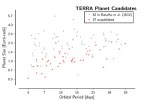
An analysis of the first three years of data from NASA’s Kepler mission, which already has discovered thousands of potential exoplanets, contains good news for those searching for habitable worlds outside our solar system.
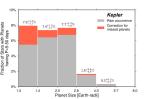
This estimate includes only planets that circle their stars within a distance of about one-quarter of Earth’s orbital radius – well within the orbit of Mercury – that is the current limit of Kepler’s detection capability. Further evidence suggests that the fraction of stars having planets the size of Earth or slightly bigger orbiting within Earth-like orbits may amount to 50 percent.
The team – UC Berkeley graduate student Erik Petigura, former UC Berkeley post-doctoral fellow Andrew Howard, now on the faculty of the Institute for Astronomy at the University of Hawaii, and UC Berkeley professor of astronomy Geoff Marcy – reported their findings today (Tuesday, Jan. 8) at a session on the Kepler mission during the American Astronomical Society meeting in Long Beach, Calif.
“Our key result is that the frequency of planets increases as you go to smaller sizes, but it doesn’t increase all the way to Earth-size planets – it stays at a constant level below twice the diameter of Earth,” Howard said.
Francois Fressin of the Harvard-Smithsonian Center for Astrophysics presented nearly identical results yesterday at the meeting, reporting that one in six stars, or at least 17 billion stars in the Milky Way Galaxy, have an Earth-size planet within an orbit like Mercury’s.
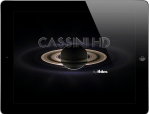


Read morecool iPad app celebrating the Cassini mission to Saturn
Cassini HD – Explore Saturn Via iPad
Our very own science/art Tumblrer stacythinx has been hard at work designing the Cassini HD iPad app, available Sept. 15 in the iTunes store (that’s tomorrow!). It will be free for the first day, by the way (I’ll add the link when it goes live).
I’ve had a chance to play with the app, and it’s really something special. NASA’s Cassini mission has provided us with what I think is the greatest catalogue of planetary images from our solar system. Saturn is such a visually striking celestial body, and exploring its moons and rings via photography gives us the ability to take a digital rocket tour with just a single click.
The Cassini HD app delivers more than just pretty pictures, of course. Tap an image to find out a little bit of the context behind each photo, and any of them can be shared on Tumblr, Twitter, Facebook, etc. right in the app. My only complaint about the app is that there isn’t more written, but the pictures are informative on their own, and still serve to inspire further study. The philosophy behind this project, and Stacey’s Tumblr, is making knowledge beautiful. Mission accomplished!
I give it a rating of 10 rings out of 10. Go get it tomorrow!
In space noone can hear you groom…. unless you beam it to the internets

 The Committee to Nuke Elysium