
Read moreFYI – ZERO. Vol 1 – in stores February 19.
Diamond Code: DEC130554
RRP: $9.99Come to us.
Read moreFor a large portion of the American/Western/advanced-industrial film audience, travel might be the activity in which geopolitics most noticeably intrudes on their lives — in the inconvenience of borders, passports, languages, currencies, customs. But none of that fazes the spy. He either circumvents restrictions entirely or he comes equipped with the tools he needs to pass through them. He doesn’t wait in line unless he’s in disguise.
What’s the first thing the spy does after arriving in a new city? You and I haul our bags to the hotel and stand shifting our weight while a bored clerk pecks at a keyboard; the spy is led briskly to an all-white room where he’s left alone with a safety deposit box. Inside the box: multiple passports, a wad of cash in different currencies, a gun with a silencer, an envelope with the name of a contact — everything he needs to navigate his new surroundings. If we see his hotel, it’s luxurious. If we see him on a plane, he’s either flying it himself or it’s a private jet. We are repeatedly shown — more often, or at least more indelibly, than in the books some of these stories are based on — that the elements of travel we ourselves find exhausting and stressful have been magically made easy for the spy.3 The spy never worries about not understanding a language; whatever it is, he already speaks it, and fluently, with no trace of an accent. Instead of sitting around in train stations and dealing with subway platforms, something he’ll do only if it’s part of a chase, the spy procures a car (who knows how) or a helicopter, or a speedboat, or whatever vehicle he needs, which he always knows how to operate expertly, even if it’s a Soviet tank. And you’d better believe he knows his way around at 100 miles an hour — he’ll take shortcuts the locals haven’t discovered yet. None of your panicked on-the-fly deciphering of Parisian road signs in your rented Renault Twingo.
When you and I pack for a trip, we’re so preemptively defeated by the thought of weather and strange places that we take crushable hats and wicking layers and comfort-fit pants with legs that zip off at the knee. The spy, whether he’s stylish like Bond or casual like Jason Bourne, never looks like he’s traveling. But rain or shine, he always has just the right outfit. That may be why, whereas we stick to tourist areas and look in a guidebook to figure out where to have dinner, the spy can go anywhere he wants. He strolls into the classiest and most dangerous bars, the finest and grimiest restaurants, the ritziest and seediest casinos.
Read moreMohammed graduated from North Carolina A&T State University with a degree in mechanical engineering in 1986. It’s not clear whether Mohammed was interested in designing a better vacuum or had ulterior motives. He might have intended to use the plans to conceal secret information or trick his jailers.
In Graham Greene’s spy thriller “Our Man in Havana,” a vacuum salesman in Cuba agrees to work for MI6, the British spy service. He dupes the British into believing his vacuum designs are military installations. The AP was unable to determine whether Mohammed ever read the famous novel.
It remains a mystery how far Mohammed got with his designs or whether the plans still exist. The secret CIA prison in Romania was shuttered in early 2006 and Mohammed was transferred later that year to Guantanamo Bay Naval Base prison, where he remains. It’s unlikely he was able to take his appliance plans to Cuba.
Mohammed’s military lawyer, Jason Wright, said he was prohibited from discussing his client’s interest in vacuums.
“It sounds ridiculous, but answering this question, or confirming or denying the very existence of a vacuum cleaner design, a Swiffer design, or even a design for a better hand towel would apparently expose the U.S. government and its citizens to exceptionally grave danger,” Wright said.
But Wright added that he often discussed “modern technological innovations” and the “scientific wonders” of the Quran with Mohammed. He called Mohammed “exceptionally intelligent.”
“If he had access to educational programs in Guantanamo Bay, such as distance learning programs, I am confident that in addition to furthering his Islamic studies, he could obtain a Ph.D. in mechanical engineering, and very likely patent inventions,” Wright said.
The CIA won’t discuss the Mohammed’s vacuum plans, either. The AP asked the CIA for copies of the vacuum designs or any government records about them under the Freedom of Information Act.
The CIA responded in a letter to the AP that the records, “should they exist,” would be considered operational files of the CIA — among its most highly classified category of government files — and therefore exempt from ever being released to the public.
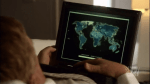


“It’s an asymmetric weapon, and it’s in the hands of a billionaire psychopath”
“All the power at our disposal… We can’t find one man with a laptop.”
“Gerhardt has the resources to become invisible. He has gone to ground and we can’t find him.”
The invisible billionaire “Bond Villain” of season 1 of XIII: The Series, Rainer Gerhardt taking down the world’s infrastructure, whilst lying on a couch in an unknown location.
Call back to piece on Spartan by Matt Jones:
…the modern Bond villain (and he might have added, villains in pop culture in general) is placeless, ubiquitous, mobile. His hidden fortress is in the network, represented only by a briefcase, or perhaps even just a mobile phone.
Or a rugged laptop.
Read more The Committee to Nuke Elysium