Read moreFirst lofted into orbit in the 1970s, the FLTSATCOM bird was at the time a major advance in military communications. Their 23 channels were used by every branch of the U.S. armed forces and the White House for encrypted data and voice, typically from portable ground units that could be quickly unpacked and put to use on the battlefield.
As the original FLTSAT constellation of four satellites fell out of service, the Navy launched a more advanced UFO satellite (for Ultra High Frequency Follow-On) to replace them. Today, there are two FLTSAT and eight UFO birds in geosynchronous orbit. Navy contractors are working on a next-generation system called Mobile User Objective System beginning in September 2009.
Until then, the military is still using aging FLTSAT and UFO satellites — and so are a lot of Brazilians. While the technology on the transponders still dates from the 1970s, radio sets back on Earth have only improved and plummeted in cost — opening a cheap, efficient and illegal backdoor.
To use the satellite, pirates typically take an ordinary ham radio transmitter, which operates in the 144- to 148-MHZ range, and add a frequency doubler cobbled from coils and a varactor diode. That lets the radio stretch into the lower end of FLTSATCOM’s 292- to 317-MHz uplink range. All the gear can be bought near any truck stop for less than $500. Ads on specialized websites offer to perform the conversion for less than $100. Taught the ropes, even rough electricians can make Bolinha-ware.
“I saw it more than once in truck repair shops,” says amateur radio operator Adinei Brochi (PY2ADN) “Nearly illiterate men rigged a radio in less than one minute, rolling wire on a coil.”
street
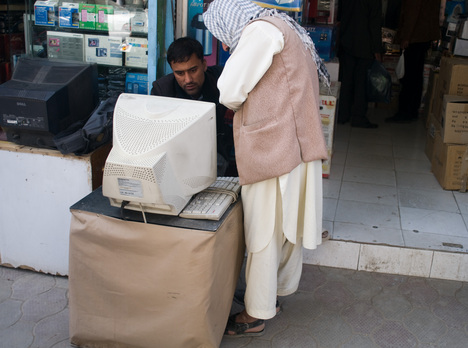
Many Kabuli residents looking for new mobile phone ringtones, wallpapers and applications to spice up their mobile phone turn to their neighbourhood content kiosk – all that is needed to set up as a vendor is a PC; access to power; a DVD starter pack of pirated content and walk-by trade. Whilst the market today is dominated by stand-alone specialists this will change.
Expect to see three disruptions in this space: the prevalence of cheap net books will lower the cost of entry and enabled vendors without constant access to mains power and/or a backup generator to set up shop – currently most content sits on desktop PC’s, the mobility offered by net books make it feasible to perch a unit to the side of a shop counter and gives the vendor something to do (playing games) whilst waiting for the next customer; the global move towards Micro-USB for charging mobile phones will also lower the barriers to transfer data – currently there are numerous methods to move data from PC to mobile phone and the consumer experience is highly variable – a standardised service makes it more of a viable proposition, and the net book is also able to function as a charging hub, and whilst not ideal it enables drop-off/ transfer/pick-up type behaviours; a shorter distance to the nearest internet connected hub to download/obtain recent content for resale. (via Street Kiosk App Stores: 3 Disruptions to Watch – Jan Chipchase – Future Perfect)
Read more The Committee to Nuke Elysium