New observations with ESO’s Very Large Telescope (VLT) in Chile have revealed alignments over the largest structures ever discovered in the Universe. A European research team has found that the rotation axes of the central supermassive black holes in a sample of quasars are parallel to each other over distances of billions of light-years. The team has also found that the rotation axes of these quasars tend to be aligned with the vast structures in the cosmic web in which they reside.

Quasars are galaxies with very active supermassive black holes at their centers. These black holes are surrounded by spinning discs of extremely hot material that is often spewed out in long jets along their axes of rotation. Quasars can shine more brightly than all the stars in the rest of their host galaxies put together.

A team led by Damien Hutsemékers from the University of Liège in Belgium used the FORS instrument on the VLT to study 93 quasars that were known to form huge groupings spread over billions of light-years, seen at a time when the Universe was about one third of its current age.

“The first odd thing we noticed was that some of the quasars’ rotation axes were aligned with each other — despite the fact that these quasars are separated by billions of light-years,” said Hutsemékers.

The new VLT results also indicate that the rotation axes of the quasars tend to be parallel to the large-scale structure in which they find themselves — a cosmic web of filaments and clumps around huge voids where galaxies are scarce.

So, if the quasars are in a long filament then the spins of the central black holes will point along the filament. The researchers estimate that the probability that these alignments are simply the result of chance is less than 1%.

via Spooky alignment of quasar axes across billions of light-years with large-scale structure | KurzweilAI

Read more

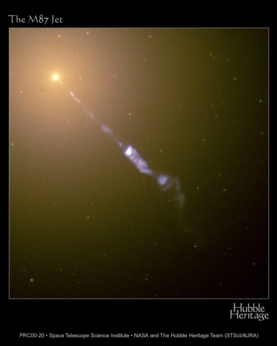
M87 possesses an enormous number of tightly packed star clusters called globulars. Whereas the Milky Way has about 160 known globular clusters M87 boasts some 10,000. Moreover, M87’s center has a black hole that dwarfs the Milky Way’s, weighing six billion to seven billion times more than the sun, over a thousand times as massive as the four-million–solar mass black hole occupying the Milky Way’s center…

If M87’s black hole actually consists of two black holes orbiting each other, they could fling away a star cluster that strayed too near. The cluster’s gravity causes the two black holes to get a little closer together, making them lose orbital energy that gets transferred to the star cluster.

Read more

Giant elliptical galaxies are the most puzzling type of galaxy in the Universe. Since they mysteriously shut down their star-forming activity and remain home only to the longest-lived of their stars – which are low-mass ones and appear red – astronomers often call these galaxies ‘red and dead’.

Up until now, it was thought that red-and-dead galaxies were poor in cold gas – the vital raw material from which stars are born. While cold gas is abundant in spiral galaxies with lively star formation, the lack of it in giant ellipticals seemed to explain the absence of new stars.

While the six galaxies with plenty of cold gas harbour moderately active black holes at their centres, the other two show a marked difference. In the two galaxies without cold gas, the central black holes are accreting matter at frenzied pace, as confirmed by radio observations showing powerful jets of highly energetic particles that stem from their cores.

The jets could be an effect of the hot gas cooling down, and flowing towards the centre of the galaxies. This inflow of cold gas can boost the black hole’s accretion rate, launching the jets that are observed at radio wavelengths.

The jets, in turn, have the potential to reheat the galaxy’s reservoir of cold gas – or even to push it beyond the galaxy’s reach. This scenario can explain the absence of star formation in all the galaxies observed in this study and, at the same time, the lack of cold gas in those with powerful jets.

“These galaxies are red, but with the giant black holes pumping in their hearts, they are definitely not dead,” comments Werner.

Read more