Read moreThink, for example, of WikiLeaks founder Julian Assange holed up in the Ecuadorian embassy in west London, or of Edward Snowden, the Prism whistleblower currently in his Hong Kong hotel. Both are now in exceptional spaces, holes in the continuum of globalised digital space. These strange anomalies are perhaps the only escapes from the ever-present digital backdoor, the only respite from the colonisation of earth by digital culture.
technomad inspirations


Literal ‘walking through walls’ scene from A Good Day to Die Hard.
Call back to the BLDBLG piece on Die Hard and Lethal Theory.
(And highlight of the whole day-um awful film)
Read moreRead moreThe best expression of countercultural lines of flight, however, can be seen in the the back-to-land movement in the United States in the late 1960s. Drop City, in Colorado, was the first of many hippie communities that sought to create a new kind of society. Between 1965 and 1973, thousands of middle class kids, in flight from Mom and Dad, society, the draft, careers, and social conventions of all kinds, came to Drop City and other communes like it in search of freedom and alternative lifestyles. The culture got by with a minimum of rules. Everything was set up to enable free-wheeling, nomadic lifestyles, which could be recreated or escaped at a moment’s notice. Nomadism, as Deleuze and Guattari understand it, doesn’t require moving around. You can sit still and be a nomad. Nomadism is a way of being. It involves refusing to be tied down by set categories and definitions. It is driven by a desire to experiment and explore, to learn, grow, and boldly venture forth on creative lines of flight.
…
Nomadism is a cultural norm. While there are plenty of people who simply want to ‘fit in’, the best and the brightest want to break out and head for the horizon.
When we look into the future, we dream of a world that is radically different from the one we know today. We may be stuck in offices, trapped in traffic, tied down by debt or shacked to unhappy relationships. Inside, we are nomads. We are already in flight. The mainland awaits.

Rather than Bond’s private infrastructure expensive cars and toys, Bourne uses public infrastructure as a superpower.
A battered watch and an accurate U-Bahn time-table are all he needs for a perfectly-timed, death-defying evasion of the authorities.
As Rod has already pointed out:
“Jason Bourne is the man-as-weapon, never troubled by indecision or doubt, immediately responsive, unbalancing his enemies’ battlefield underneath them. He moves forward constantly, like a shark, and lives in a fast forward that’s the exact opposite of bullet-time – blurred fragments experienced at extraordinary speed – and his reactions are all reflex-fast”
But in addition, Bourne wraps cities, autobahns, ferries and train terminuses around him as the ultimate body-armour, in ways that Old Etonians could never even dream of.
Read moreWarren Ellis » The Manfred Macx Media Diet
“Do you ever feel like that upon waking? Six hours behind the moment. Sleeping took you off the road to the future.”
Warren Ellis » The Manfred Macx Media Diet
Read more "Warren Ellis » The Manfred Macx Media Diet"Read moreUsing the theoretical idioms of ‘smooth and striated space’ (Deleuze and Guattari, 1987, A Thousand Plateaus Continuum, London) and ‘the event’ (Badiou, 2005, Being and Event Continum, London), this paper will position parkour as an alternate way of theorising the city as an arena for capitalist versus subversive practices. Moving away from the idea of smooth space incorporating a ‘war machine’, the Badiouian event is a more appropriate lens through which to theorise parkour and its participants’ relationship with the city, in that it embraces a serene ethos of urban rediscovery.
Weizman goes on to interview a commander of the Israeli Paratrooper Brigade. The commander describes his forces as acting “like a worm that eats its way forward, emerging at points and then disappearing. We were thus moving from the interior of homes to their exterior in a surprising manner and in places we were not expected, arriving from behind and hitting the enemy that awaited us behind a corner.”
This is how the troops could “adjust the relevant urban space to our needs,” he explains, and not the other way around.
Indeed, the commander thus exhorted his troops as follows: “There is no other way of moving! If until now you were used to moving along roads and sidewalks, forget it! From now on we all walk through walls!”
…
In fact, I’m reminded of a scene toward the end of the recent WWII film Days of Glory in which we see a German soldier blasting his way horizontally through a house, wall by wall, using his bazooka as a blunt instrument of architectural reorganization—"adjusting the relevant space to his needs,“ we might say—and chasing down the French troops without limiting himself to doors or stairways.
In any case, post-battle surveys later revealed that "more than half of the buildings in the old city center of Nablus had routes forced through them, resulting in anywhere from one to eight openings in their walls, floors, or ceilings, which created several haphazard crossroutes"—a heavily armed improvisational navigation of the city.
So why do I mention all this in the context of Die Hard? The majority of that film’s interest, I’d suggest, comes precisely through its depiction of architectural space: John McClane, a New York cop on his Christmas vacation, moves through a Los Angeles high-rise in basically every conceivable way but passing through its doors and hallways.
…
Over the course of the film, McClane blows up whole sections of the building; he stops elevators between floors; and he otherwise explores the internal spaces of Nakatomi Plaza in acts of virtuoso navigation that were neither imagined nor physically planned for by the architects.
His is an infrastructure of nearly uninhibited movement within the material structure of the building.
…
What I find so interesting about Die Hard—in addition to unironically enjoying the film—is that it cinematically depicts what it means to bend space to your own particular navigational needs. This mutational exploration of architecture even supplies the building’s narrative premise: the terrorists are there for no other reason than to drill through and rob the Nakatomi Corporation’s electromagnetically sealed vault.
Die Hard asks naive but powerful questions: If you have to get from A to B—that is, from the 31st floor to the lobby, or from the 26th floor to the roof—why not blast, carve, shoot, lockpick, and climb your way there, hitchhiking rides atop elevator cars and meandering through the labyrinthine, previously unexposed back-corridors of the built environment?
Why not personally infest the spaces around you?
…
For example, Weizman outlines what the Israeli Defense Forces call "hot pursuit"—that is, to "break into Palestinian controlled areas, enter neighborhoods and homes in search of suspects, and take suspects into custody for purposes of interrogation and detention.” This becomes a spatially extraordinary proposition when you consider that someone could be kidnapped from the 4th floor of a building by troops who have blasted through the walls and ceilings, coming down into that space from the 5th floor of a neighboring complex—and that the abductors might only have made it that far in the first place after moving through the walls of other structures nearby, blasting upward through underground infrastructure, leaping terrace-to-terrace between buildings, and more.
…
If Jason Bourne’s actions make visible the infrastructure-rich, borderless world of the EU, then John McClane shows us a new type of architectural space altogether—one that we might call, channeling topology, Nakatomi space, wherein buildings reveal near-infinite interiors, capable of being traversed through all manner of non-architectural means. In all three cases, though—with Bond, Bourne, and McClane—it is Hollywood action films that reveal to us something very important about how cities can be known, used, and navigated: these films are filled with the improvisational crossroutes that constitute Eyal Weizman’s “Lethal Theory.”
…
On the other hand, as Weizman points out, this is not a new approach to built space at all:
“In fact, although celebrated now as radically new, many of the procedures and processes described above have been part and parcel of urban operations throughout history. The defenders of the Paris Commune, much like those of the Kasbah of Algiers, Hue, Beirut, Jenin, and Nablus, navigated the city in small, loosely coordinated groups moving through openings and connections between homes, basements, and courtyards using alternative routes, secret passageways, and trapdoors.”
This is all just part of “a ghostlike military fantasy world of boundless fluidity, in which the space of the city becomes as navigable as an ocean.”
Treated as an architectural premise, Die Hard becomes an exhilarating catalog of unorthodox movements through space.
http://bldgblog.blogspot.co.uk/2010/01/nakatomi-space.html
space and time and fictional realities
Manfred has a suite at the Hotel Jan Luyken paid for by a grateful multinational consumer protection group, and an unlimited public transport pass paid for by a Scottish sambapunk band in return for services rendered. He has airline employee’s travel rights with six flag carriers despite never having worked for an airline. His bush jacket has sixty-four compact supercomputing clusters sewn into it, four per pocket, courtesy of an invisible college that wants to grow up to be the next Media Lab. His dumb clothing comes made to measure from an e-tailor in the Philippines he’s never met. Law firms handle his patent applications on a pro bono basis, and boy, does he patent a lot – although he always signs the rights over to the Free Intellect Foundation, as contributions to their obligation-free infrastructure project.
In IP geek circles, Manfred is legendary; he’s the guy who patented the business practice of moving your e-business somewhere with a slack intellectual property regime in order to evade licensing encumbrances. He’s the guy who patented using genetic algorithms to patent everything they can permutate from an initial description of a problem domain – not just a better mousetrap, but the set of all possible better mousetraps. Roughly a third of his inventions are legal, a third are illegal, and the remainder are legal but will become illegal as soon as the legislatosaurus wakes up, smells the coffee, and panics. There are patent attorneys in Reno who swear that Manfred Macx is a pseudo, a net alias fronting for a bunch of crazed anonymous hackers armed with the Genetic Algorithm That Ate Calcutta: a kind of Serdar Argic of intellectual property, or maybe another Bourbaki math borg. There are lawyers in San Diego and Redmond who swear blind that Macx is an economic saboteur bent on wrecking the underpinning of capitalism, and there are communists in Prague who think he’s the bastard spawn of Bill Gates by way of the Pope.
Manfred is at the peak of his profession, which is essentially coming up with whacky but workable ideas and giving them to people who will make fortunes with them. He does this for free, gratis. In return, he has virtual immunity from the tyranny of cash; money is a symptom of poverty, after all, and Manfred never has to pay for anything.
There are drawbacks, however. Being a pronoiac meme-broker is a constant burn of future shock – he has to assimilate more than a megabyte of text and several gigs of AV content every day just to stay current. The Internal Revenue Service is investigating him continuously because it doesn’t believe his lifestyle can exist without racketeering. And then there are the items that no money can’t buy: like the respect of his parents. He hasn’t spoken to them for three years, his father thinks he’s a hippy scrounger, and his mother still hasn’t forgiven him for dropping out of his down-market Harvard emulation course. (They’re still locked in the boringly bourgeois twen-cen paradigm of college-career-kids.) His fiance and sometime dominatrix Pamela threw him over six months ago, for reasons he has never been quite clear on. (Ironically, she’s a headhunter for the IRS, jetting all over the place at public expense, trying to persuade entrepreneurs who’ve gone global to pay taxes for the good of the Treasury Department.) To cap it all, the Southern Baptist Conventions have denounced him as a minion of Satan on all their websites.
…
Franklin clears his throat. “I’ll be needing an NDA and various due-diligence statements off you for the crusty pilot idea,” he says to Manfred. “Then I’ll have to approach Jim about buying the IP.”
“No can do.” Manfred leans back and smiles lazily. “I’m not going to be a party to depriving them of their civil rights. Far as I’m concerned, they’re free citizens. Oh, and I patented the whole idea of using lobster-derived AI autopilots for spacecraft this morning – it’s logged all over the place, all rights assigned to the FIF. Either you give them a contract of employment, or the whole thing’s off.”
“But they’re just software! Software based on fucking lobsters, for God’s sake! I’m not even sure they are sentient – I mean, they’re what, a ten-million-neuron network hooked up to a syntax engine and a crappy knowledge base? What kind of basis for intelligence is that?”Manfred’s finger jabs out: “That’s what they’ll say about you, Bob. Do it. Do it or don’t even think about uploading out of meatspace when your body packs in, because your life won’t be worth living. The precedent you set here determines how things are done tomorrow. Oh, and feel free to use this argument on Jim Bezier. He’ll get the point eventually, after you beat him over the head with it. Some kinds of intellectual land grab just shouldn’t be allowed.”
“Lobsters – ” Franklin shakes his head. “Lobsters, cats. You’re serious, aren’t you? You think they should be treated as human-equivalent?”
“It’s not so much that they should be treated as human-equivalent, as that, if they aren’t treated as people, it’s quite possible that other uploaded beings won’t be treated as people either. You’re setting a legal precedent, Bob. I know of six other companies doing uploading work right now, and not one of ‘em’s thinking about the legal status of the uploaded. If you don’t start thinking about it now, where are you going to be in three to five years’ time?”
Pam is looking back and forth between Franklin and Manfred like a bot stuck in a loop, unable to quite grasp what she’s seeing. “How much is this worth?” she asks plaintively.
“Oh, quite a few million, I guess.” Bob stares at his empty glass. “Okay. I’ll talk to them. If they bite, you’re dining out on me for the next century. You really think they’ll be able to run the mining complex?”
“They’re pretty resourceful for invertebrates.” Manfred grins innocently, enthusiastically. “They may be prisoners of their evolutionary background, but they can still adapt to a new environment. And just think, you’ll be winning civil rights for a whole new minority group – one that won’t be a minority for much longer!”
Accelerando by Charles Stross
Read more
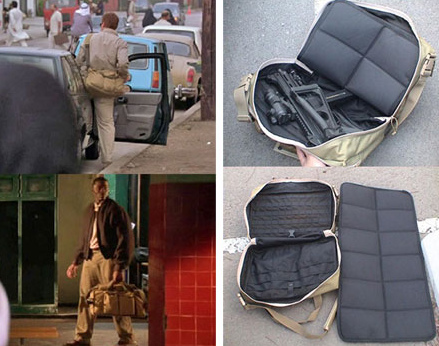
But then in an almost throw-away aside to Adam, he reflected that the modern Bond villain (and he might have added, villains in pop culture in general) is placeless, ubiquitous, mobile.
His hidden fortress is in the network, represented only by a briefcase, or perhaps even just a mobile phone.
Maybe it’s in the objects. It’s not the pictures that got small, but the places our villains draw they powers from.
Perhaps the architypical transformation from gigantic static lair to mobile, compact “UbiLair” is in the film Spartan, where Val Kilmer’s anti-heroic ronin carries everything he needs in his “go-bag” – including a padded shooting mat that unfolds from it to turn any place into a place where he holds the advantage.
[Snip… where to my delight he starts invoking Zeke Stane, already on this tag]
So – for a “4th generation warfare” supervillain there aren’t even objects for the production designer to create and imbue with personality. The effects and the consequences can be illustrated by the storytelling, but the network and the intent can’t be foreshadowed by environments and objects in the impressionist way that Adam employed to support character and storytelling.
Read moreRead more“Who are these people?” wondered Don on behalf of the audience about the ragtag bunch of old-money Eurotrash. They’re trotting the globe living out a sexually and economically liberal lifestyle – they’re like Midge’s pals from series one, but with a boat in the harbour at Monaco. Hanging with the rootless, beautiful rich. Isn’t this Don’s fantasy?
 The Committee to Nuke Elysium