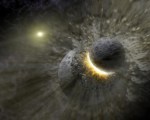
Aside from a small amount of water acquired by the youthful Earth in the form of hydrated silicate rocks, the great bulk of Earth’s water must have been delivered from beyond. The pummelling Earth received in its youth from asteroids and comets will have delivered the water that is so vital to life as we know it.

The problem is actually exacerbated by the collision that formed the moon. That giant impact occurred after the proto-Earth had differentiated – with the heaviest elements (such as iron and nickel) settling to our planet’s core. This means that the mantle and crust of the Earth, stripped off by the collision, would also have contained most of Earth’s water at the time.

Without the asteroid and comet collisions that have occurred since the moon’s formation, the Earth would most likely be dry and lifeless. But impacts are a stochastic, chance thing – some planetary systems will have architectures that are poorly set up from the point of view of the delivery of volatiles to any terrestrial worlds therein.

On the other hand, studies of the formation and evolution of the “hot Jupiters” – planets like Jupiter orbiting far closer to their hosts than Mercury orbits the sun – suggest that the inward migration of such planets could drag with them vast amounts of volatiles.

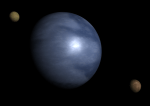
In those models, so much water is delivered to the inner reaches of those systems that any Earth-like planets that form are water worlds – drenched in oceans hundreds of kilometres deep.

While such worlds might well be teeming with life, it is unlikely that it would be easy to detect. Indeed, without continents, the oceans could be almost completely lifeless, with the only source of nutrients being volcanoes on the ocean floor.

If life on such water worlds did exist, it might be so deeply buried in the ocean that any sign of it would be extremely challenging to detect, particularly from a distance measured in tens or hundreds of light-years. As such, ocean worlds would most likely be poor targets for the initial stages of the search for life elsewhere.

Read more
Massive ‘ocean’ discovered towards Earth’s core

The water is hidden inside a blue rock called ringwoodite that lies 700 kilometres underground in the mantle, the layer of hot rock between Earth’s surface and its core.

The huge size of the reservoir throws new light on the origin of Earth’s water. Some geologists think water arrived in comets as they struck the planet, but the new discovery supports an alternative idea that the oceans gradually oozed out of the interior of the early Earth.

“It’s good evidence the Earth’s water came from within,” says Steven Jacobsen of Northwestern University in Evanston, Illinois. The hidden water could also act as a buffer for the oceans on the surface, explaining why they have stayed the same size for millions of years.

Massive ‘ocean’ discovered towards Earth’s core

Read more "Massive ‘ocean’ discovered towards Earth’s core"

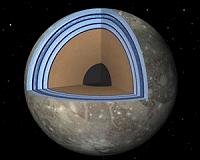
The results support the idea that primitive life might have possibly arisen on the icy moon. Scientists say that places where water and rock interact are important for the development of life; for example, it’s possible life began on Earth in bubbling vents on our sea floor.

Prior to the new study, Ganymede’s rocky sea bottom was thought to be coated with ice, not liquid – a problem for the emergence of life. The “club sandwich” findings suggest otherwise: the first layer on top of the rocky core might be salty water.

“This is good news for Ganymede,” said Vance. “Its ocean is huge, with enormous pressures, so it was thought that dense ice had to form at the bottom of the ocean. When we added salts to our models, we came up with liquids dense enough to sink to the sea floor.”

The results can be applied to exoplanets too, planets that circle stars beyond our sun. Some super-Earths, rocky planets more massive than Earth, have been proposed as “water worlds” covered in oceans. Could they have life? Vance and his team think laboratory experiments and more detailed modeling of exotic oceans might help find answers.

Ganymede is one of five moons in our solar system thought to support vast oceans beneath icy crusts. The other moons are Jupiter’s Europa and Callisto and Saturn’s Titan and Enceladus.

Read more