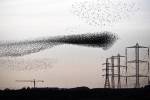

Read moreA murmuration of starlings coalesce over a field near Netivot, Israel, on January 24, 2013.
Read moreA murmuration of starlings coalesce over a field near Netivot, Israel, on January 24, 2013.


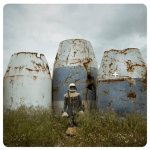

Read more“Spanish photographer Cristina De Middel’s fictional documentation of a failed 1960s space programme in Zambia – The Afronauts – has just been nominated for the 2013 Deutsche Borse photography prize.”




Read moreWe are made of music. The universe resonates – each part differently. Sometimes you hear Miles Davis, sometimes Venetian Snares, sometimes Brian Eno’s ‘Apollo’, sometimes birds, sometimes a girl you’re making love to and nothing else, other times it’s everything and you are gone, lost in whatever this is.
(There’s probably another essay in this – I’m talking specifically about the similarities between breakcore and jazz, but I’m not getting into that until I’m at least 40 and much smarter than I am now, so if you want to go with it and write your own, do it and then just make sure to send it to me.)
I grew up listening to music and, speaking of albums and bands and performers, I started with some incredibly trite stuff. I even listened to and actively enjoyed Backstreet Boys, for fuck’s sake. If my child listened to the 2020 equivalent of Backstreet Boys at any age I would be worried, simply because I would find myself hoping that its taste eventually turns from shit to at least moderately ok, because experiences are fine, we all have those, we all had to go get tested after a night we weren’t so sure about, we all had to realize that some parts of us needed improvement, we all had to realize it sometimes really isn’t our fault, but if my child would start looping Backstreet Boys on a day-to-day basis like I used to, I’d probably consider hacking its ears off and putting them on a necklace.
But would I really? Probably not. I’d probably give my child some richer music instead, like The Clash and Mozart and Beastie Boys and The Cure and Gang Gang Dance and Goodspeed You! Black Emperor and DJ Krush and plenty more. And then I’d wonder where things went wrong when the child comes back and says “I actually like this old music” and shows me a fucking Skrillex video. But who am I to judge these things for others.
Back to me as a ten year old. Thankfully, Prodigy’s ‘Fat of the Land’ arrives into my ten-year-old brain via the ‘Firestarter’ and ‘Breathe’ videos and from that moment on, my music taste starts going in all these new directions and it doesn’t stop.
Now, I wouldn’t say my family is full of great listeners – quite far from it, actually. I come from a poor industrial area of Czech Republic, a large city full of factories and people with underdeveloped social skills. Coal miners and rampant alcoholism surrounded by beautiful woods and large seemingly empty fields and smaller villages, the sort of thing that resembles the North of England so much it feels almost like a carbon copy unless you dive much deeper.
My parents, I don’t know how they did it but I am glad they did, they never gave a rat’s ass about the environment’s abilities to stifle my growth, and if they did, they never let it influence my growth, at least not until they became scared when I became truly wild near the puberty. And then I left the house and they couldn’t stop me.
Now we’re back at the beginning, and here’s what happened: they read to me since before I was even born — I’m not making this up — and they taught me to read by the time I was three, which, coupled with the amount of books, comics, films and stories they shoveled at me while maintaing my overall happiness (and their overall great parenting during my early years) strongly contributed to who I am now.
(Watching people who weren’t listening to themselves and/or me & others helped as well. Seeing patterns. Seeing the patterns and allowing myself not understand things. Maybe this will help you. Maybe you’re in a position similar to what mine was back then.)
But Prodigy and The Cure and Pink Floyd and Manic Street Preachers and Radiohead of my early teenage years? That wasn’t all the music there was. Because there is a way to listen to everything – a way of accepting and immersing yourself within all the seeming chaos and all of its order, the order that sometimes avoids direct gaze until one finds its flow and merges with it in order to float and potentially also find some answers.
It’s like sea diving. If you dive deep enough, you can see the bottom of the sea and the bottom is rich with immediately visible, easy to understand detail. You can see the movements of the sea itself within the bottom, you can trace them back, you can predict them and most importantly, you can be in the moment and see the sea and its bed for what they are. You get the flow once you see what the bottom is made of. Sometimes you just get the flow instinctually, too. Perhaps all of what we call memory is but an act of remembering.
CHANGE is a balancing act as well. It’s diving into the chaos and seeing what’s at the bottom, then assembling, understanding. It’s like the puzzles I’m putting together with my little sisters these days, and it is a magical act, because once we got deep into creating this story, it became blatantly obvious that making CHANGE anything less than what it became would mean abandoning what is alive in me. Thankfully, Morgan, Sloane and Ed are talented, hard-working and brave and they held me together as I wrote this thing, bit by bit, adding more and more substance and playfulness to a story that would be nothing like it is without them.
Anyway, all of this is a long-winded way of saying that each issue of CHANGE is named after a song.
Change #1:
Change #2:
Perhaps it might be worth it to pay special attention to the photograph ‘Almost Forgot Myself’ begins with – I had no idea until I found the track on youtube ten minutes ago, but the place on the photo is also one of the key locations in Change, which is exactly the kind of synchronicity I’m riding while making this thing. Because sometimes the universe (and/or universes) winks at you, and you can decide what to do next. I like to smile and ask it for a dance.
EDIT: And sometimes my mind just dances with itself, to make another music reference. The right Doves track for this was ‘There Goes the Fear’. But now? It’s both.
Change #3:
Won’t tell you much about #4, except that it’s 36 pages, it will come out March 20th and it will cost $3.50. It is where everything ends.
But CHANGE #3 is out next Wednesday. Dive in.
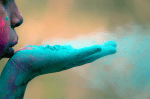



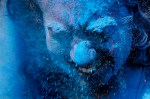
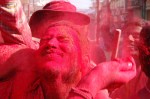

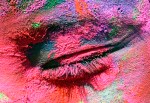

Read moreHoli, the Hindu festival of colour.This has to be the most beautiful celebration on the planet.
(via unsolnosilumina)
I would like to witness this someday.


Read more‘Habitable Zone’ for Alien Planets, and Possibly Life, Redefined
One of the most important characteristics of an alien planet is whether or not it falls into what’s called the habitable zone — a Goldilocks-like range of not-too-close, not-too-far distances from the parent star that might allow the planet to host life.Now scientists have redefined the boundaries of the habitable zone for alien planets, potentially kicking out some exoplanaets that were thought to fall within it, and maybe allowing a few that had been excluded to squeeze in.
“This will have a significant impact on the number of exoplanets that are within habitable zone,” said research team leader Ravi Kumar Kopparapu of Penn State University.
The habitable zone defines the region where a planet might be able to retain liquid water on its surface. Any closer to the star and water would vaporize away; any farther, and it would freeze to ice. But water in its liquid state is what scientists are after, since that is thought to be a prerequisite for life.
The new definition of the habitable zone is based on updated atmospheric databases called HITRAN (high-resolution transmission molecular absorption) and HITEMP (high-temperature spectroscopic absorption parameters), which give the absorption parameters of water and carbon dioxide — two properties that strongly influence the atmospheres of exoplanets, determining whether those planets could host liquid water. [9 Exoplanets That Could Host Alien Life]
The scientists cautioned that the habitable zone definition still does not take into account feedback effects from clouds, which will also affect a planet’s habitability.
The previous habitable zone definitions were derived about 20 years ago by Penn State researcher James Kasting, who was also part of the team behind the updates.
“At the time when he wrote that paper no exoplanets were discovered,” Kopparapu told SPACE.com. “In 20 years, hundreds, maybe thousands have been discovered.”
The new definition isn’t radically different from the old one. For example, in our own solar system, the boundaries of the habitable zone have shifted from between 0.95 astronomical units (AU, or the distance between Earth and the sun) and 1.67 AU, to the new range of 0.99 AU to 1.7 AU.
“It’s a surprise that Earth is so close to the inner edge of the habitable zone,” said astronomer Abel Méndez of the University of Puerto Rico at Arecibo, who was not part of the team behind the redefinition.
Méndez manages a list, called the Habitable Exoplanet Catalog, off all the known planets beyond our solar system that could be habitable to life. The new study will necessitate some adjustments to the catalog, he said.
“Right now as I see it as a significant change,” Méndez said. “Many of those planets that we believe were inside are now outside. But on the other side, it extends the habitable zone’s outer edge, so a few planets that are farther away might fall inside the habitable zone now.”
He mentioned one planet in particular, Gliese 581d, was thought to lie at the outer edge of its star’s habitable zone. With the new definition, though, it falls almost smack in the middle, making it perhaps a better candidate for extraterrestrial life.
“That will be a big change for that particular planet,” Méndez said. “That means the prospects for life on the planet will be much better.”
The researchers detail their new habitable zone definition in a paper to be published in an upcoming issue of the Astrophysical Journal.
To explore the Habitable Planet Catalog directy, visit: http://phl.upr.edu/projects/habitable-exoplanets-catalog
image 1: A new definition of the habitable zone around planets, denoting where liquid water could exist, shifts Earth toward the very edge of the solar system’s own habitable zone.
CREDIT: PHL @ UPR Arecibo, Rogelio Bernal Andreo
image 2: The graphic shows habitable zone distances around various types of stars, according to an updated habitable zone definition. Some of the known extrasolar planets that are considered to be in the habitable zone of their stars are also shown. On this scale, Earth-Sun distance is 1 astronomical unit, which is roughly 150 million kilometers.
CREDIT: Chester Herman


Read morefrom kepler’s theoretical model of the correlation between the ratios of the platonic solids arranged concentrically in a given order, and the first five planets from the sun. he was wrong about it yeah, but like i still thought it looked rad so i replicated it in steel.



Read moreNele Azevedo’s ice people, via Flavorwire
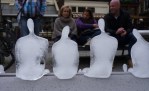
Brazilian artist Nele Azevedo’s ice people: 1,000 small sitting figures made from ice. The Berlin installation, intended to draw attention to climate change in the Arctic, lasted until his last figure melted in the heat of the day.
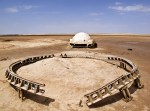










 The Committee to Nuke Elysium