


Read moreAnother old work.
One of my favourite set EVER.
Go check the whole series at THE.ORY PhotoArt 😉
Read moreAnother old work.
One of my favourite set EVER.
Go check the whole series at THE.ORY PhotoArt 😉





Read morethe Adi Granov Age of Ultron variants tell a story unto themselves- which i think is pretty cool.


Read more..Algaculture suggests a future where humans would be enhanced with algae living inside bodily organs, making humans plant-like by gaining food from the light. The team claims that this semi-photosynthesis, the symbiotic relationship with the algae, is appropriate for the short-term future, whereas in the longer term, the need to find better ways to nourish ourselves will result in new bodily organs. 22
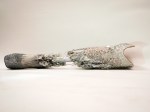
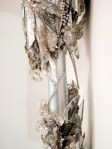
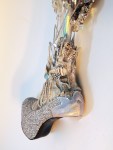
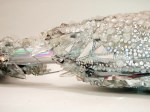
Read moreCrystallized Leg made for Viktoria Modesta playing the Ice Queen at the London 2012 Paralympic Closing Ceremony



Read moreAn anonymous author’s novel written on the walls of an abandoned house in Chongqing, China (2012)



Read moreIn Focus: Hurricane Sandy: 80 Days Later
Two and a half months after Superstorm Sandy made landfall in New Jersey, the U.S. Congress appears to be close to approving a relief package of tens of billions of dollars. Government workers, contractors, and volunteers on the ground are still in the midst of an extensive cleanup phase and welcome the much-needed funds as they rebuild homes, businesses, and infrastructure. While some of the estimated 230,000 cars damaged by Sandy’s saltwater surge will soon be going up for auction, many are simply headed for the crusher. Gathered below are images of the ongoing cleanup efforts and those still suffering from the aftermath of Hurricane Sandy.
See more. [Images: AP, Getty, Reuters]

Read moreEarth-Size Planets Common in Galaxy: 17 Percent of Sun-Like Stars Have Planets Within the Orbit of Mercury |
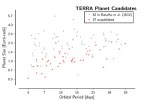
An analysis of the first three years of data from NASA’s Kepler mission, which already has discovered thousands of potential exoplanets, contains good news for those searching for habitable worlds outside our solar system.
This estimate includes only planets that circle their stars within a distance of about one-quarter of Earth’s orbital radius – well within the orbit of Mercury – that is the current limit of Kepler’s detection capability. Further evidence suggests that the fraction of stars having planets the size of Earth or slightly bigger orbiting within Earth-like orbits may amount to 50 percent.
The team – UC Berkeley graduate student Erik Petigura, former UC Berkeley post-doctoral fellow Andrew Howard, now on the faculty of the Institute for Astronomy at the University of Hawaii, and UC Berkeley professor of astronomy Geoff Marcy – reported their findings today (Tuesday, Jan. 8) at a session on the Kepler mission during the American Astronomical Society meeting in Long Beach, Calif.
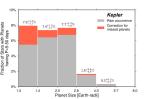
“Our key result is that the frequency of planets increases as you go to smaller sizes, but it doesn’t increase all the way to Earth-size planets – it stays at a constant level below twice the diameter of Earth,” Howard said.
Francois Fressin of the Harvard-Smithsonian Center for Astrophysics presented nearly identical results yesterday at the meeting, reporting that one in six stars, or at least 17 billion stars in the Milky Way Galaxy, have an Earth-size planet within an orbit like Mercury’s.









 The Committee to Nuke Elysium