








Read moreA Coffee Date (of sorts): Molly and Gus talk riddles, predators, and their next move.


Read moreWhat Is the Universe? Real Physics Has Some Mind-Bending Answers
–
Science says the universe could be a hologram, a computer program, a black hole or a bubble—and there are ways to check
–
The questions are as big as the universe and (almost) as old as time: Where did I come from, and why am I here? That may sound like a query for a philosopher, but if you crave a more scientific response, try asking a cosmologist. This branch of physics is hard at work trying to decode the nature of reality by matching mathematical theories with a bevy of evidence. Today most cosmologists think that the universe was created during the big bang about 13.8 billion years ago, and it is expanding at an ever-increasing rate. The cosmos is woven into a fabric we call space-time, which is embroidered with a cosmic web of brilliant galaxies and invisible dark matter. It sounds a little strange, but piles of pictures, experimental data and models compiled over decades can back up this description. And as new information gets added to the picture, cosmologists are considering even wilder ways to describe the universe—including some outlandish proposals that are nevertheless rooted in solid science:The universe is a hologram
Look at a standard hologram, printed on a 2D surface, and you’ll see a 3D projection of the image. Decrease the size of the individual dots that make up the image, and the hologram gets sharper. In the 1990s, physicists realized that something like this could be happening with our universe.
Classical physics describes the fabric of space-time as a four-dimensional structure, with three dimensions of space and one of time. Einstein’s theory of general relativity says that, at its most basic level, this fabric should be smooth and continuous. But that was before quantum mechanics leapt onto the scene. While relativity is great at describing the universe on visible scales, quantum physics tells us all about the way things work on the level of atoms and subatomic particles. According to quantum theories, if you examine the fabric of space-time close enough, it should be made of teeny-tiny grains of information, each a hundred billion billion times smaller than a proton.
Stanford physicist Leonard Susskind and Nobel prize winner Gerard ‘t Hooft have each presented calculations showing what happens when you try to combine quantum and relativistic descriptions of space-time. They found that, mathematically speaking, the fabric should be a 2D surface, and the grains should act like the dots in a vast cosmic image, defining the “resolution” of our 3D universe. Quantum mechanics also tells us that these grains should experience random jitters that might occasionally blur the projection and thus be detectable. Last month, physicists at the U.S. Department of Energy’s Fermi National Accelerator Laboratory started collecting data with a highly sensitive arrangement of lasers and mirrors called the Holometer. This instrument is finely tuned to pick up miniscule motion in space-time and reveal whether it is in fact grainy at the smallest scale. The experiment should gather data for at least a year, so we may know soon enough if we’re living in a hologram.
The universe is a computer simulation
Just like the plot of the Matrix, you may be living in a highly advanced computer program and not even know it. Some version of this thinking has been debated since long before Keanu uttered his first “whoa”. Plato wondered if the world as we perceive it is an illusion, and modern mathematicians grapple with the reason math is universal—why is it that no matter when or where you look, 2 + 2 must always equal 4? Maybe because that is a fundamental part of the way the universe was coded.
In 2012, physicists at the University of Washington in Seattle said that if we do live in a digital simulation, there might be a way to find out. Standard computer models are based on a 3D grid, and sometimes the grid itself generates specific anomalies in the data. If the universe is a vast grid, the motions and distributions of high-energy particles called cosmic rays may reveal similar anomalies—a glitch in the Matrix—and give us a peek at the grid’s structure. A 2013 paper by MIT engineer Seth Lloyd builds the case for an intriguing spin on the concept: If space-time is made of quantum bits, the universe must be one giant quantum computer. Of course, both notions raise a troubling quandary: If the universe is a computer program, who or what wrote the code?
(via What Is the Universe? Real Physics Has Some Mind-Bending Answers | Science | Smithsonian)









Read moreZONA by Alex Andreyev
Digital art guru, Saint-Petersburg based illustrator Alex Andreyev created a concept for ZONA TV series (based on the short science fiction novel written by Arkady and Boris Strugatsky), to be released in 2015
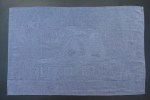
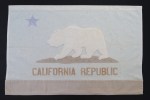
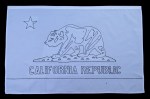

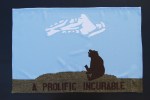
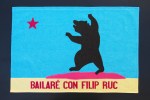


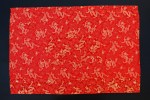
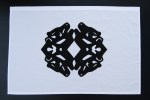
A few years ago, when the media was reporting about “the endangered state of California,” we screen-printed some shirts with the bear from the flag of the state of California on them. The shirts were gray and the ink we used matched the color of the shirts making the bears intentionally difficult to see. We followed the shirts with a reproduction of the Bear Flag using a gray-blue fabric for each component and allowing the edges of each component to fray. It was a reminder that our state is always a blank slate and that as citizens we have a choice in what our state is and what it can and will be.
That flag led to a series of flags that do some or all of the following, but are still recognizable as the California flag:
- rearrange or reposition the components (star, bear, ground, stripe)
- recolor or retexture (through fabric choices) the components
- resize or re-proportion the components overall or in relation to each other
- remove components
- use anagrams of CALIFORNIA REPUBLIC
- reproduce another historic California flag
When we travel and when people visit us in our home, the flags are often shared and a conversation ensues about the diverse past, present, and imagined futures of our state. People play with the components of the flag and we inevitably create new flags as a result of their ideas. We call this project Californias, a conversation about our collective hopes and dreams for the place that we have called home for over twenty-two years. These are parallel Californias, Parallelifornias that coexist in time and space. They are not a call for splitting the state that we love for all its contrasts, its imperfections, and its beauty. It’s exactly the opposite, an appreciation for our California, simultaneously one and infinite.
We have several more flags in the works and we’re always on the lookout for ideas. If you would like to be part of this conversation, please contact us with your thoughts. Last year, Sophia and Enzo made a Scratch project that allows you to move around the components of the flag. It’s not the same as sketching or playing with fabrics, but if you make something you like with it, please take a screenshot and share it with us.
IF AT FIRST YOU DON’T SECEDE
Read more


Teaser for the next episode of Transmissions of a Cosmic Anthropologist.
Which may in fact be two or three connected eps, because monster research binge and interviews are in effect and field agents being deployed.
E.C.C.O:
updated with The Invisible’s Barbelith (thx @catvincent) and 2001’s Monolith.
Read more "Presenting: A Teaser for the next episode of Transmissions of a Cosmic Anthropologist."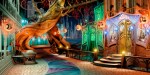






Read moreHere’s a thing I’ve had around in my head for a while!
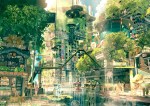
Okay, so I’m pretty sure that by now everyone at least is aware of Steampunk, with it’s completely awesome Victorian sci-fi aesthetic. But what I want to see is Solarpunk – a plausible near-future sci-fi genre, which I like to imagine as based on updated Art Nouveau, Victorian, and Edwardian aesthetics, combined with a green and renewable energy movement to create a world in which children grow up being taught about building electronic tech as well as food gardening and other skills, and people have come back around to appreciating artisans and craftspeople, from stonemasons and smithies, to dress makers and jewelers, and everyone in between. A balance of sustainable energy-powered tech, environmental cities, and wicked cool aesthetics.
A lot of people seem to share a vision of futuristic tech and architecture that looks a lot like an ipod – smooth and geometrical and white. Which imo is a little boring and sterile, which is why I picked out an Art Nouveau aesthetic for this.
With energy costs at a low, I like to imagine people being more inclined to focus their expendable income on the arts!
Aesthetically my vision of solarpunk is very similar to steampunk, but with electronic technology, and an Art Nouveau veneer.
So here are some buzz words~
Natural colors!
Art Nouveau!
Handcrafted wares!
Tailors and dressmakers!
Streetcars!
Airships!
Stained glass window solar panels!!!
Education in tech and food growing!
Less corporate capitalism, and more small businesses!
Solar rooftops and roadways!
Communal greenhouses on top of apartments!
Electric cars with old-fashioned looks!
No-cars-allowed walkways lined with independent shops!
Renewable energy-powered Art Nouveau-styled tech life!Can you imagine how pretty it would be to have stained glass windows everywhere that are actually solar panels? The tech is already headed in that direction! Or how about wide-brim hats, or parasols that are topped with discreet solar panel tech incorporated into the design, with ports you can stick your phone charger in to?
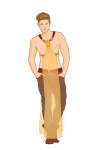
(((Character art by me; click the cityscape pieces to see artist names)))










 The Committee to Nuke Elysium